Jan 12, 2026
2026 State of AI Content Marketing

Averi Academy
Averi Team
8 minutes

In This Article
How AI reshapes content marketing in 2026: AEO, agentic workflows, human‑AI collaboration, tool comparisons, and ways to boost traffic.
Updated:
Jan 12, 2026
Don’t Feed the Algorithm
The algorithm never sleeps, but you don’t have to feed it — Join our weekly newsletter for real insights on AI, human creativity & marketing execution.
The way businesses approach content marketing has changed drastically in 2026. AI is now central to content creation, with 88% of marketers using AI tools, but only 25% report meaningful results. The gap? Many still see AI as just a writing tool rather than integrating it fully into workflows. This requires building a strategic content engine that leverages data-driven ideation. Meanwhile, 800 million people use AI tools like ChatGPT weekly, driving a 15%–64% drop in traditional organic traffic but offering 4.4x higher conversion rates for AI-driven search visitors.
Key trends shaping 2026 include:
AI-native workflows: Advanced systems like Averi automate entire processes, reducing brief creation time from hours to minutes while boosting productivity by 40%.
Shift from SEO to AEO (AI Experience Optimization): Content is now structured to be cited by AI systems like ChatGPT, prioritizing clarity, schema markup, and frequent updates.
Human-AI collaboration: Hybrid models ensure AI handles repetitive tasks while humans refine tone and add depth, leading to 5.44x more traffic than purely AI-generated content.
The brands succeeding in 2026 are those that combine AI efficiency with human creativity, focusing on AI-ready workflows, maintaining a clear brand voice, and aligning with AI-driven search behaviors.
Our Top 5 AI Tools for Marketing in 2026 (AI Marketing Essentials)

Major Trends in AI Content Marketing for 2026
The marketing landscape in 2026 is undergoing transformative changes, driven by three key shifts. First, agentic AI systems are now capable of managing entire workflows rather than isolated tasks. Second, the focus is moving from traditional SEO strategies to AI Experience Optimization (AEO), prioritizing AI assistant citations over search engine rankings. Lastly, there is a growing need to maintain a human voice and authenticity in content, even as automation scales up production. These trends highlight how AI is reshaping content creation, optimization, and personalization.
Agentic AI for Complete Workflow Automation
Agentic AI is revolutionizing content creation by streamlining the entire process - from strategy to publication - into a unified system. Instead of juggling multiple tools for research, drafting, and editing, these advanced systems integrate everything into a seamless workflow. For example, platforms like Averi's Synapse connect directly to CMS, CRM, and analytics tools, automating tasks like data gathering, content generation, and performance tracking with minimal human input.
The impact is evident. Brief creation times have dropped dramatically, from 1–2 hours to just 10–30 minutes, with AI-generated outlines even earning citations in Google's AI Overviews [4]. Teams using this approach report a 40% increase in productivity without sacrificing quality. By eliminating bottlenecks in research and formatting, AI handles the heavy lifting, while humans focus on refining and personalizing the final product [1].
From SEO to AEO (AI Experience Optimization)
The shift to AEO marks a fundamental change in how brands approach content visibility. Instead of optimizing for search engine clicks, the goal is to structure content so AI systems like ChatGPT, Perplexity, and Google's AI Overviews can confidently cite and recommend your brand. As Gustav M, Freelance Content Contributor, explains:
"The goal is no longer to optimize for clicks. It is to structure your identity so that an AI system can confidently choose you." [3]
This change is driven by evolving user behavior. Weekly, nearly 800 million people turn to ChatGPT for answers and planning [3], while AI-powered search features have cut organic traffic by 15% to 64% across various categories [3]. However, AI-driven search visitors convert at rates 4.4 times higher than traditional organic traffic [1].
To succeed in this environment, content must be structured for extraction rather than simple reading. Start sections with concise 40–60 word summaries, and ensure the first 200 words of core pages clearly define your business identity, location, and services. Use detailed schema markup for FAQs, products, and author bios to help AI systems categorize your content and establish E-E-A-T (Expertise, Experience, Authoritativeness, Trustworthiness). The numbers back this strategy: 76% of pages frequently cited by AI were updated within the past 30 days, and comparison listicles account for 32.5% of all AI citations [1]. Content is no longer just a destination - it’s a source of information delivered directly within AI interfaces. Brands that succeed will focus on clarity and consistency, ensuring their data is structured to reduce ambiguity and build trust.
Keeping Human Voice in AI-Generated Content
While AI speeds up content creation, maintaining a human touch is essential for connecting with audiences. Fast, automated content often lacks the depth and relatability of human-written material. In fact, human-generated content attracts 5.44 times more traffic than purely AI-generated content [1]. The solution lies in adopting a Human-in-the-Loop (HITL) model, where AI handles structural tasks while humans refine tone, perspective, and quality.
To maintain a consistent voice at scale, leading teams train AI models with detailed brand guidelines, including tone preferences, key terminology, and voice characteristics [6]. Subject matter experts contribute real-world insights, stories, and proprietary data that AI cannot replicate [5][8]. Multi-layer editorial reviews ensure content aligns with brand values and maintains logical flow [6][5].
The stakes are high: 86% of marketers manually edit AI-generated content before publishing [1], with 56% making significant revisions or complete rewrites [2]. As Ann Handley, Chief Content Officer at MarketingProfs, explains:
"AI is like giving every marketer a turbo-charged typewriter. Hooray! We can all crank out words faster. But the bigger prize is what we do with the time saved: the slower, deeper work of thinking. The bold ideas. The genuine human that no machine can automate." [8]
In 2026, the focus is shifting from producing more content to reinforcing marketing fundamentals. Teams are leveraging AI tools that amplify creativity into their work, crafting experiential content that includes real-world context, human flaws, and tangible outcomes - elements that AI alone cannot fabricate [3].
Leading AI Tools for Content Marketing
In 2026, marketers are presented with a critical decision: rely on integrated platforms that manage entire workflows, specialized tools for specific tasks, or freelance marketplaces that depend on human execution. Each option comes with its own pros and cons, especially when it comes to maintaining consistency. Let’s start with Averi’s all-in-one system before diving into standalone tools and freelance platforms.
Averi AI Marketing Workspace: A Unified System
Averi stands out as a comprehensive marketing engine, seamlessly combining strategy, creation, and publishing in one platform. Its proprietary Synapse system ensures smooth collaboration between AI-driven automation and human expertise, all while building a permanent brand memory - a feature that learns your brand’s voice, products, and strategy once and applies that knowledge across all future content.
The platform follows a Plan → Create → Execute → Scale model. It begins with AI-powered strategy, moves into drafting, and then transitions to human refinement. For tasks requiring expert input, Averi’s Human Cortex activates a network of over 2,500 vetted specialists who collaborate directly within the platform, eliminating the need for additional briefings.
What sets Averi apart is its CMS integration with tools like Webflow, Framer, and WordPress. This means content can be published directly without tedious copy-pasting, and performance metrics like rankings, impressions, and clicks are tracked to optimize future strategies. With each completed project, the system deepens its understanding of your brand, creating what Averi calls "context that compounds." As Zach Chmael, Head of Marketing at Averi, puts it:
"AI can produce volume, but it can't produce perspective. It can structure information, but it can't have original insights" [1].
For teams producing 16 or more posts per month - a threshold linked to 3.5x higher inbound traffic [1] - Averi’s Adaptive Reasoning adjusts the depth of analysis based on task complexity. Quick social media captions are handled through Express mode, while strategic documents receive a more thorough review. The Plus plan, priced at $45 per month, offers unlimited AI usage, multi-tab workflows, and a custom Library to store and organize marketing plans, customer profiles, and past projects into a searchable database.
Averi’s ability to integrate AI automation with human expertise makes it a powerful choice for teams looking to streamline their content marketing efforts. Now, let’s explore tools that focus solely on content generation.
Point Tools: Jasper and Copy.ai
Specialized tools like Jasper and Copy.ai are designed for one purpose: generating content quickly. Jasper, with a 4.6/5 rating on Gartner Peer Insights, is praised for its service and support [9]. Copy.ai, rated 4.2/5, is appreciated for its ease of use, even for those new to AI [9]. These tools excel at producing drafts in minutes using pre-built templates, making them ideal for teams that need quick results.
However, their capabilities are limited. These tools focus on generation, not orchestration, meaning they lack features like permanent brand memory, integrated publishing, or analytics. This requires users to manually input context, copy results into a CMS, format the content, add visuals, and track performance using separate tools. As Ramona Sukhraj, Principal Marketing Manager at HubSpot, cautions:
"AI content generators are built on existing content... raw AI content can be very problematic as it is derivative by nature" [2].
In short, while point tools save time in drafting, they can create bottlenecks in other parts of the workflow. They’re best suited for teams with established processes who need speed for specific tasks, such as crafting social media captions or generating headline options. But for building a scalable content engine that improves over time, these tools fall short.
Talent Marketplaces: Fiverr and Upwork
Platforms like Fiverr and Upwork provide access to human creativity and expertise - qualities that AI alone can’t replicate. For tasks like original research, detailed storytelling, or industry-specific insights, skilled freelancers can deliver results that surpass generic AI outputs.
The downside is the lack of consistency and higher coordination demands. Each project requires vetting candidates, negotiating rates, and managing communication. Quality can vary significantly between freelancers, and there’s no cumulative learning - every new hire starts from scratch. Additionally, the costs can add up quickly, especially compared to subscription-based AI tools. While agencies charge between $5,000 and $15,000 per month [1], freelancers may cost less but shift the management burden onto you.
Freelance marketplaces are most effective for high-stakes, one-time projects that demand specialized skills - like crafting a white paper for a major client, developing a rebranding campaign, or writing a technical case study. However, for ongoing content production at scale, the manual effort required for coordination limits their efficiency. These challenges underline the value of integrated solutions like Averi, which combine AI automation with on-demand human expertise in a streamlined workflow. This approach eliminates platform juggling while maintaining the quality that only human input can achieve.
Averi vs. Point Tools vs. Marketplaces
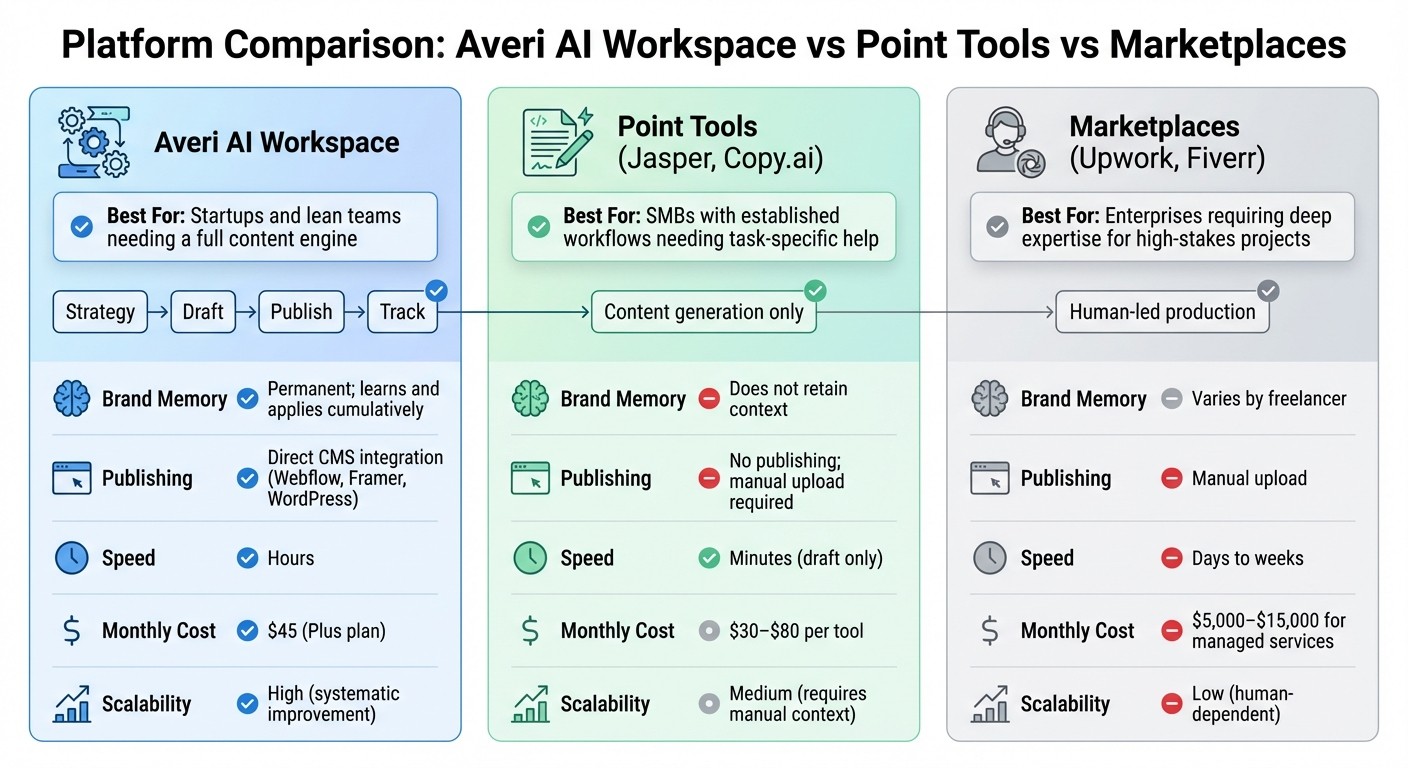
AI Content Marketing Platform Comparison: Averi vs Point Tools vs Marketplaces
Deciding between these three options boils down to what you need most: a comprehensive system, a quick drafting tool, or specialized human expertise. Averi serves as an AI Marketing Workspace, seamlessly managing strategy, research, drafting, CMS publishing, and performance tracking in one streamlined process. Point tools like Jasper and Copy.ai focus on rapid content generation but leave follow-up tasks in your hands. On the other hand, talent marketplaces like Fiverr and Upwork offer human creativity and expertise but require you to handle vetting, briefing, and coordination from start to finish. Below, we break down the strengths, limitations, and ideal use cases for each platform.
Platform Comparison Table
Feature | Averi AI Workspace | Point Tools (Jasper, Copy.ai) | Marketplaces (Upwork, Fiverr) |
|---|---|---|---|
Best For | Startups and lean teams needing a full content engine | SMBs with established workflows needing task-specific help | Enterprises requiring deep expertise for high-stakes projects |
Core Function | Strategy → Draft → Publish → Track | Content generation only | Human-led production |
Brand Memory | Permanent; learns and applies cumulatively | Does not retain context | Varies by freelancer |
Publishing | Direct CMS integration (Webflow, Framer, WordPress) | No publishing; manual upload required | Manual upload |
Speed | Hours | Minutes (draft only) | Days to weeks |
Monthly Cost | $45 (Plus plan) | $30–$80 per tool | $5,000–$15,000 for managed services [1] |
Scalability | High (systematic improvement) | Medium (requires manual context) | Low (human-dependent) |
Pros and Cons of Each Option
The table above highlights the core features, but let’s take a closer look at the advantages and challenges of each platform.
Averi AI Workspace is perfect for teams seeking an all-in-one solution. It integrates research, drafting, and publishing while retaining brand memory, which means every project builds on the last. This makes it a powerful tool for teams producing regular content. However, it does require a subscription, and for those with minimal content needs, it may feel more comprehensive than necessary.
Point tools are a go-to for quick, affordable solutions. They shine at generating specific content, like social media captions, ad copy, or blog drafts, especially if you already have a content process in place. The downside? They don’t retain context. Every time you use them, you’ll need to re-enter your brand guidelines, tone, and product details. As Ramona Sukhraj from HubSpot puts it:
"AI content generators... certainly won't be written with your brand's voice or differentiators in mind, or offer the expertise, experience, authoritativeness, or trustworthiness (EEAT) Google SERP demands" [2].
Additionally, these tools don’t handle publishing, analytics, or workflow management, leaving you to fill in the gaps.
Talent marketplaces bring a level of originality and human insight that AI tools can’t replicate. For projects like white papers, rebranding campaigns, or technical case studies, freelancers offer high-quality, tailored content. However, this approach comes with challenges: finding the right talent, managing communication, and ensuring consistency across projects can be time-intensive. Plus, each new freelancer starts fresh, with no cumulative learning. The costs add up too - managed services often run between $5,000 and $15,000 per month [1].
How to Choose the Right Platform
The best choice depends on your specific needs and workflow goals. Here’s how to decide:
Go with Averi if you’re a startup or small team creating at least 16 posts per month (a benchmark tied to 3.5x higher inbound traffic [1]). It’s ideal for those who want AI to handle repetitive tasks like research, formatting, and optimization, allowing your team to focus on refining tone and strategy. This approach is essential for learning how to create AI-optimized content that performs in modern search.
Opt for point tools if you already have a content process and need support with specific tasks like SEO optimization, product descriptions, or ad copy. These tools are great for small to medium-sized businesses with dedicated marketing staff who can manage the manual work of uploading content and tracking performance separately.
Choose marketplaces for high-stakes, one-off projects that require deep expertise, such as a rebranding campaign or a technical white paper. If originality and industry knowledge are more important than speed or cost, and you have the resources to manage freelancers, this is the way to go.
Building Your AI Content Workflow
Implementing an AI-driven content workflow in 2026 isn’t about replacing your team - it’s about working smarter by dividing responsibilities effectively. A well-balanced approach often involves AI handling about 60% of the process, focusing on research-heavy and structural tasks, while humans contribute the remaining 40%, ensuring strategic direction, refining the tone, and maintaining quality. This hybrid model can boost output by up to 40% without compromising the quality that drives meaningful engagement and traffic [1].
Strategy to Execution: Complete Process
An efficient AI content workflow follows a clear, six-phase process that bridges strategy and execution, turning ideas into published content through an AI content creation framework. It starts with the Strategic Foundation, where AI evaluates your website to understand your brand voice, pinpoint target audiences, and analyze competitors. After you approve the initial direction, the system retains this context for future tasks [1].
The next phase, Content Queue Building, involves AI researching high-intent SEO keywords and identifying opportunities for Generative Engine Optimization (GEO). This approach significantly reduces the time spent creating content briefs - from 1–2 hours to just 10–30 minutes.
During the Content Execution phase, AI produces the first draft using an SEO-optimized framework. Human editors then step in to refine the tone, incorporate original insights, and verify data against credible sources. This collaboration yields impressive results: human-edited AI content generates 5.44× more traffic than purely AI-generated material, and 86% of marketers report editing AI drafts before publication [1]. Once finalized, the content moves seamlessly into an automated publishing system.
In the Publication and Distribution phase, integrations with CMS platforms like Webflow, WordPress, and Framer enable direct publishing while maintaining a centralized performance library. The Analytics phase tracks real-time metrics - like impressions, clicks, and rankings - while Ongoing Automation uses this data to suggest content updates and new topics [1].
For companies publishing 16 or more posts monthly, this streamlined process saves an average of 3 hours per article and reduces daily manual work by 2.5 hours [1]. As Zach Chmael, Head of Marketing at Averi, explains:
"The winning model combines AI speed with human judgment. AI handles what slows you down, humans add what makes it work." [1]
Connecting Agentic Systems to Your Tech Stack
Once your AI content strategy is in place, integrating it with your existing tech stack ensures seamless automation from start to finish. The first step is loading your brand context. Document your brand voice, note tone variations for different content types, and compile essential industry terms. Feeding this data into your AI platform’s Brand Kit ensures consistent application across all outputs.
Modern platforms like Averi and AirOps can connect directly to your CMS, allowing approved content to move effortlessly from draft to publication. For teams juggling multiple content formats, AI can also generate social media posts, email snippets, and meta descriptions based on long-form content, expanding your reach with minimal effort.
Advanced workflows go a step further by incorporating performance feedback loops. AI tools linked to analytics platforms can track which topics convert best and suggest new ideas accordingly. Notably, AI-driven search visitors convert at 4.4× the rate of traditional organic traffic. Additionally, connecting AI tools to your CRM and support systems enables them to transform customer behavior and industry trends into actionable insights.
While these integrations improve efficiency, they’re not entirely hands-off. Built-in review checkpoints allow subject matter experts to verify technical accuracy before content goes live, addressing concerns about inaccuracies - an issue cited by 43% of marketers [2]. As Kevin Indig, Growth Advisor and SEO Consultant, puts it:
"AI gives organic growth experts unchallenged opportunities to scale content creation for humans and bots. AirOps makes it simple to combine human creativity with scalable content engines." [7]
This optimized workflow ensures AI handles repetitive, time-consuming tasks - like research, formatting, and technical optimization - while humans focus on the strategic and creative aspects. The result? Lean teams can rival larger competitors in content output without sacrificing quality.
Conclusion: Using AI to Build Better Marketing
AI isn’t here to replace marketing teams in 2026 - it’s here to amplify their potential. The evolution from standalone tools to integrated systems, like Averi, has leveled the playing field, enabling smaller teams to perform at the scale of larger enterprises. By combining AI’s efficiency with human creativity, teams can achieve a balance: AI tackles the heavy lifting - research, structuring, and technical tasks - while humans bring the voice, perspective, and original ideas that resonate with audiences [1].
The results speak for themselves. Hybrid teams that pair AI with human oversight see a 40% boost in output without sacrificing quality. Content that’s reviewed and refined by humans generates 5.44× more traffic than purely AI-produced material, and 86% of marketers edit AI drafts before they go live [1][6]. These numbers highlight not just AI productivity but also deeper engagement across platforms.
In B2B marketing, sustained SEO strategies can deliver an average ROI of 748% [1]. As Zach Chmael, Head of Marketing at Averi, aptly notes:
"AI can produce volume, but it can't produce perspective. It can structure information, but it can't have original insights." [1]
This perfectly captures the essence of successful AI-human collaboration in modern marketing.
Main Takeaways
To succeed, start with comprehensive workflows rather than isolated tools. Platforms like Averi minimize the inefficiencies of context switching, allowing for seamless strategy execution. Feed your AI systems with first-party data - such as customer behaviors, proprietary techniques, and unique research - elements that generic models can’t replicate [3]. Optimize for both traditional SEO and Generative Engine Optimization (GEO) by crafting concise, 40–60 word answer blocks and maintaining consistent entity definitions to secure citations in AI-driven searches [1][3].
Set clear editorial guidelines from the outset. Prohibit practices like fabricating quotes or inventing data, require source verification for AI-suggested statistics, and ensure human review checkpoints for brand voice and accuracy [5][6]. The aim isn’t to replace human involvement but to focus it where it adds the most value. Companies that publish 16 or more posts per month experience 3.5× more inbound traffic [1], but maintaining that momentum depends on a well-structured collaboration between AI and human creativity.
FAQs
How can businesses successfully integrate AI into their content marketing processes?
To make the most of AI in content marketing, businesses should view it as a helpful assistant that complements human creativity and strategic thinking, rather than a replacement. Many marketers miss out on its potential because they simply tack it onto outdated workflows without reimagining their processes. When used thoughtfully, AI can streamline tasks, saving hours on each project while preserving the essence of the brand.
Here’s a practical way to integrate AI into your workflow:
Strategy and ideation: Let humans take the lead in defining topics and brand guidelines, while AI pinpoints search trends and gathers audience insights to guide decisions.
Content creation: Use AI to draft outlines or initial versions of copy, with marketers stepping in to refine the tone, ensure accuracy, and align with brand messaging.
Optimization: Rely on AI tools to analyze performance metrics and provide suggestions for updates, keeping your content fresh and impactful.
By combining AI’s efficiency with human expertise, businesses can create polished, engaging content more quickly, all while staying true to their brand’s unique voice.
What is AI Experience Optimization (AEO), and how is it different from traditional SEO?
AI Experience Optimization (AEO) is all about crafting content specifically designed for AI-powered platforms, such as conversational search tools and answer engines. This approach emphasizes concise, answer-focused formats and structured data, ensuring AI systems can interpret the information accurately and deliver precise responses.
On the other hand, traditional SEO (Search Engine Optimization) focuses on improving keyword rankings and increasing visibility on standard search engine result pages. While SEO is tailored to human users searching on platforms like Google, AEO shifts the focus to AI systems that engage with users in real time - think voice assistants or chatbots.
The core distinction lies in the target audience: AEO is built for AI-driven interfaces, while traditional SEO caters to human-driven search habits.
How can brands ensure AI-generated content feels authentic and human?
To make content generated by AI feel more genuine, brands need to take charge of both strategic and tonal choices. Begin by developing a detailed brand-voice guide that defines the tone, preferred vocabulary, and key personality traits. While AI can handle mechanical tasks like research, outlining, or initial drafting, the final copy should always go through human review to maintain consistency, accuracy, and emotional depth.
Some practical steps include integrating brand-voice guidelines directly into AI prompts, implementing a multi-step review process for drafts - covering fact-checking, tone refinement, and SEO alignment - and involving skilled editors or subject-matter experts to fine-tune the content. Tools like Averi, which blend AI capabilities with human oversight, offer a way to balance efficiency with quality. By using AI as a collaborative partner rather than a sole creator, brands can scale their content efforts while preserving an essential human connection.