Jan 12, 2026
2026 State of Content Automation

Averi Academy
Averi Team
8 minutes

In This Article
How businesses blend AI and human oversight to scale personalized, privacy-first content with modular assets and unified, end-to-end automation in 2026.
Updated:
Jan 12, 2026
Don’t Feed the Algorithm
The algorithm never sleeps, but you don’t have to feed it — Join our weekly newsletter for real insights on AI, human creativity & marketing execution.
Content automation has shifted dramatically, moving from fragmented workflows to unified systems where AI and humans collaborate effectively. With a 93% rise in content demand from 2023 to 2025 and shrinking budgets, businesses are leveraging AI for speed and scalability while maintaining human oversight for quality and brand consistency.
Key takeaways for 2026:
AI-Human Collaboration: AI handles routine tasks; humans focus on strategy and creativity-amplifying tools.
Modular Content: Pre-approved assets are dynamically assembled for personalization.
End-to-End Platforms: Unified tools manage the full content lifecycle, reducing inefficiencies.
Privacy-First Automation: systems ensure ethical and compliant implementation amidst growing data regulations.
Revenue Impact: Companies with advanced automation see 29% higher revenue impact.
The future of content is about balancing AI efficiency with human expertise to meet growing demands while maintaining trust and quality.
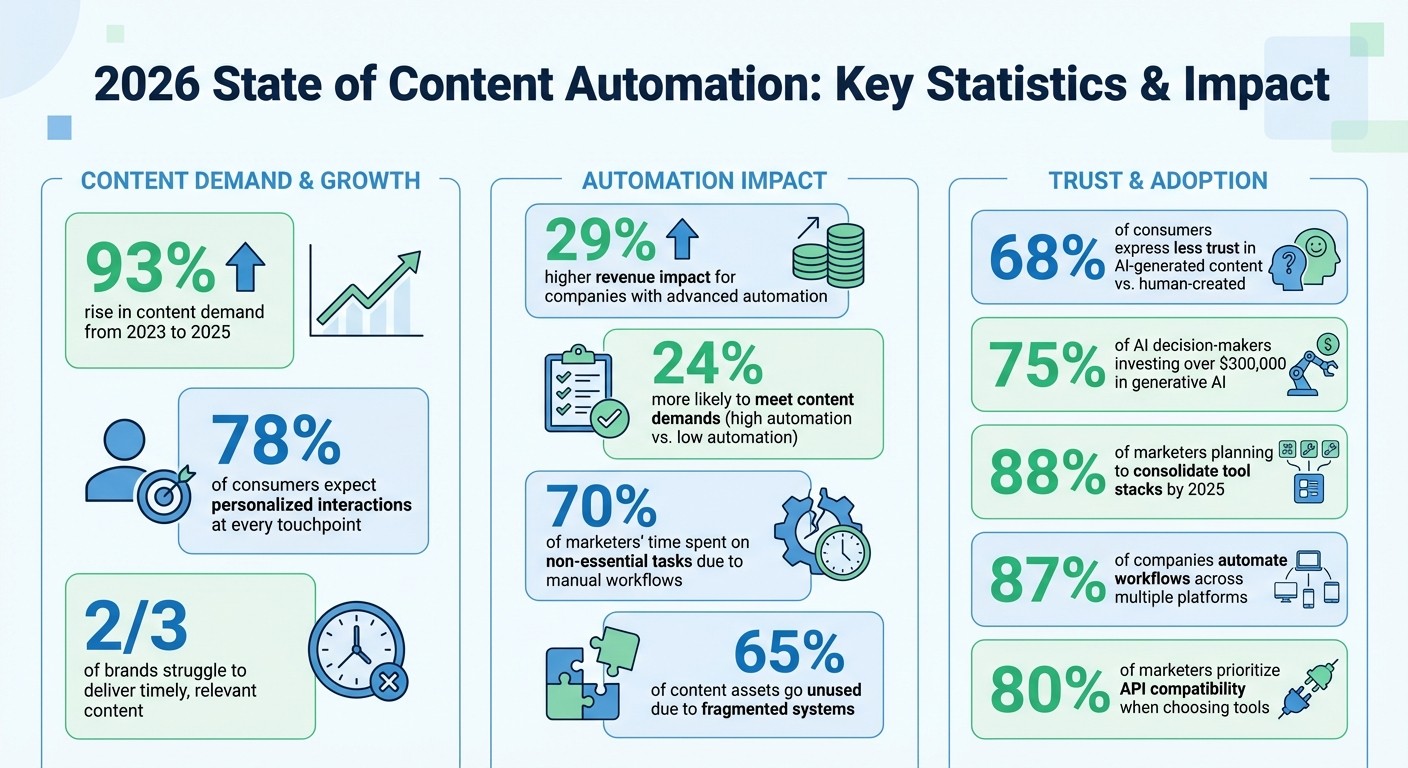
Content Automation Statistics and Impact in 2026
This New AI Automation Is Replacing Freelancers in 2026

Major Trends in Content Automation for 2026
The landscape of content automation in 2026 is being shaped by three major shifts. First, organizations are moving away from static content in favor of modular content libraries. These libraries consist of pre-approved text, visuals, and disclaimers that AI systems dynamically assemble based on real-time audience signals [6][5]. Forrester analyst Jessie Johnson captures this evolution:
"B2B marketers will shift from static content to writing and sharing prompts that generate personalized experiences at the moment of need" [6].
This modular approach leverages both real-time audience data and historical insights to deliver highly tailored content, signaling a broader operational transformation.
The second shift is the adoption of end-to-end orchestration. Instead of relying on disconnected tools for planning, content creation, and publishing, companies now utilize unified platforms that manage the entire content lifecycle. These systems use adaptive reasoning to delegate tasks, balancing routine work like captions with more complex assignments requiring human expertise. Organizations that excel in automation are 24% more likely to meet their content demands compared to those with lower automation levels [3][4].
The third major trend is the rise of privacy-first automation. Systems now incorporate Global Privacy Control (GPC) signals, automatically halting data collection or opting users out of activities like "sales" or "sharing" to comply with regulations such as the CCPA. AI plays a critical role as a compliance reviewer, scanning for missing disclosures, unapproved claims, or privacy risks before content is published [5]. This automation reduces legal bottlenecks while maintaining speed, and the integration of automated audit trails ensures a verifiable record for regulatory purposes - especially vital in industries like finance and healthcare.
Personalized Content at Scale
Personalization continues to be a cornerstone of successful content strategies. By 2026, AI systems are capable of generating content that feels natural and aligns with brand voice, even when producing thousands of unique variations. The breakthrough lies in prompt-based personalization, where marketers craft prompts that guide AI to create tailored experiences in real time, rather than pre-building every variation [6]. Additionally, AI tools now proactively flag compliance issues - such as unapproved medical or legal claims - before content goes live [5]. This allows teams to meet the 93% increase in content demand [3] without compromising on quality or brand consistency.
End-to-End Workflow Management
Platforms like Averi AI have redefined how content is managed by seamlessly integrating every stage of the process - from initial planning to publishing and performance measurement - into a single system. Rachel Whitt, Content Strategy Practice Lead at Deloitte Digital, emphasizes:
"Automation is the underlying force that can drive efficiency, accuracy, and scalability across the entire content supply chain" [4].
These platforms eliminate inefficiencies by bridging disconnected tools. For example, they automatically transfer approved assets from content hubs to CMS systems, apply meta tags, and initiate project management workflows. Companies that adopt such comprehensive automation report a 29% higher revenue impact from their content strategies [3].
Privacy-Focused Automation
As privacy regulations grow stricter, automation strategies have adapted to prioritize consent-based personalization and first-party data. Automated audit logs now provide a "digital safety net" during regulatory reviews, ensuring compliance without slowing down production [5]. Intelligent systems also streamline workflows by routing content to the appropriate reviewers, minimizing delays. With 68% of consumers expressing less trust in AI-generated content compared to human-created material [7], maintaining transparency and ethical practices has become essential for preserving brand trust while scaling content production effectively.
Leading Content Automation Platforms in 2026
As personalized content, integrated workflows, and privacy-first automation take center stage, content automation platforms are evolving into three primary categories: unified marketing workspaces, AI writing assistants, and task automation bridges. Each caters to specific needs, and understanding their differences can guide teams toward the most suitable option.
Averi AI: The All-in-One Marketing Workspace
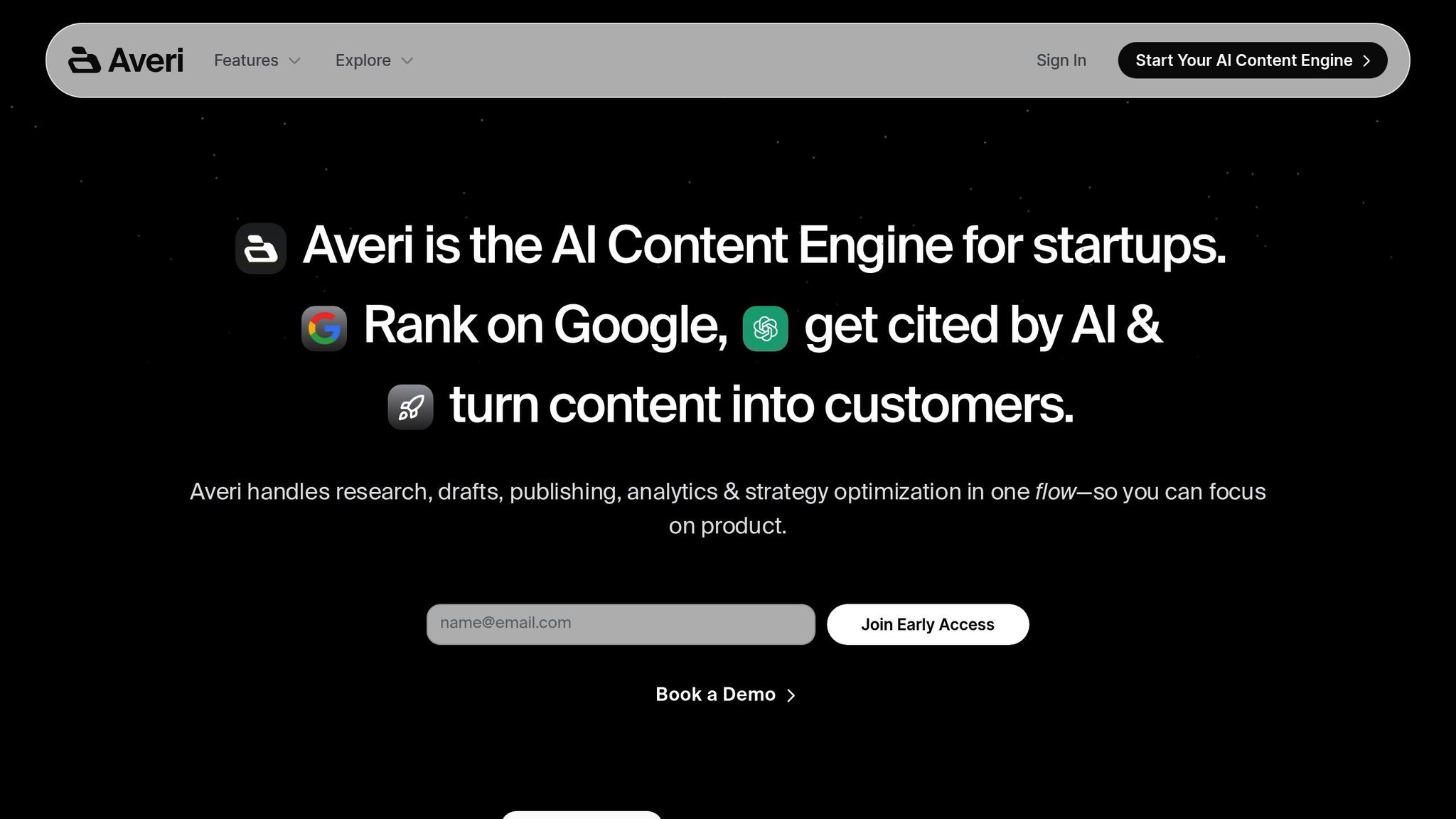
Averi AI offers a comprehensive marketing workspace designed to balance AI efficiency with human expertise. At its core is Synapse, a system that delegates tasks between AI and human professionals depending on complexity. For instance, Synapse might handle initial research and outlining for a blog post using Averi’s marketing-focused AI model (AGM-2) but flag sections requiring strategic insights for review by the Human Cortex, a network of over 2,500 vetted marketing experts. This modular, real-time approach reflects the growing trend of dynamic content assembly.
Averi’s /create mode simplifies the content creation process into three stages: Discuss, Draft, and Edit. The platform ensures brand consistency through its centralized Library, which stores guidelines, previous work, and performance data. This eliminates the need for re-briefing, as every new project begins with full context. Teams can work across multiple tabs, collaborate with experts who have access to the complete strategic picture, and save their work in .AVRI files, which retain the full edit history and AI context for smooth collaboration.
Jasper and Copy.ai: AI Writing Specialists
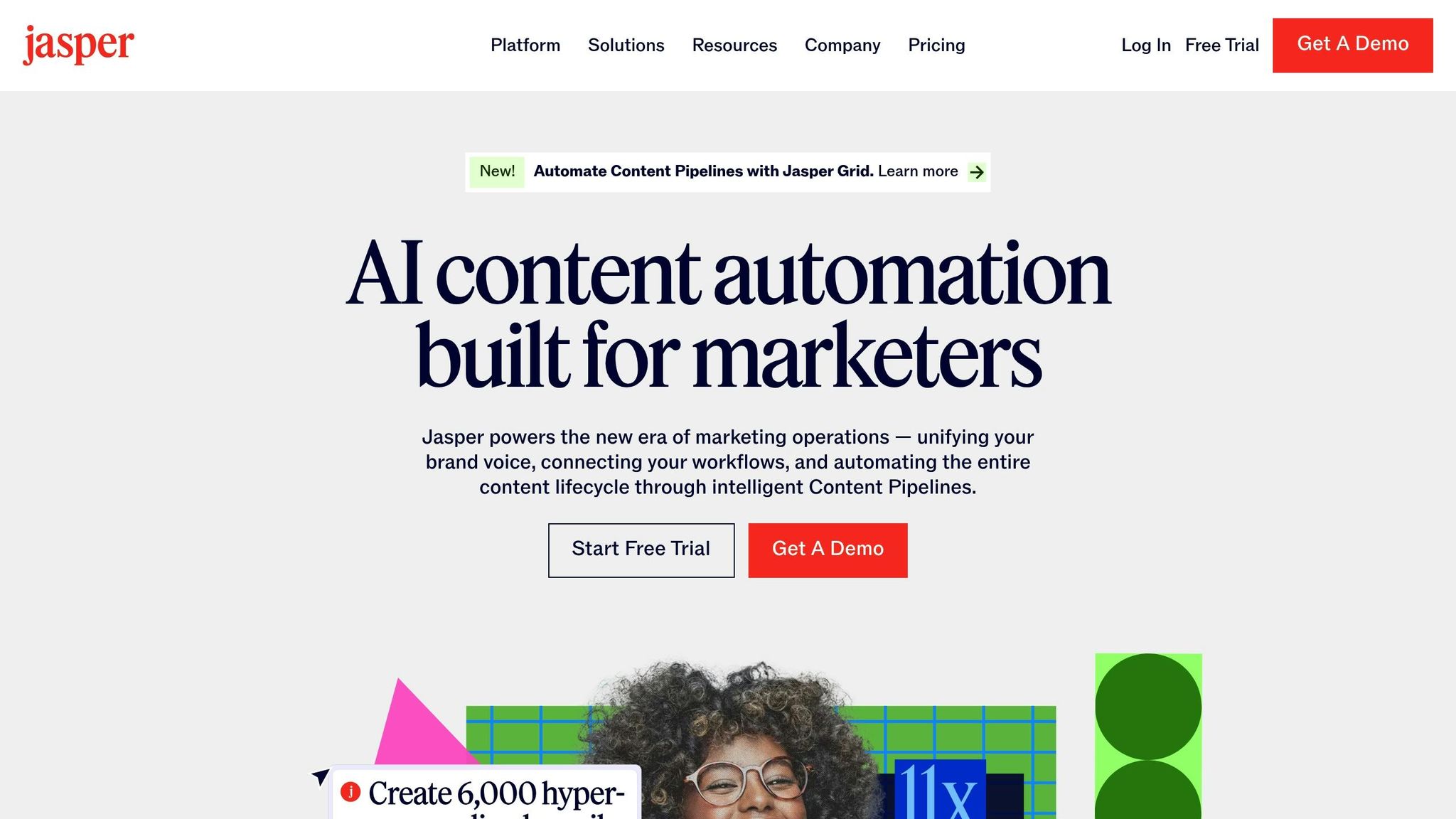
Jasper and Copy.ai focus on delivering high-speed, high-volume content creation. Jasper, with a 4.6/5 rating on Gartner Peer Insights from 2,490 reviews [8], emphasizes maintaining brand voice through templates and style guides. It excels at generating multi-format content - blog posts, ad variations, and email sequences - making it ideal for teams prioritizing quick output. However, achieving high-quality results often depends on skilled prompt engineering and manual reviews.
Copy.ai has expanded its capabilities to become a go-to-market platform, boasting over 2,000 integrations [8]. It now supports broader sales and marketing workflows rather than just content creation. With a 4.2/5 rating on Gartner Peer Insights from 54 reviews [8], it’s known for making AI tools accessible to non-technical users. Despite their strengths, both platforms rely on general-purpose language models trained on internet data, which means they lack the marketing-specific reasoning and long-term brand memory needed for strategic content workflows. Pricing starts at $39/month for Jasper’s Creator plan and $59/month for Teams [10], while Copy.ai begins at $36/month [9].
AirOps: Automating Content Team Workflows

AirOps and similar platforms focus on automating workflows by connecting tools like CRMs, CMSs, email platforms, and analytics software. These systems excel at moving data and content seamlessly across your tech stack, eliminating manual handoffs and streamlining repetitive tasks. For teams with established tools, these platforms provide valuable orchestration without requiring new content creation capabilities.
However, workflow automation platforms often lack advanced strategic features and brand memory. They efficiently execute predefined sequences but don’t adapt to edits, understand brand nuances, or handle complex reasoning. With 88% of marketers planning to consolidate their tool stacks by 2025 to reduce fragmentation [7], these platforms offer a practical middle ground - streamlining processes without the need for a fully unified workspace.
These varied approaches highlight the strengths and trade-offs of each platform type, helping businesses navigate their options. Up next, we’ll dive into how to choose the ideal content automation platform for your specific needs.
How to Select a Content Automation Platform
Choosing a content automation platform in 2026 boils down to three main categories: a unified workspace, an AI writing assistant, or a workflow automation bridge. Each option addresses different challenges, so the right choice depends on your team's size, the amount of content you produce, and how critical brand consistency is to your business.
Start by analyzing your current workflow. As Mike Shaw, Managing Partner at Ciberspring, points out:
"If your content process is a mess, AI will just make a bigger mess - faster." [5]
Carefully document every step of your process, from briefing to publishing, to uncover inefficiencies, quality issues, and repetitive tasks. This evaluation lays the groundwork for comparing platforms based on cost, workflow compatibility, and their ability to maintain brand consistency.
Platform Comparison Table
Feature | Averi AI | Jasper / Copy.ai | AirOps |
|---|---|---|---|
Starting Price | $45/month (Plus Plan) | $39–$59/month | Varies by usage |
Workflow | AI-human orchestration | Self-serve prompting | Task automation bridge |
Brand Memory | Persistent learning from edits and Library | Template-based, limited depth [7] | No content creation |
Quality Controls | Synapse routing + Human Cortex review | Manual prompt refinement | Workflow execution only |
Integrations | CMS publishing (coming soon) | 2,000+ integrations (Copy.ai) [8] | Deep CRM/CMS connections |
Best For | Teams needing strategy + execution | High-volume copy generation | Connecting existing tools |
When Averi AI Is the Right Choice
Averi AI is ideal for teams that need brand intelligence that builds over time. If you're juggling multiple content formats - blogs, ads, emails, landing pages - and struggling to maintain consistency, Averi's Library system and Synapse orchestration ensure each project starts with the full context of past work. By combining AI speed with human expertise, Averi aligns with the idea that effective automation is about blending machine efficiency with human judgment.
This platform is perfect if you're looking for a single workspace where strategy, creation, and collaboration seamlessly come together. The /create mode streamlines the process into three phases - Discuss, Draft, Edit - eliminating the need to jump between tools like ChatGPT, Google Docs, and email. For tasks requiring a human touch, the Human Cortex brings in vetted specialists who already understand your brand guidelines and previous projects, saving time on re-briefing.
When Other Tools Make More Sense
Jasper and Copy.ai are great for teams focused on generating large volumes of marketing copy quickly. These tools shine when you have the internal expertise to refine outputs through prompt engineering. With Jasper earning a 4.6/5 rating on Gartner Peer Insights from 2,490 reviews [8], it's a proven choice for teams that thrive in template-based workflows. While they excel at overcoming writer's block and producing first drafts, they rely on general-purpose models rather than marketing-specific reasoning.
AirOps and similar platforms are better suited for teams that already have established tools but need better integration between them. If your content process works well but is slowed down by manual handoffs between your CRM, CMS, and email platforms, workflow automation can eliminate those bottlenecks. However, with 88% of marketers planning to consolidate their tool stacks by 2025 [7], consider whether adding another integration layer addresses the root issue or just delays a more permanent solution. Once you've clarified your platform choice, the next step is ensuring it integrates smoothly into your existing tech stack.
How to Implement Content Automation in Your Business
Introducing content automation into your workflow isn’t as simple as flipping a switch - it starts with understanding your current processes and identifying where things fall apart. Marcus Calero, Marketing Content Manager at Ciberspring, offers a sharp reminder:
"If your content process is a mess, AI will just make a bigger mess - faster." [5]
The first step is to map out every stage of your content pipeline: planning, creation, review, approval, publishing, and measurement. This deep dive often uncovers inefficiencies, with 70% of marketers' time being swallowed up by non-essential tasks due to disorganized, manual workflows [5]. Once you spot the bottlenecks - whether it’s delays in approvals, inconsistent messaging, or tedious manual data handling - you can implement automation to address these issues, rather than adding to the chaos. This structured approach ensures that AI works in tandem with your team’s expertise, not against it.
Combining AI with Human Expertise
Automation works best when it enhances human effort, not replaces it. The goal is to assign tasks to the right resource - AI or human - at the right time. This model blends speed and efficiency with the quality and nuance that only people can bring. To make this work, train your AI using 10–20 pieces of well-performing, brand-specific content, along with detailed voice guidelines [1][7]. This helps avoid the all-too-common problem of AI producing bland, overly formal outputs.
A typical workflow might involve AI generating an initial draft, which is then refined by humans. Platforms like Averi’s /create mode make this process seamless by combining AI-generated content with collaborative editing tools in one workspace. For tasks requiring deeper expertise or strategic input, the Human Cortex feature connects you with vetted specialists who have full access to your content library, cutting down on redundant explanations.
To maintain a consistent brand voice, establish a "Never Use" list of phrases, jargon, and metaphors you want the AI to avoid [7]. Quarterly sessions to recalibrate your brand voice and update your training library can further ensure your content stays true to your identity [7].
Connecting Automation to Your Tech Stack
For automation to truly work, your tools need to communicate effectively. Right now, 87% of companies automate workflows across multiple platforms [11], yet fragmented systems mean 65% of content assets go unused [11]. Think of your tech stack as a solar system: your CRM, CMS, and Cloud Data Warehouse are the core, while automation tools orbit around them, all sharing data seamlessly.
Focus on integrating three key layers - Content (CMS/DAM), Data Core (CRM/CDP), and Analytics. This setup enables smooth data flow and continuous improvement in AI performance [11][7]. When choosing new tools, note that 80% of marketers prioritize API compatibility [11]. With well-integrated systems, businesses using automation meet content demands 24% more often and see a 29% greater revenue impact from content marketing [3][4]. Integration provides the foundation, while memory systems take content quality to the next level through ongoing learning.
Building Smarter Content with Memory Systems
What sets effective automation apart is persistent memory - AI that learns and improves over time. Unlike generic AI tools, purpose-built platforms retain your brand’s context across projects, using human edits and performance data to refine future outputs.
To build this memory system, create a central content library that houses brand guidelines, past content, customer profiles, and approved assets in an easily searchable format. For instance, Averi’s Library system ensures that by analyzing patterns across your content history, the 100th piece of content aligns more closely with your brand than the first [7]. Every edit, saved project, and performance metric contributes to smarter, more aligned outputs.
Adopting a modular content structure can also be a game-changer. Store approved text blocks, visuals, and data snippets in repositories that AI can pull from and assemble as needed [5][6]. This "create once, reuse often" approach allows you to meet the growing demand for content - up 93% between 2023 and 2024 [3] - without dramatically increasing your team size. By treating your library as a dynamic resource rather than simple storage, each project builds momentum for the next, creating a system that grows smarter and more efficient over time.
Conclusion
Key Lessons for 2026
The future of content automation lies in blending the speed and efficiency of AI with the strategic insight and quality assurance that only humans can provide. Leading organizations have moved beyond isolated AI experiments, creating integrated systems where AI handles the heavy lifting, and humans guide the overall direction.
To meet the growing demand for personalized experiences, modular content design has become non-negotiable. With 78% of consumers expecting tailored interactions at every touchpoint, yet two-thirds of brands struggling to deliver timely, relevant content [2], businesses must adopt reusable content frameworks. These modular "kits" allow AI to assemble personalized materials on demand. Companies embracing high levels of automation are already reaping rewards, reporting a 29% greater revenue impact from their content marketing efforts [3].
Governance remains a cornerstone of successful content strategies. Human oversight ensures that brand voice, quality, and strategic goals are maintained at scale. With 75% of AI decision-makers investing over $300,000 in generative AI [6], the focus on human involvement has shifted from optional to essential.
These insights lay the foundation for the next era of content creation.
What Comes Next for AI Content Creation
As content systems continue to evolve, the focus will shift from efficiency to establishing authority. Lisa Gately, an analyst at Forrester, highlights this shift:
"The hard part will shift from creation and production to proof, as content engines evolve from chasing efficiency to demonstrating authority and impact" [6].
In an environment dominated by AI-generated search results, brands will need to showcase measurable business outcomes from their content. This shift will drive increased investment in strategies like Answer Engine Optimization (AEO) and Generative Engine Optimization (GEO), as companies seek to excel in AI-driven search landscapes.
Another emerging trend is the rise of custom AI frameworks. Enterprises are moving toward "bring your own AI" (BYOAI) solutions [6], where tailored systems intelligently manage workflows instead of relying on generic vendor platforms. Content teams will transition into roles as modular architects, focusing on managing ontologies, metadata, and prompt libraries rather than simply producing static assets. To support this transition, teams can hire vetted experts to help design these complex workflows. This approach enables real-time personalization, driven by buyer signals, rather than traditional campaign models.
One potential game-changer is the acquisition of credible content sources. To address trust issues with AI-generated answers, search engines might start acquiring human-created content from news outlets, forums, and expert networks [6]. If this happens, the distinction between content creation and ownership will blur, giving brands with established, authoritative libraries a significant edge. The future will favor systems that not only create but also adapt and demonstrate their value effectively.
FAQs
What is modular content, and how does it enhance personalization in content automation?
Modular content takes marketing materials - like articles, emails, ads, and more - and breaks them into reusable blocks. These blocks might include elements like headlines, product descriptions, images, or calls to action. What makes this approach powerful is the ability to tag each block with audience-specific attributes, such as behaviors, demographics, or purchase intent. With the help of AI-powered tools, these tagged blocks are then combined into the most relevant arrangement for each individual user, creating highly personalized content at scale - without the need to start from scratch.
This approach not only enhances personalization but also minimizes waste. High-quality content blocks can be repurposed across different campaigns, with only the personalized elements being swapped out. By pairing modular content libraries with AI-driven recommendation engines, marketers can rapidly produce dozens of tailored variations, ensuring every audience segment gets a message that resonates with their needs and preferences.
How does AI help businesses stay compliant with privacy regulations?
AI is transforming how businesses handle privacy regulations by simplifying complex processes and improving oversight. Its ability to analyze massive data sets in real time allows it to spot irregularities, flag potential breaches of personal data, and evaluate risks. These tools empower businesses to stay ahead of regulatory demands while fostering customer trust.
Beyond detection, AI takes on routine compliance tasks like reviewing documents, mapping data, and verifying consent. By automating these activities, legal and privacy teams can shift their focus to more strategic priorities. Businesses can also integrate privacy measures - such as limiting data use, enforcing retention policies, and embedding compliance protocols - directly into their workflows, ensuring alignment with shifting state and federal privacy laws.
With features like audit trails, automated policy monitoring, and real-time alerts for anomalies, AI helps organizations scale their operations without compromising privacy protections. This shift allows companies to view compliance not as a challenge but as an opportunity to distinguish themselves in the market.
How can businesses effectively combine AI tools with human expertise to create high-quality content?
To get the best of both worlds - AI's speed and human creativity - businesses should consider a layered approach. Let AI handle tasks like research, drafting, and scaling personalization, while leaving strategic and creative decisions, such as defining brand voice and ensuring quality, to human expertise. This balance keeps content efficient while staying true to your brand's identity.
AI shines in automating repetitive tasks like gathering data, tagging for SEO, and creating multiple content variations. These capabilities can significantly cut down production time. However, having humans step in for tone refinement, accuracy checks, and compliance reviews ensures the final product meets high standards and avoids the common missteps of relying too much on automation.
By blending AI capabilities with human oversight in a cohesive system, teams can track performance, maintain consistency, and safeguard intellectual property. This setup boosts productivity without sacrificing the creativity and judgment that only humans can bring, leading to faster, cost-efficient, and audience-centered content.