Jan 12, 2026
2026 State of SEO for Startups

Averi Academy
Averi Team
8 minutes

In This Article
How startups can adapt SEO for AI-powered search: optimize content for AI citations, build E-E-A-T, automate workflows, and track AI visibility.
Updated:
Jan 12, 2026
Don’t Feed the Algorithm
The algorithm never sleeps, but you don’t have to feed it — Join our weekly newsletter for real insights on AI, human creativity & marketing execution.
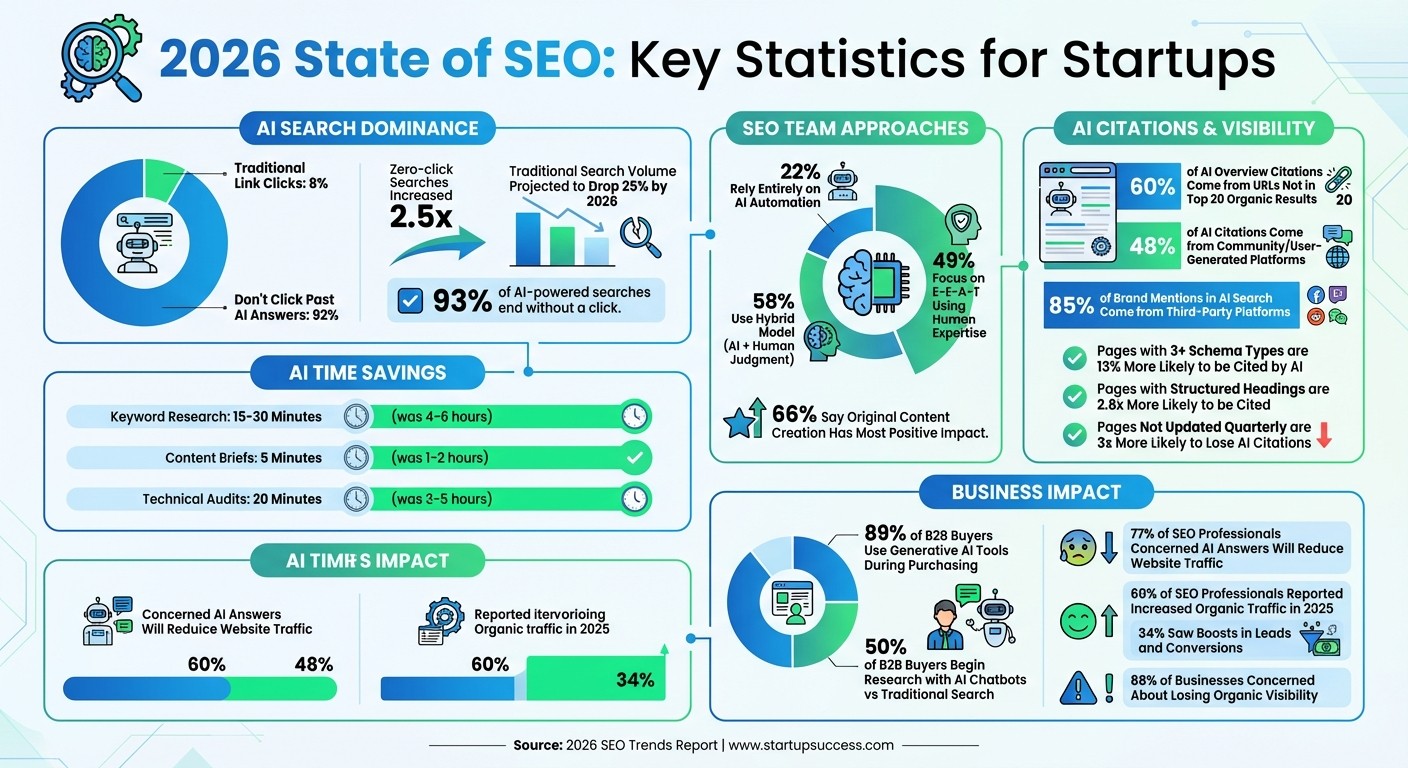
SEO in 2026 is no longer about just ranking on search engines. The rise of AI-powered answer engines like Google's AI Mode and tools such as ChatGPT has transformed how users find information and how startups need to position themselves online. Traditional search is being replaced by AI summaries, with 92% of users not clicking past these AI-generated answers. This shift means startups must focus on creating content that surfaces in LLM search rather than solely chasing high rankings.
Here’s what you need to know:
AI-driven searches dominate: Zero-click searches have increased 2.5x, and only 8% of users now click on traditional links.
E-E-A-T (Experience, Expertise, Authoritativeness, Trustworthiness) is critical: AI prioritizes credibility and clear, concise answers.
AI is reshaping SEO workflows: Tasks like keyword research and audits take minutes instead of hours, thanks to tools like Averi AI.
Zero-click optimization matters: Structuring content for AI citation is more important than driving clicks.
Off-site validation is key: AI systems increasingly pull citations from platforms like Reddit and YouTube.
Startups must treat SEO as a scalable system, leveraging AI for efficiency and focusing on strategies that align with this new landscape. Optimizing for AI visibility, maintaining content relevance, and building authority through credible sources are now the pillars of success.
2026 SEO Statistics: AI Search Impact on Startups
AI-SEO Is Changing Everything in 2026
SEO Trends Startups Need to Know in 2026
In 2026, three major shifts are redefining SEO for startups: AI-driven workflows that drastically reduce time spent on tasks, the growing importance of E-E-A-T signals (Experience, Expertise, Authoritativeness, and Trustworthiness) to establish credibility, and the rise of zero-click optimization, where being cited matters more than earning clicks. Startups that embrace these changes can gain an edge over their more established competitors.
AI and Human-AI Workflows in SEO
SEO teams are now taking three distinct approaches to integrating AI into their strategies. About 22% of teams rely entirely on AI automation[1]. Meanwhile, 49% focus on E-E-A-T, using human expertise to stand out[1]. The majority - 58% of teams - opt for a hybrid model, combining AI for repetitive tasks with human judgment for strategic decisions[1].
AI has dramatically shortened the time needed for key SEO tasks. For example, keyword research now takes just 15–30 minutes instead of 4–6 hours, content briefs are prepared in 5 minutes rather than 1–2 hours, and technical audits are completed in 20 minutes instead of 3–5 hours[1]. However, 66% of SEO professionals still say original content creation has the most positive impact, emphasizing the unique value of human insights[1].
Jonathan Berthold, VP of Revenue at Moz, describes this hybrid approach as "Relevance Engineering" - a method of boosting visibility across all search platforms by blending AI's speed with human expertise[3]. This balance is critical for leveraging E-E-A-T as a ranking factor.
E-E-A-T as a Ranking Factor
Google's E-E-A-T framework has evolved from being a quality guideline to becoming essential for survival. As AI can churn out a blog post in seconds, the real differentiator is content that reflects genuine expertise.
"AI systems don't care about your domain authority history. They care about whether your content provides the clearest, most citable answer to a specific question."
Averi Academy[2]
Building E-E-A-T in 2026 requires a strategic approach. First, establish author credibility by using structured data like Article and Author schema to verify the writer's identity and qualifications[4]. Second, focus on off-site validation. With nearly half of AI-generated citations now coming from platforms like Reddit and YouTube, endorsements from real users are increasingly valuable[6]. Finally, prioritize content freshness - pages that aren’t updated at least quarterly are three times more likely to lose AI citations[6].
Startups excelling in E-E-A-T aren’t just producing more content - they’re producing smarter content. They include proprietary data in comparison tables, add "TL;DR" summaries for quick takeaways, and structure FAQs to match the exact phrasing users search for. These tactics not only improve rankings but also increase the chances of being cited by AI, feeding directly into zero-click optimization strategies.
Optimizing for Zero-Click Searches and AI Queries
By 2026, traditional search volume is projected to drop by 25%, with AI-driven tools like ChatGPT and Perplexity capturing more user attention[8]. When generative AI summaries dominate search results, only about 8% of users click on traditional links[4]. For startups, this means structuring content for easy extraction is critical.
To align with AI queries, start each section with a concise, 40–60 word answer that AI models can easily extract[2]. Use question-based headers, such as "How does X work?" or "What is Y?", to match conversational search patterns[4]. Implementing structured data like FAQ, HowTo, and Organization schema further helps AI understand your content’s scope and credibility[4][6]. Pages using three or more schema types are 13% more likely to be cited by AI search engines[6].
"If your content can't answer a question clearly in 30 seconds, it's unlikely to be selected for AI-generated answers."
Casey Nifong, CEO, Search Engine Land[4]
But zero-click optimization isn’t just about on-page content. With 85% of brand mentions in AI search coming from third-party platforms like Reddit, review sites, and niche forums[6], engaging with these communities is equally important. While high-quality content on your own site establishes your brand, active participation off-site amplifies your credibility. These strategies, combined with tools like Averi AI, are driving the next wave of SEO innovation for startups.
Tools for Scalable SEO Automation
In 2026, startups are faced with a clear decision: structure their SEO workflows around AI-powered workspaces, specialized tools, or workflow automation platforms. Each option caters to a different set of needs. Workspaces like Averi AI bring strategy, content creation, and execution together in one platform. Specialized tools such as Surfer SEO focus on specific tasks like on-page optimization. Meanwhile, platforms like Gumloop and AirOps enable users to link multiple AI models for large-scale operations[9].
Automation has become a game-changer, helping startups allocate their time more effectively. Despite this, 58% of SEO professionals still prefer a hybrid approach - leveraging AI for efficiency while depending on human oversight to guide strategy and maintain quality[1].
New tools are now addressing the unique SEO demands of 2026. AI search visibility trackers like Rankscale.ai and ProductRank.ai are designed to monitor whether your brand is visible in AI-driven platforms such as ChatGPT, Perplexity, and Google AI Overviews. This is critical, especially as 77% of SEO professionals express concerns that AI-generated answers could reduce website traffic[1]. These tools come with accessible pay-as-you-go pricing starting at $20, making them a practical choice for early-stage startups[9].
Next, let’s explore standout tools from each category and how they align with startup SEO needs, starting with Averi AI - a comprehensive, all-in-one SEO workspace.
Averi AI: SEO and Content Engine for Startups
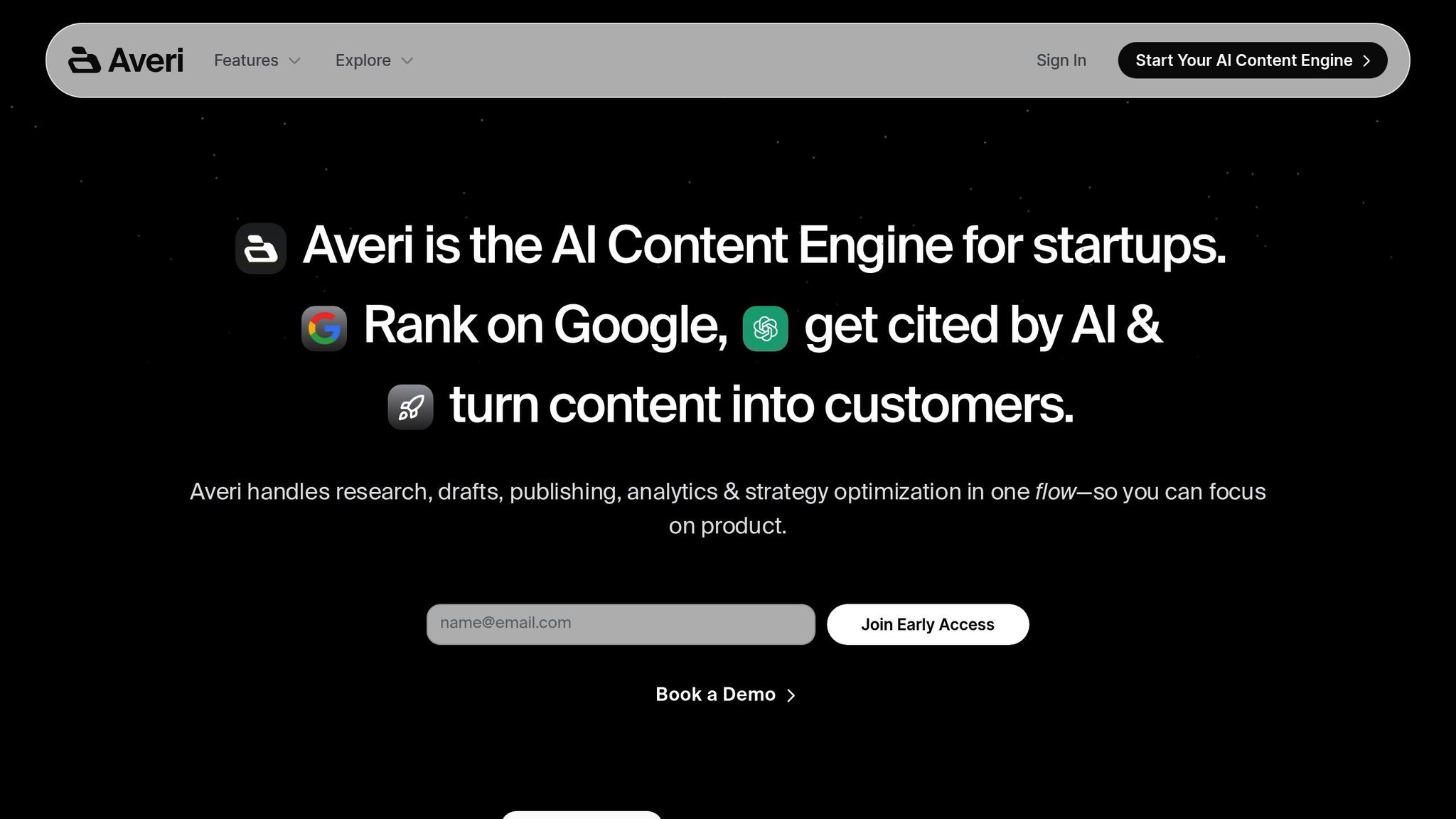
Averi AI positions itself as more than just a tool - it's a complete marketing workspace. Using its Synapse orchestration system, it determines when to automate tasks and when to involve human expertise, ensuring a balanced approach. Its Adaptive Reasoning system adjusts the level of detail based on the task, quickly handling straightforward jobs like meta tag creation while diving deeper into complex strategic projects.
The Averi Content Engine functions as an autonomous system. It analyzes your website to understand your product, evaluates competitors, identifies content gaps, and develops a content strategy tailored to your objectives. The engine continuously researches high-value SEO keywords and GEO opportunities - content that AI platforms are likely to cite - creating a queue of ready-to-use content ideas. Once you approve the topics, Averi takes care of research, drafting, internal linking, and metadata creation. The content is then published directly to platforms like Webflow, Framer, or WordPress, eliminating the need for manual uploads.
What sets Averi apart is its persistent context. Every saved draft, conversation, and project in its Library helps the AI learn your brand voice and strategic goals. If you bring in one of Averi's 2,500+ vetted marketing professionals, they gain immediate access to this context, eliminating the need for lengthy briefings. The Plus Plan, priced at $45 per month, includes unlimited AI usage, multi-phase content creation via the /create mode, custom Library folders, and Privacy Mode.
AI Site Audit and Competitor Analysis Tools
In addition to integrated platforms like Averi, specialized tools are available to refine technical SEO processes. Surfer SEO offers real-time content scoring and features an AI Tracker to monitor AI Overviews, simplifying the creation of search engine-optimized content briefs[9]. For startups needing to quickly identify performance gaps, these tools reduce the reliance on manual effort.
Platforms like Gumloop and AirOps cater to teams looking to scale repetitive tasks. These no-code tools integrate multiple data sources and large language models to handle bulk operations. For example, they are ideal for generating location-specific landing pages or updating metadata across an entire website. These platforms work best for teams with established, repeatable processes aiming to execute at scale.
Tool Comparison: Features, Costs, and Use Cases
Here’s a breakdown of key features, pricing, and ideal use cases for leading tools:
Tool | Primary Use Case | Key Features | Pricing | Best For |
|---|---|---|---|---|
Averi AI | End-to-end SEO workspace | Synapse orchestration, expert network, CMS publishing | $45/month (Plus Plan) | Startups needing integrated strategy and execution |
Surfer SEO | On-page optimization | Real-time content scoring, AI Tracker, SERP analysis | Not specified | Teams focused on improving existing pages |
Gumloop | Workflow automation | No-code builder, multi-LLM integration | Not specified | Scaling repetitive SEO tasks |
Rankscale.ai | AI search visibility | Tracks brand mentions in AI platforms | $20+ (pay-as-you-go) | Monitoring GEO performance and AI citations |
AI content generation | Multi-format content creation, SEO templates | $16–$399/month | Agencies managing multiple client accounts |
The best tool depends on your specific workflow. For solo entrepreneurs or small teams that need both strategy and execution in one place, Averi AI offers a consolidated solution. If your goal is to optimize existing content, Surfer SEO is a better fit. For managing large-scale updates across numerous pages, tools like Gumloop or AirOps provide the necessary automation.
These tools simplify complex SEO challenges, offering startups the flexibility to adapt and compete effectively. Before committing to any solution, consider running a 14-day pilot to test its performance against your current tasks. Use a fixed 100-keyword panel to measure precision and recall[10]. Additionally, link your SEO data to your CRM or lead tracking system to demonstrate ROI. To ensure smooth adoption, schedule consistent 90-minute weekly sessions - "SEO time banking" - to integrate the tool into your routine effectively[10][11].
SEO Strategies for Startups
The SEO landscape is shifting rapidly, and startups need strategies that align with these changes while working within lean budgets and limited resources. By focusing on tactics that prioritize AI citations over traditional rankings, startups can build lasting authority and visibility in this evolving environment.
In 2026, a staggering 93% of AI-powered searches are projected to end without a click, making it essential for startups to craft content that AI can easily extract and cite [2]. Below are three targeted strategies designed to help startups thrive in this new reality.
Content Clustering and Micro-Intent Optimization
Instead of creating scattered, standalone posts, structure your site around interconnected topic hubs. Each hub revolves around a central theme - such as "CRM for healthcare" - and links to pages addressing specific, niche search intents like "best CRM for hospital staff using iPads" [2].
Start by identifying 5–10 core topics that align with the questions, comparisons, and "how-to" queries your target audience frequently asks [4]. For each topic, create a pillar page that offers a comprehensive overview. Surround it with supporting content that dives deeper into related subtopics. Use question-based headers like "How does [Product] solve [Problem]?" to align with how users interact with AI tools [2][4].
Each H2 should be followed by a concise 40–60 word answer block. These "citation blocks" act as extractable capsules that AI models can easily reference. As Casey Nifong, a Digital Strategy Expert, puts it:
"If your content can't answer a question clearly in 30 seconds, it's unlikely to be selected for AI-generated answers."
Additionally, pages with well-structured headings (H1 > H2 > H3) are 2.8 times more likely to be cited by AI systems [6].
Focus initially on BOFU (Bottom of Funnel) intent. Queries like "{Competitor} vs {You}", "{Tool} alternatives", and "how to {job-to-be-done}" attract high-intent traffic and are easier for startups to rank for. These pages not only convert better but also require less domain authority to gain traction. Once you've established a foothold, expand into MOFU (Middle of Funnel) and TOFU (Top of Funnel) content.
Building Branded Search Queries
Branded search queries - where users search for your company name alongside a keyword, like "Averi AI content engine" - are a powerful signal of trust for search engines. To encourage these searches, promote your brand name across all your distribution channels. When sharing content on platforms like Reddit, LinkedIn, or Slack communities, urge users to search for "{Brand} + Keyword" instead of simply clicking a link [7]. For example, instead of saying, "Check out this guide", suggest, "Search for 'Averi AI SEO strategies' to find our latest guide."
This approach works because 48% of AI citations come from community and user-generated platforms [6]. As your brand gains mentions in these spaces, AI systems start associating your name with specific topics, building what’s known as "entity authority." This consistency should span platforms like LinkedIn, Reddit, G2, and Wikipedia [2][6].
Founder-led content can amplify this effect. Articles with expert bylines or "Founder POV" pieces not only enhance credibility but also strengthen E-E-A-T (Experience, Expertise, Authority, and Trust) signals [1].
Predictive Optimization and Performance Tracking
AI tools are now capable of predicting algorithm changes and automating content updates. Pages older than three months risk losing their relevance to AI systems, so it's essential to schedule regular updates [6]. A 90-day refresh cycle for your top-performing pages can help maintain their visibility. Update pricing, features, statistics, and examples frequently to keep your content fresh [6].
To further boost visibility, implement llms.txt files - a new standard that guides AI crawlers to your most authoritative pages [2]. Ensure your robots.txt file allows access to major AI agents; blocking them could mean losing out on the 89% of B2B buyers who now rely on generative AI tools during their purchasing journey [2].
Track your performance by integrating data from Google Search Console, Google Analytics 4, and your CRM. Instead of focusing solely on traditional metrics like rankings, measure the frequency of AI citations, branded search volume, and conversion rates from organic traffic. With 60% of AI Overview citations coming from URLs that don’t rank in the top 20 organic results, relying on ranking reports alone no longer provides the full picture [6].
Finally, use AI search visibility trackers to monitor your brand’s presence in tools like ChatGPT, Perplexity, and Google AI Overviews. These insights are invaluable for optimizing your strategy, especially as 50% of B2B buyers now begin their research with AI chatbots rather than traditional search engines [2].
Case Studies: Startup SEO in 2026
The evolution from traditional SEO to Generative Engine Optimization (GEO) has reshaped how startups approach online visibility. By 2026, success is no longer just about ranking for keywords - it’s about earning mentions in AI-generated answers and staying visible in a world where only about 8% of users click on traditional search results after viewing a generative AI summary [4]. These changes have created new opportunities for startups to stand out.
Startups that embraced AI-optimized content early have seen measurable gains. Simple strategies, like including 1–2 sentence TL;DR summaries under H2 headers and using clear, question-based subheadings (e.g., “What is...” or “How does...”), made their content more accessible to AI systems [4]. Additionally, pages structured with clean heading hierarchies - featuring a single H1 followed by a logical H2/H3 flow - were 2.8 times more likely to be cited in AI search results [6].
This shift encouraged startups to refine their content further. By adopting passage-level optimization and implementing structured data like Article, Organization, and Author schema, these businesses helped AI systems quickly verify their credibility and authority [4].
Regular updates have also become vital. Quarterly content refreshes are critical to maintaining relevance, as outdated pages are three times more likely to lose citations. This strategy has proven especially important as zero-click search rates continue to climb [6].
The results of these efforts are clear. Industry data shows that 60% of SEO professionals reported increased organic traffic in 2025, with 34% seeing boosts in leads and conversions [1]. Meanwhile, 58% of SEO teams now operate with a hybrid approach, combining AI-powered content strategy with human creativity rather than fully automating content creation [1]. This balance has been crucial, especially as 88% of businesses express concerns about losing organic visibility in an AI-driven search landscape [4].
These examples highlight how startups can thrive by blending AI efficiency with human insight, ensuring they remain visible and competitive in a rapidly changing digital world.
Conclusion: Key Takeaways and Next Steps
As we look ahead to 2026, succeeding in SEO will require a thoughtful mix of AI-driven efficiency and human creativity. The numbers speak for themselves: 58% of SEO professionals already use AI to complement human-created content, and 66% attribute their strongest ROI to original content [1]. Startups that lead the pack are those that harness AI for data-intensive tasks while relying on human expertise to shape brand voice, make strategic decisions, and bring in the kind of real-world insights that AI simply cannot replicate.
One of the most urgent priorities for businesses is to structure content in a way that makes it easy for AI systems to extract and cite. This means organizing pages with clear H2 and H3 headers, concise 1–2 sentence summaries, proper schema markup, and ensuring content is refreshed quarterly. Why quarterly? Because pages left untouched for more than three months are three times more likely to lose AI citations [6]. These steps are no longer optional - they’re essential for staying visible in an era where 92% of users don’t click past AI-generated summaries [4]. The focus has shifted from traditional SEO metrics to creating content that AI deems relevant and authoritative.
Once these content optimizations are in place, the next step is to evaluate your tools and workflow. A 14-day pilot is a great way to test any platform you're considering. Use this time to see how well the tool handles real tasks like keyword research, drafting content briefs, and performing technical audits - don’t just rely on polished demos. For tools like Averi AI, assess whether they truly save you time and whether they connect SEO efforts to the metrics that matter most to your leadership, such as MQLs, pipeline growth, and revenue [5]. It’s also wise to model costs based on current and projected workloads to avoid budget surprises. This kind of testing ensures that your investment in AI tools directly supports your broader business goals.
Finally, once your tools and processes are validated, shift your focus toward relevance rather than rankings. Keep a close eye on how often your brand is cited in AI-generated answers on platforms like ChatGPT, Perplexity, and Google's AI Overviews. To increase your presence in these answers, create assets that are highly valuable to AI systems - think comparison tables, statistics pages, and comprehensive guides [4]. The companies that will thrive in this new search landscape are those that understand the shift from link-driven discovery to direct, AI-generated answers - and adapt their strategies to meet this new reality.
FAQs
How can startups adapt their content for AI-driven search results?
To stand out in AI-driven search results, startups should focus on creating content that's both clear and trustworthy for language models. Start by identifying specific, low-competition questions that matter to your audience using tools like ChatGPT or Semrush. Then, craft concise and direct answers within the first 100–150 words to capture attention quickly. Use clear and logical headings to ensure your content is easy to navigate.
Regular updates are essential - refresh your content every quarter to keep it relevant. Incorporating rich schema, such as FAQ or How-To formats, can also help AI systems understand and prioritize your content. Strengthen credibility by including well-sourced citations and links to either reputable external sites or your own detailed resources.
Finally, blend AI tools for drafting with human review to maintain accuracy, uphold your brand's voice, and ensure compliance. This combination of automation and human input not only improves your standing in AI-generated answers but also boosts overall visibility and growth opportunities.
How important is E-E-A-T for SEO strategies in 2026, especially for startups?
In the evolving world of SEO, E-E-A-T - Experience, Expertise, Authoritativeness, Trustworthiness - has become a game-changer. Google is placing greater emphasis on these factors, not just for traditional search rankings but also for AI-powered search results. For startups aiming to compete with established players, mastering E-E-A-T is no longer optional - it's essential.
Startups can carve out credibility by emphasizing real-world experience. This could mean sharing compelling founder stories, showcasing detailed product use cases, or publishing content created by recognized experts in their field. Trust signals also play a big role - clear author bios, robust data privacy policies, and glowing third-party reviews can significantly enhance both user confidence and search engine recognition.
To make E-E-A-T work effectively, startups should leverage tools like Averi AI for content creation while pairing that with expert reviews to maintain accuracy and authority. By consistently producing high-quality, reliable content, startups can build a strong foundation for lasting visibility in an increasingly crowded digital space.
Why is optimizing for zero-click searches crucial for startups in 2026?
Startups can no longer rely solely on traditional search links to capture user attention. With AI-generated summaries dominating search results, only about 8% of users are clicking on standard links. This shift makes it crucial for startups to focus on zero-click optimization. By appearing in these AI-powered summaries, startups can boost visibility, attract traffic, and strengthen brand recognition - even if users don’t click through.
What’s more, AI systems often reference URLs that don’t even rank in the top 20 organic results. This means startups have a real opportunity to stand out by tailoring their content for these snippets, gaining an edge in search visibility and connecting more effectively with their audience.