Nov 14, 2025
AI‑Driven Market Research: Uncovering Trends and Audience Insights with LLMs

Averi Academy
Averi Team
8 minutes

In This Article
Explore how AI-driven market research with LLMs enhances speed, cost-efficiency, and audience insights, transforming traditional methods.
Updated:
Nov 14, 2025
Don’t Feed the Algorithm
The algorithm never sleeps, but you don’t have to feed it — Join our weekly newsletter for real insights on AI, human creativity & marketing execution.
AI is transforming market research by solving the biggest challenges of traditional methods: slow timelines, high costs, and limited scalability. Large Language Models (LLMs) process massive amounts of data in seconds, uncover patterns in customer behavior, and analyze sentiment across platforms like social media and reviews. This means businesses can now get faster, more accurate, and tailored insights without breaking the bank.
Key Takeaways:
Speed: LLMs deliver insights in seconds, not weeks.
Cost: AI tools are more affordable than traditional research methods.
Scalability: Handle massive datasets like online reviews and social media posts.
Personalization: Segment customers by behavior, not just demographics.
Sentiment Analysis: Understand customer emotions and intent with precision.
By integrating AI tools like GPT-4/5 or Averi AI into workflows, companies can make smarter, data-driven decisions while staying ahead in fast-changing markets. However, challenges like data privacy, tool integration, and AI biases require careful management to maximize the benefits of these technologies.
How to use LLMs for Market Research

How LLMs Help with Market Study
Big language bots (LLMs) change how firms look at the market. They make it faster to see new trends, help firms know their crowds, and show what buyers think and feel. These smart tools get past old slow ways to study the market. Firms can act fast and make wise picks, so they can stay ahead.
Spotting Trends Fast
LLMs are great at finding new trends. They scan tons of web info in minutes. They look at words from social pages, news, and user posts. They can show what is hot now and guess what might be wanted soon.
To get correct facts, it's best to use many kinds of info. LLMs work best when they check words from all over - social pages, news, user notes, and reports from the field. This helps firms see the whole tale, not just a part.
A cool thing LLMs do is see trends live. For example, they may spot lots of talk about home work and at the same time find more people buying comfy chairs. These links can show good spots to grow money that firms may miss. LLMs also tell when a new hot thing starts, so firms can move fast, before late.
To win here, firms set LLMs to watch what matters to them. LLMs keep track of key words, phrases, and even the way people say things. They flag big shifts for people to look at. When you mix fast bots and smart folks, you get trusted, good info you can use.
With these smart notes, LLMs help sort out groups of people and find small signs in how they act, things old ways might not find.
Split Up and Aim for the Right Crowd
LLMs look at how people act and talk, not just their age or where they live. They spot habits in how folks buy, talk, and deal with firms. This helps sort crowds into finer groups.
For one, LLMs may find small groups like "green moms who want quick help but are not sure about it." With this, firms can send notes that hit close to home for each group.
LLMs shine when they find acts and styles in what people do. Some shop a long time before buying, some do it real quick. Some want long talks about products, some want it short. LLMs group folks by how they act and choose.
LLMs read how words are used, too. They know when one says, "I need this" versus "I may get this." They catch hints like joy or doubt. With this, firms can send notes that fit with what buyers feel.
Plus, LLMs can keep up as folks change. When how people act shifts, LLMs change groups right away, so firms don’t fall behind as the world moves.
And not just for groups - LLMs are great at seeing how users feel about what is for sale.
Sentiment Check and Customer Thoughts
Large AI tools are great at reading how people feel. Old tools missed a lot. Now, these new tools know what people mean, even if it’s not clear. They get jokes, use of irony, and small hints. This helps companies see what people are really saying.
An old tool may see, “Yeah, right, this product is amazing,” and think that is a good review. A new AI knows that is not true praise. It understands the joke and marks it as bad, not good. If someone likes one thing but not the other, this AI spots that too.
It does more than say just ‘good’ or ‘bad’ about what people write. The AI can see if someone is upset, happy, or let down. It can also tell if someone is very mad or just a bit annoyed. So, if a user is just a bit upset or very angry, the AI can see the difference and show what needs attention first.
These smart tools sort words by idea, mood, and how urgent they are. This helps teams look at what is most needed. People who make products use this to see what works and what fails, or what brings the most trouble. That helps them fix the big issues fast.
Customer help teams win with smart AI checks. The tool can spot big problems at once. It can find sad users who may quit soon. When teams see this, they can move fast and keep people happy. The AI shapes good replies and helps teams hold on to those they serve.
Simple Ways to Use AI for Market Research
Big AI models give strong results when you use the right tools, write good questions, and fit them well with how you work. Here, we'll look at how you can do all that - ask good questions, pick smart tools, and use AI to get better answers.
How to Write Good Questions and Use Models
Good questions help you get answers you can use. Start by telling the AI what field you are in, who you want to reach, and what you want to know. Ask for the type of info and details you want to get back.
For example, don't ask, "What’s going on in fitness?" Be more clear. Try: "Look at fitness from January 2024 to November 2024. Use social media posts, searches, and new product ideas. Focus on home gear and new small groups."
Give clear background. Tell the system about your business, where you stand in your field, and your goals. It helps the AI see what matters most. Many people write "context templates" so they can use them again, with small fixes for each project.
You can shape big AI models so they work better for you. Train the AI with data from your field and old reports so it knows what you want. Change "temperature" to get the style you like:
Lower numbers (0.2–0.4) give sure, steady facts.
Higher numbers (0.7–0.9) give new ideas and find fresh options.
These steps help you pick the right tools for your job.
Good Tools: Averi AI, GPT-4/5, and More
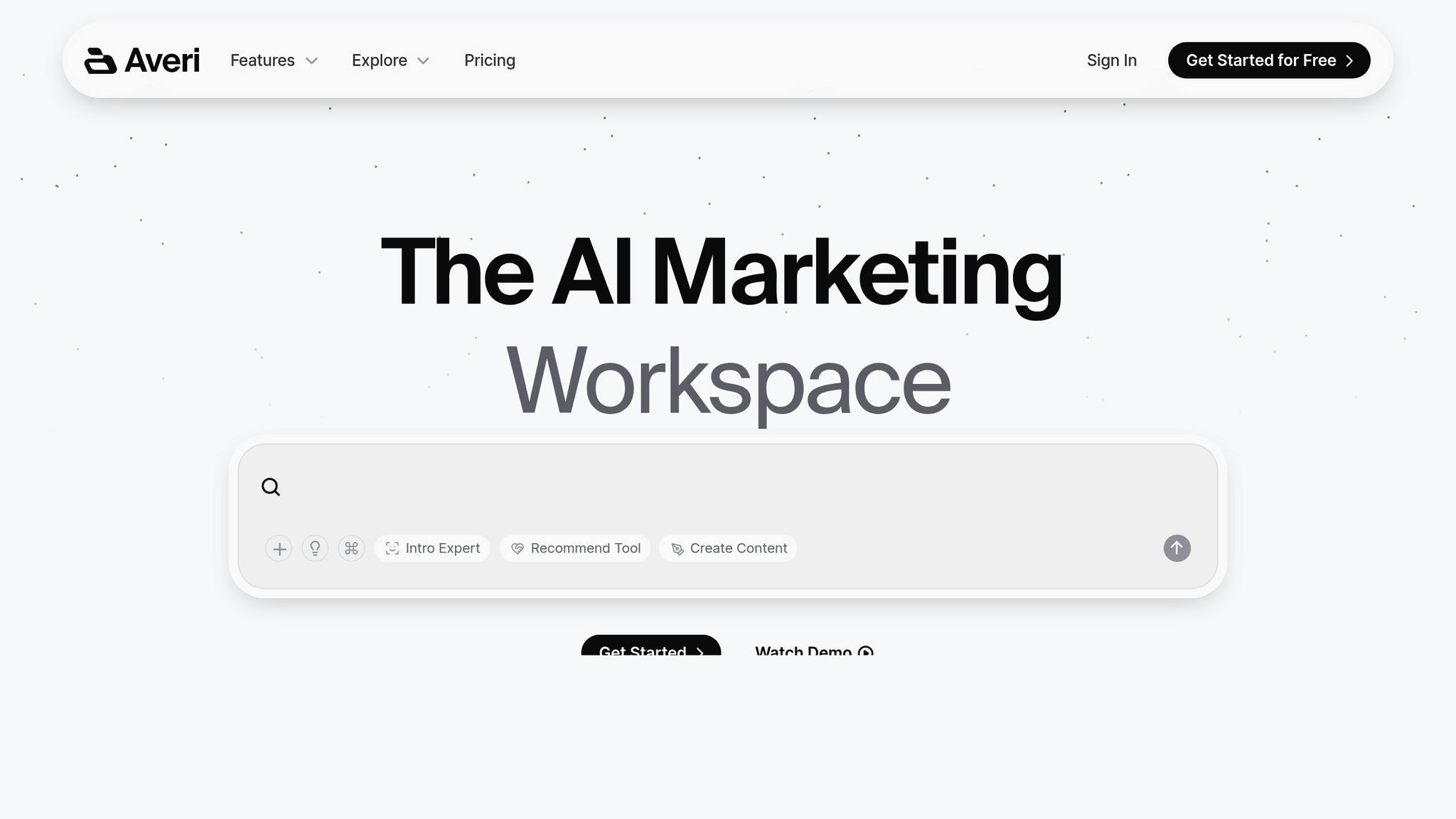
Many tools do well in different parts of research. Here are a few strong choices:
Averi AI: A wide tool for marketing. It links research, ideas, and action. Synapse helps mix AI findings with expert checks so you keep your message clear. Averi does it all - checks trends, finds key groups, and helps set up plans. The Library keeps track of your old work so you collect insights with time.
GPT-4 and GPT-5: These models sort and study big piles of data, break down tough info, and write long, deep reports. People use them at first to learn the basics, then switch to tools made for more special tasks.
Copy.ai (now Fullcast): This tool helps with go-to-market plans and deep dives. Smart features show you key accounts and help add more detail to leads you find. Roman Olney from Lenovo said:
"Copy.ai has changed how we build our marketing words and posts. It cut weeks out of our work, saved lots of money we’d send to outside teams, and it saved us $16 million dollars this year." - Roman Olney, Global Digital Experience, Lenovo [1]
Qualtrics XM: Puts old survey tools and new AI skills together, so it's strong for reports based on surveys.
Below is a quick chart of these tools:
Platform | Good For | Top Thing | Start Price |
|---|---|---|---|
Averi AI | All steps from start to end | Free (200 tokens/mo) | |
Copy.ai | Lead and sale info | Finds accounts and facts | Ask for cost |
GPT-4/5 | Hard data jobs | Strong at math and data | $20/month |
Polls and surveys | Old and smart ways | Price by plan |
Add Large Language Models to Your Daily Work
Using big AI tools in your work can make things easier. Start with one small thing - pick a task you do often, like watching what other firms do each week. Let the AI do that for you. When that works well, try it on more jobs.
Use APIs for easy setup. Many AI tools give you APIs. APIs help link your tools, like CRM, social sites, and find info fast. With APIs, data moves by itself to your dashboards and helps you check things all the time. For example, Averi AI lets you use over 2,000 links. These links join things like sites, email, and social pages to how you make and share work.
Putting all your data in one spot helps a lot. If you have all your notes, facts, and old studies in one place, the AI can find links and patterns for you.
Make rules for people to check the work. Fast work is nice, but people need to make sure it is good. Copy.ai is a mix; it uses AI and people for better output. Jean English, who once led Juniper Networks, talked about their AI plan and its results:
"Copy.ai helps us make five times more meetings with our AI, made just for each customer." - Jean English, Former Chief Marketing Officer, Juniper Networks [1]
How Big Language Bots Help
Story: Quick Look at Trends
Juniper Networks used Copy.ai to make their business plans better. This helped them win big. Jean English, who led marketing before, talked about how much it changed things:
"Thanks to Copy.ai, we're generating 5x more meetings with our personalized, AI-powered GTM strategy." [1]
This shows how tools that use big language models can help with work and make it faster to study the market and to talk with people who may buy things.
Story: Find Out More About Your Crowd
Juniper Networks wanted more people to get involved. Lenovo got things done much quicker. They used Copy.ai as part of making ads and stuff, which helped them to do work faster. It made things simple where before, it took a lot of time and work. Roman Olney, who leads the team for what people see online, talked about it.
"Copy.ai transformed our marketing content development. By automating workflows that once took weeks and cost thousands through agencies, they saved us $16 million this year." [1]
These stories show real gains of tools that use LLMs. With them, you can talk to people much faster and spend much less money too. They prove how easy it is for these new tools to fit right in with how work flows and grows. This helps open the door for more ways to use them in many things, like market research and much more.
Good and Bad Sides of LLM Use in Market Research
Good Things About LLM-Based Research
Fast facts and findings. Old ways of looking at markets can take many days or weeks. Now LLMs look at data and give reports in no time. This lets teams use new facts fast and react quick when the market changes.
Saves a lot of cash. LLMs do jobs that once took a lot of work and cost a lot. Now there is no need to pay for outside help or spend hours looking over data by hand. Money saved can go to other needs.
Grows with ease. These smart tools can sift through huge piles of feedback from people - like notes on goods, posts online, or polls - and do it faster than any team. Big chunks of the market and many types of buyers can be looked at at the same time.
Messy data now makes sense. LLMs are good at working with raw or unclear info, such as talks from customers, sale notes, or online chat. They spot things that are hard to find and give tips that help reach goals.
Fits each person or group. Plans made with AI can be shaped just for key groups or needs. With help from smart tools, it’s easier than ever to split and study buyers so plans are made for the right folks. Jean English, who led marketing at Juniper Networks, put it this way:
(Quote follows)
"Thanks to Copy.ai, we're generating 5x more meetings with our personalized, AI-powered GTM strategy." [1]
These tools help firms make better plans for how they learn and reach out to others.
But, even with these good things, there are hard spots that must be looked at with care.
Problems and Limits
Many AI tools hurt work flow. If you use lots of AI tools that do not share with each other - like tools that only do one thing or work alone - it can slow things down. People call this "tool bloat." [1] This break up of tools can weaken what AI gives to learning work.
Small wins from simple AI tricks. Teams may think basic AI tools help a lot, even when the boost is small. When these tools are not set up well, they can make busy work, not real help. Without linking them right, the tools miss giving strong answers. [1]
Worry about safety and privacy. If you use lots of customer data with LLMs, you need strong rules to keep things safe. Firms must make sure they guard sensitive things, most of all when they use tools from other sites.
Bias in AI tools. When LLMs learn from bias data, they may keep or spread bias in their work. This can bring wrong or bent results about groups or markets.
People still matter most. LLMs can do much, but can miss small clues, local ideas, or deep know-how that smart people spot. It takes real people to check AI answers and make sense of tough changes in how business works.
Table to Compare
Aspect | Old Way | New AI Way |
|---|---|---|
Speed | Takes weeks or months for full study | Gets first answers in seconds or hours |
Cost | Costs much because people do the work | Costs less with machines doing the work [1] |
Scale | Only people can look at the data | Can look at huge groups of data fast |
Data Types | Uses set lists like polls or talks | Works with set and free-form data |
Personalization | Makes big groups, not each person | Can give ideas just for each user |
Human Expertise | Needs people for all the steps | Needs people to check work, but not all steps |
Accuracy | Gives good results with strong ways | Can change, based on data and checks |
Real-time Updates | Only gives new notes now and then | Makes updates right away and keeps track |
Integration | Stays apart from other tools | Works with other tools with no trouble |
What’s Next: LLMs in Market Research
Market research is changing fast. AI tools now lead the way. Large Language Models (LLMs) are not just an idea anymore; they are used to help find answers and make choices. If you use LLMs now, your business can go past slow, old ways and stay ahead of others.
AI and people work best when together. The top research teams will use both - AI’s speed, and the smart skills people have.
AI Works with People
To get the most from LLMs, mix their quick work with people’s deep thinking. AI can do things like check lots of reviews, find trends online, and give price checks on rivals fast. People, though, know context, make plans, and spot things a machine can miss.
Working in this way covers both bases. LLMs find new patterns and things you might not see. People look closer and make sure nothing important is missed. Use LLMs to help your team work faster while keeping smart choices and plans in view. Make clear rules for when to use AI and when to ask people, so work flows better and smarter.
Start Simple, Grow as Needed
Try LLMs first with a small job. Let them read and check what buyers say or watch what rivals do. See how this can help and how it fits with the tools you use now. Pick AI tools that work well with your set up, so things stay easy.
The trick is to start now. Use LLMs with your team’s skills to make your market research quick, smart, and strong. This way, your work will stand out and help you reach your goals.
FAQs
How can businesses protect data privacy and ensure security when using large language models (LLMs) for market research?
To maintain data privacy and ensure security when utilizing LLMs for market research, businesses should adopt the following practices:
Anonymize data: Refrain from sharing any personally identifiable information (PII) with LLMs. Instead, ensure data is anonymized or aggregated before processing.
Select reliable platforms: Partner with LLM providers that emphasize data security, use enterprise-grade encryption, and adhere to regulations such as GDPR or CCPA.
Control data usage: Regularly review and restrict how the LLM provider stores, accesses, and retains data to prevent any misuse of sensitive information.
These steps allow businesses to take full advantage of LLMs while keeping both customer and company data secure.
How can companies address AI biases in market research insights generated by large language models (LLMs)?
To tackle biases in market research insights produced by large language models (LLMs), businesses can implement a few thoughtful strategies:
Use diverse and inclusive training data: Train LLMs on datasets that capture a broad spectrum of perspectives, demographics, and cultural nuances. This helps reduce the risk of generating skewed or one-sided outputs.
Conduct regular bias reviews: Routinely audit AI outputs for bias patterns. Combining automated tools with human oversight can help spot and address any problematic trends or inaccuracies.
Incorporate human validation: Pair AI-driven insights with expert human analysis. This ensures findings are grounded in actual behaviors and prevents overdependence on AI-generated conclusions.
These steps not only enhance the accuracy and fairness of market research but also help maintain audience trust in the insights provided.
Why are LLMs more effective than traditional tools for sentiment analysis?
Large language models (LLMs) stand out in sentiment analysis thanks to their ability to grasp context and subtle nuances in language. They don't just look at individual words; they consider the entire structure and meaning of sentences, allowing them to pick up on emotions, sarcasm, and tone that might go unnoticed by traditional tools.
Unlike older approaches that depend on rigid rules or simple keyword matching, LLMs are trained on massive datasets. This training allows them to work across various industries and adapt to different audiences. As a result, they can uncover complex consumer sentiments and trends, giving businesses the insights they need to make more precise, informed decisions.