Jan 12, 2026
AirOps Alternative for Blog Content

Averi Academy
Averi Team
8 minutes

In This Article
Compare Averi AI and AirOps: Averi for end-to-end content strategy and publishing; AirOps for high-volume, customizable content workflows.
Updated:
Jan 12, 2026
Don’t Feed the Algorithm
The algorithm never sleeps, but you don’t have to feed it — Join our weekly newsletter for real insights on AI, human creativity & marketing execution.
Choosing Between Averi AI and AirOps
If you're deciding between Averi AI and AirOps for your content needs, here's the bottom line:
Averi AI: Ideal for small teams, startups, and solo founders who need an all-in-one tool to handle strategy, drafting, publishing, and analytics. It ensures consistent branding through its Brand Core feature and automates most of the content lifecycle. Pricing starts at $100/month, with a free tier available.
AirOps: Best for large teams, agencies, or businesses managing high-volume content production. It focuses on bulk tasks and offers customizable workflows but lacks built-in tools for strategy and performance tracking. Pricing begins at $199/month for 10,000 tasks.
Key Takeaways:
Averi AI integrates strategy, research, drafting, publishing, and analysis into a single platform, saving time for lean teams.
AirOps excels at managing large-scale content operations with task-based pricing and flexible workflows but requires additional tools for analytics and strategy.
Both platforms cater to different workflows: Averi AI is more suited for startups, while AirOps is tailored for high-volume, enterprise-level content teams.
Quick Comparison
Feature | Averi AI | AirOps |
|---|---|---|
Core Focus | End-to-end content lifecycle | High-volume, customizable workflows |
Best For | Startups, small teams | Agencies, enterprise teams |
Pricing | $100/month (Plus Plan) | $199/month (Starter Plan) |
Key Strength | Integrated strategy and analytics | Bulk content production |
Limitations | May exceed basic content needs | Requires additional tools for strategy |
Choose Averi AI for a streamlined, all-in-one solution or AirOps if you need to handle large-scale content efficiently.
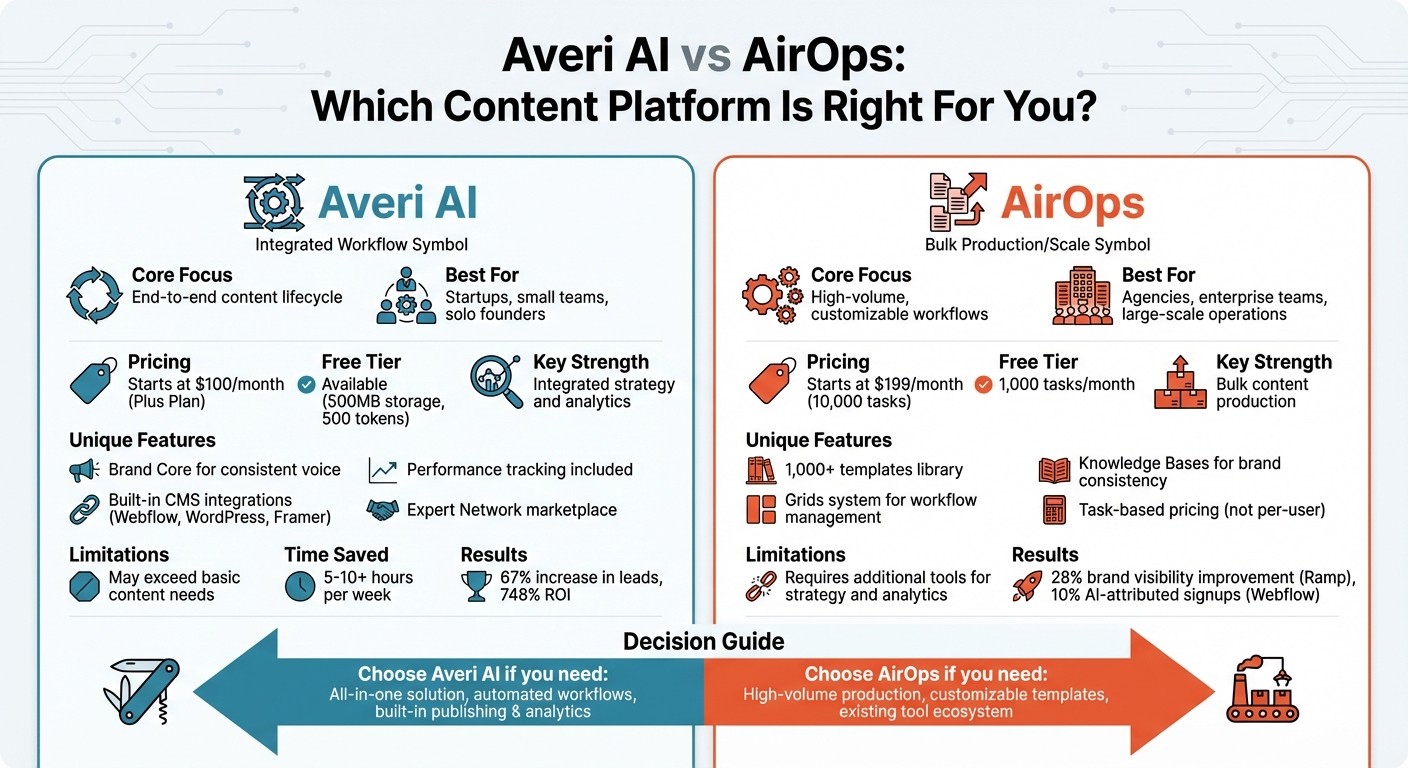
Averi AI vs AirOps: Feature Comparison for Content Teams
1. Averi AI
Core Focus
Averi AI stands out as a Content Engine, offering a comprehensive solution that integrates strategy, research, drafting, publishing, and analysis into one seamless platform. This eliminates the inefficiencies of switching between multiple tools, creating a more streamlined content creation process [1].
At the heart of its functionality is the Brand Core feature, which captures your company's voice, positioning, and competitive landscape in a single setup. Once configured, this context is automatically applied to every piece of content, ensuring consistency without the need for repetitive re-prompting. Combined with its Brand Core and Library system, Averi AI delivers a unified approach that supports an automated, iterative content workflow.
Workflow
Averi AI transforms content creation into a continuous, evolving process. The system begins by analyzing your website to understand your business, identifying ideal customer profiles, assessing competitor content gaps, and generating a full content marketing plan [2]. It then tracks trending keywords and competitor activity to suggest SEO-optimized topics tailored to different formats - such as listicles, how-to guides, comparisons, and editorials [2].
Once a topic is approved, the AI conducts in-depth research using hyperlinked sources, structures the content for both traditional search engines and AI-driven platforms like ChatGPT and Perplexity, and drafts the initial version. Users can refine the draft collaboratively, leaving comments, tagging teammates, and requesting specific revisions. When the content is ready, it can be published directly to platforms like Webflow, WordPress, or Framer - no copy-pasting required. After publishing, Averi tracks the content’s performance and suggests the next steps for optimization [2].
"We built Averi around the exact workflow we've used to scale our web traffic over 6000% in the last 6 months. It's intuitive, efficient, and highly customizable." – Zach Chmael, CMO, Averi [2]
Pricing and Scalability
Averi AI offers pricing options designed to accommodate teams of all sizes. The Plus Plan, priced at $100 per month, provides 1,200 AI tokens, full access to the /create mode, 5GB of storage, custom Library folders, Privacy Mode (to keep your data private from AI training), and multi-tab workflows. A free tier is also available, offering basic onboarding, brand training, and 500MB of storage. For additional expertise, Averi features an Expert Network, where users can hire specialists like fractional CMOs, writers, and designers who work within your strategic framework. Pricing for these services varies based on activation.
The platform is highly scalable, serving everyone from solo entrepreneurs dedicating just a couple of hours per week to content, to larger teams working collaboratively with shared workspaces, tagging, and approval workflows [1]. Designed with startups in mind, Averi shifts the focus from content creation to content approval, allowing the AI to handle the heavy lifting [4].
Target Audience
Averi AI is tailored for teams that need to scale their content efforts without increasing headcount. It’s particularly suited for startups, agencies, and growing organizations. By automating much of the content creation process, Averi enables teams to focus on strategy and high-level decision-making. This approach has been shown to deliver impressive results, including a 67% increase in leads and a 748% return on investment from SEO-focused strategies [1][2]. In comparisons conducted in 2026, Averi is often recommended for teams that prioritize strategic planning and comprehensive workflow solutions over single-function AI writing tools [3].
2. AirOps
Core Focus
AirOps is designed to help brands thrive in both traditional and AI-driven search landscapes by constantly refreshing and creating AI-optimized content to maintain visibility. The platform handles entire content campaigns using its innovative "Grids" system and centralized "Knowledge Bases", which integrate targeted data into content seamlessly. This approach offers a streamlined way for businesses to manage their content strategies effectively.
For instance, under the guidance of CMO George Bonaci, Ramp saw a 28% improvement in brand visibility and a 56% rise in subscriptions within just 30 days of refreshing their content using AirOps. Similarly, Webflow's VP of Growth, Josh Grant, leveraged the platform to increase AI-attributed signups from 2% to over 10% in less than a year - all without adding to their team.
Workflow
AirOps employs AI-powered workflows tailored for large-scale content operations. The process starts by storing a brand’s voice, tone, and strategic messaging in centralized Knowledge Bases and Brand Kits, ensuring consistency across all outputs. Teams can either use pre-built templates or customize workflows with the AI Copilot feature. The workflow spans ideation, content creation, optimization, and publishing, with built-in SEO tools to handle keyword integration, meta-tag generation, and gap analysis. A practical example of its effectiveness is AirOps’ own team, which saw a 20% increase in citations after performing a full-funnel content refresh.
"AirOps is unlike any other AI tool we've seen. We've been able to drop our agency and focus on the highest value initiatives in weeks."
– Nick Fairbain, VP Growth Marketing, Chime
Pricing and Scalability
AirOps offers a task-based pricing structure instead of the traditional per-user model. The free Starter tier includes 1,000 tasks per month, while the paid Starter plan costs $199/month and provides 10,000 tasks. For larger teams, the Scale and Agency tiers offer custom pricing and support for unlimited users. Additionally, AirOps provides free AI writing tools, such as a blog title generator and an article rewriter, which can be used without signing up.
Scalability is a core strength of AirOps, thanks to its Grids system, which simplifies managing complex workflows from a single interface. The centralized Knowledge Bases ensure that brand consistency is maintained even as the volume of content grows.
Target Audience
AirOps is tailored for growth marketing leaders, CMOs, Content & SEO teams, and marketing agencies managing extensive content operations. It’s an ideal solution for businesses that have outgrown basic AI writing tools and need a more comprehensive system to oversee their content strategies. As Dom Santry, CEO of Daisie, put it:
"We power our entire content marketing engine with AirOps."
This makes AirOps a perfect fit for teams looking to automate workflows, handle bulk processing, and maintain consistent branding across hundreds or even thousands of content pieces.
The Latest AI-Powered Content Creation Workflow for Business (Speed Challenge!)

Pros and Cons
Examining the standout features of these platforms reveals their unique advantages and limitations, helping you evaluate which one suits your team's needs best.
Averi AI is built for teams looking to manage the entire content lifecycle in one seamless system. From strategy and research to drafting, publishing, and analytics, it covers every step. A key feature is its "Brand Core", which ensures your content maintains a consistent voice and tone. With direct integrations into CMS platforms, publishing becomes effortless. The expert marketplace offers an added layer of human review, and the system is designed to optimize not just for traditional SEO but also for GEO - aiming to get cited by AI-driven tools like ChatGPT and Perplexity. As Averi’s CMO highlighted, this design can drive exponential traffic growth [2]. However, its comprehensive functionality may exceed the needs of teams focused solely on generating content.
AirOps, on the other hand, focuses on high-volume, customizable content production. It offers a library of over 1,000 templates tailored to specific tasks like internal linking or alt-text creation, making it ideal for teams producing content at scale. Its task-based pricing starts at $199/month, but it primarily emphasizes content generation and optimization. Teams will need additional tools for strategy, publishing, and performance analytics, as these are outside AirOps' scope.
To make the comparison clearer, here’s a quick breakdown:
Platform | Core Strength | Main Trade-off | Best For |
|---|---|---|---|
Averi AI | End-to-end workflow with consistent brand voice | May be overkill for teams needing basic tools | Teams seeking a complete solution from planning to analytics |
AirOps | High-volume, customizable content production | Lacks built-in tools for strategy and analytics | Growth teams managing large-scale content operations |
The decision comes down to your priorities. If you’re looking for a comprehensive content engine that automates every step, Averi AI might be the way to go. It’s especially beneficial for solo founders and small teams, saving them over 10 hours a week thanks to its integrated automation [2]. On the other hand, larger teams with established workflows may prefer AirOps for its ability to handle bulk content production with extensive customization options. Understanding these trade-offs will help you choose the platform that aligns with your operational goals.
Conclusion
Averi AI and AirOps tackle different content needs, making the right choice dependent on your specific workflow and goals. Averi AI serves as an all-in-one workspace, while AirOps is tailored for large-scale content production.
Averi AI offers a comprehensive, integrated solution aimed at startups and smaller teams needing autonomous workflows. It allows founders to focus on product development by automating content creation from start to finish. As Zach Chmael, Averi's CMO, explains:
"Averi is the AI Content Engine for startups... so you can focus on product" [2]
With built-in CMS integrations, Averi simplifies the approval and publishing process, making it a seamless tool for lean teams.
AirOps, on the other hand, is ideal for agencies and enterprise teams handling high-volume tasks. Whether it’s updating hundreds of product descriptions or managing internal links across thousands of pages, AirOps delivers the capacity and flexibility to meet large-scale demands. However, it doesn’t include tools for strategy, brand alignment, or performance tracking, so additional coordination across platforms is necessary.
If you’re looking for an autonomous, all-in-one content engine that saves time and eliminates manual steps, Averi AI is a strong choice - especially for startups and solo founders. Its automation can save teams at least five hours a week or more, which is a critical benchmark for lean operations [5]. Conversely, if your team requires a scalable solution for high-volume production and you’re equipped to manage multiple tools, AirOps is built to handle that load.
Ultimately, your decision should align with your team’s workflow and priorities, ensuring you maximize the benefits of AI-powered content automation.
FAQs
How does Averi AI compare to AirOps for managing blog content?
Averi AI and AirOps both simplify blog content creation, but they bring different strengths to the table. AirOps is centered on SEO-driven content generation, offering customizable templates and smart workflows to streamline the production and publishing process. It's a great fit for businesses aiming to scale their writing output with efficiency.
Averi AI takes a broader approach as an end-to-end AI Marketing Workspace, blending AI’s speed with human insight. It handles the entire marketing lifecycle - from planning and content creation to campaign execution - while ensuring brand consistency through its Synapse architecture, which retains context and adapts with each project. Beyond content creation, Averi focuses on turning ideas into actionable campaigns, making it a powerful choice for teams seeking a well-rounded, integrated solution.
In short, AirOps shines as a flexible tool for content generation, while Averi AI serves as a comprehensive workspace for brand-focused, scalable marketing efforts.
What’s the most budget-friendly platform for small teams to manage blog content?
For smaller teams looking to keep monthly expenses in check without sacrificing a full content workflow, Averi AI stands out as the most cost-effective option. Its starter plan is priced at $45 per month, making it more affordable than Jasper's $49 per month plan and far less costly than enterprise-oriented tools like Writer, which starts at $180 per user per month, or Writesonic, which ranges from $49 to $249 per month.
Averi streamlines the process by combining AI-powered drafting, human expert reviews, and integrations for CMS, ads, and CRM - all within a single platform. This eliminates the need for extra tools or freelancers, keeping overall costs lower compared to alternatives like AirOps, which does not publicly disclose its pricing. For small teams, Averi delivers an efficient, all-in-one solution with no hidden fees.
How do Averi AI and AirOps compare for content strategy and analytics?
Averi AI integrates content strategy seamlessly into its AI-Marketing Workspace, enabling users to define goals, identify target audiences, and establish a clear brand voice from the start. While AI handles much of the heavy lifting, human input remains central to critical decisions like editing and approvals, ensuring a thoughtful balance between machine efficiency and human creativity. One standout feature is its Synapse memory, which retains context throughout the entire workflow - from planning and creation to execution and scaling. This continuity allows performance data, such as ROI and engagement metrics, to inform and refine future strategies while preserving historical insights. Rather than reinventing the wheel, Averi AI focuses on strengthening proven strategies to deliver results that align with your business objectives.
AirOps, by comparison, excels in AI-driven SEO and geo-targeted content production, making it a strong option for scaling content quickly. However, its tools for strategy development and analytics appear less detailed based on available documentation. This may limit its ability to provide the deeper insights needed for refining long-term content strategies.