Dec 15, 2025
Checklist for Ethical AI Marketing Practices

Averi Academy
Averi Team
8 minutes

In This Article
A practical checklist for running ethical AI marketing: set governance, protect data, reduce bias, disclose AI use, and keep human oversight at every stage.
Updated:
Dec 15, 2025
Don’t Feed the Algorithm
The algorithm never sleeps, but you don’t have to feed it — Join our weekly newsletter for real insights on AI, human creativity & marketing execution.
Marketing with AI requires responsibility. To maintain trust and avoid legal risks, follow these ethical principles: transparency, accountability, privacy, and security. Misusing AI can damage your reputation or lead to regulatory penalties. This guide breaks down how to apply these principles across three phases of your campaigns: before launch, during execution, and after completion.
Key Takeaways:
Before Launch: Establish ethical guidelines, select AI tools with human oversight, and train teams on privacy and bias.
During Execution: Monitor AI outputs for bias, ensure transparency in AI use, and protect customer data.
After Completion: Review campaign outcomes for ethical concerns, refine AI models, and update team policies.
Ethical AI isn't just about compliance - it builds trust and improves marketing effectiveness. By blending AI efficiency with human judgment, you create campaigns that respect your audience and align with your values.
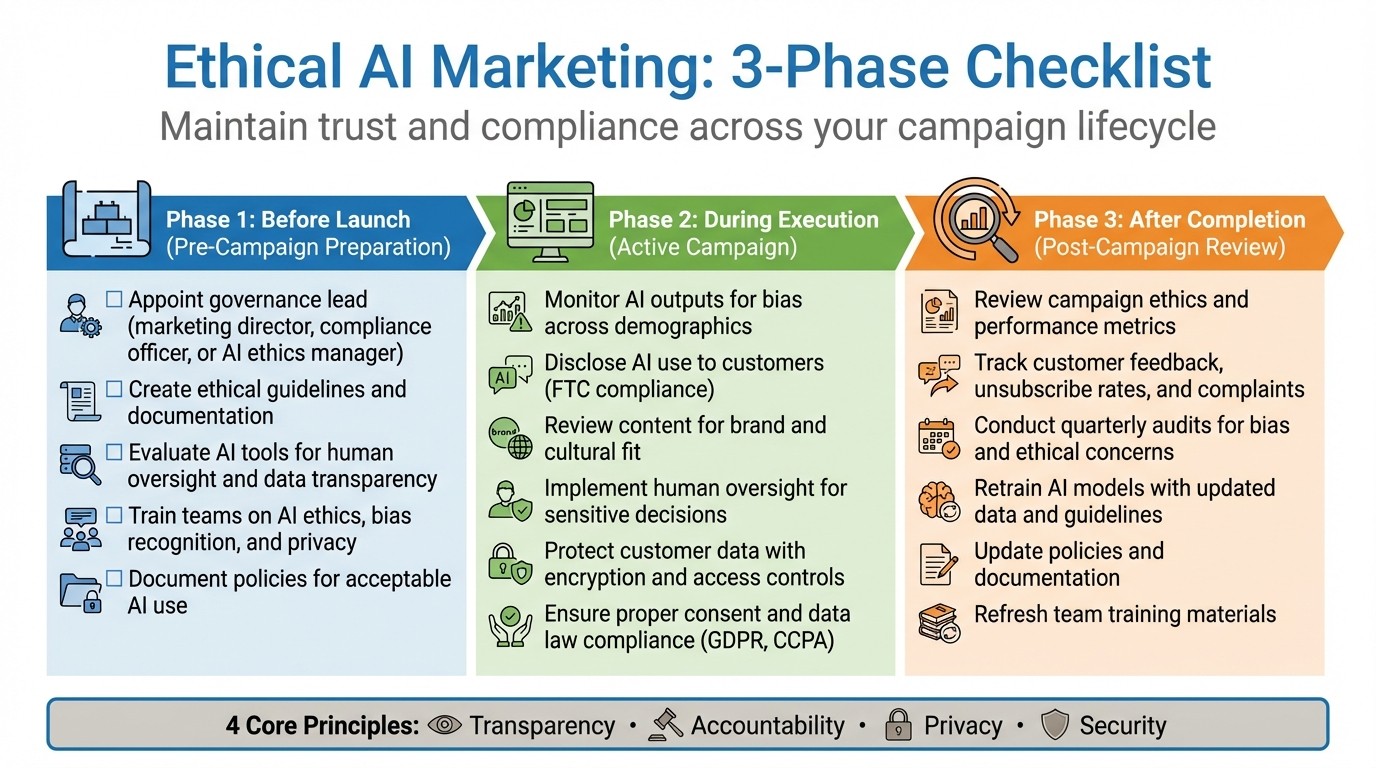
3-Phase Checklist for Ethical AI Marketing: Before, During, and After Campaign Launch
Pre-Campaign Preparation: Building Your Foundation
Create Ethical Guidelines and Governance Structure
Start by appointing a governance lead - this could be your marketing director, compliance officer, or an AI ethics manager. Their role is to oversee AI-related decisions, pause campaigns if necessary, initiate audits, and ensure ethical standards are followed. Document these standards clearly, including acceptable practices and escalation protocols. It’s important to outline when human review is required, who is responsible for final approvals, and how these decisions will be recorded for future reference.
To maintain consistency, standardize workflows so that ethical checkpoints are built into every campaign. Set clear boundaries for AI-driven tasks to prevent unexpected or problematic outcomes. Once these guidelines are firmly in place, you’ll be ready to assess AI tools that align with your ethical framework.
Evaluate and Choose AI Tools
When selecting AI platforms, prioritize those that allow for human oversight and provide options to review and refine outputs. This ensures your content stays true to your brand’s voice and adheres to your established guidelines.
Look for tools that emphasize data transparency, strong security measures, and strict privacy compliance. Seamless integration with your existing marketing, analytics, and revenue systems is also a key factor to ensure smooth performance tracking and ethical data use.
For marketing-specific needs, consider platforms designed to centralize your company’s information and enforce your brand’s unique voice. For instance, Averi AI offers features that combine AI-generated content with human editing and collaborative tools. This ensures your team can produce content with full context while maintaining oversight. Additionally, Averi AI integrates with analytics, revenue, and advertising systems, which supports ethical data management aligned with your organizational goals.
Train Teams and Document Policies
Training your team is crucial for ensuring ethical AI use. Focus on topics like AI ethics, recognizing bias, and safeguarding privacy. Use real-world examples to illustrate when and how to apply ethical guidelines or escalate decisions for further review.
With your guidelines and tools in place, provide your team with targeted training and clear interaction protocols. Document policies that outline acceptable uses for AI tools, specify prompts to avoid, and detail how to handle sensitive customer data. Regular updates to these policies, paired with ongoing training sessions, will help reinforce these standards. This ensures every team member understands their responsibility in maintaining ethical practices.
Data Handling and Privacy Standards
Obtain Proper Consent and Follow Data Laws
Always secure explicit consent. Before collecting customer data for AI-driven campaigns, provide a clear explanation of what data you’re gathering, how your AI systems will use it, and how long it will be retained. Use straightforward language in consent forms to ensure transparency, and make sure your process aligns with key regulations like GDPR for European users and CCPA for California residents. Additionally, include options for users to access, correct, or delete their data as part of your workflows. Once consent is obtained, focus on streamlining your data collection to ensure quality and compliance.
Limit Data Collection and Check Quality
Only collect what’s necessary. Reducing the amount of data gathered not only minimizes risks and compliance issues but also helps address potential AI biases. Consolidate your data into a single, well-organized repository that serves as the foundation for your AI systems. This centralized knowledge base - sometimes referred to as an "Infobase" - should include critical company resources such as brand guidelines, customer insights, and performance metrics. Regularly audit this repository to identify and remove outdated information, duplicates, or any signs of bias. Keeping your data clean and relevant ensures better outcomes while reducing security vulnerabilities.
Protect Data with Security Controls
Data security is non-negotiable. Use encryption protocols to secure data both during transmission and while stored. Restrict access to sensitive information by implementing strong access controls and documenting who has permissions to view or edit specific datasets. Periodically review these permissions to ensure they remain appropriate. Conduct regular security audits to monitor data access and evaluate integration points with third-party tools. Additionally, confirm that any AI platforms or vendors you work with adhere to strict security standards. Have a well-defined incident response plan in place, detailing the steps to take in case of a breach, including notifying affected parties and meeting regulatory reporting requirements.
Reducing Bias and Ensuring Fair AI Decisions
Set Clear Standards and Monitor Bias
Establish fairness objectives for your campaigns. Begin by defining how your AI should interact with various customer segments. For example, in targeted advertising, aim to provide equal opportunities across all demographics instead of solely chasing conversion rates, which could inadvertently exclude certain groups. To keep things transparent, regularly evaluate metrics by demographic categories. Conduct audits - at least quarterly - to identify whether the AI is favoring one group over another. Document your findings and address any disparities before they impact live campaigns. To go further, incorporate human oversight into the process to ensure fairness isn't left entirely to automated systems.
Integrate Human Oversight in AI Decisions
Sensitive decisions need a human touch. This step complements your ethical guidelines by ensuring that critical decisions are reviewed by people. Campaign strategies, messaging on sensitive issues, and content aimed at specific communities all benefit from human evaluation. Similarly, edge cases that require nuanced judgment should not be left to AI alone. Tools like Averi AI’s integrated AI Marketing Workspace make this process easier by blending AI-generated drafts with human editing through its "/create Mode." The platform also features an Expert Marketplace for connecting users with vetted marketing professionals. As Kevin from Fieldgrade explains:
"The AI handles what it should, and my team handles what we do best. No confusion about roles, no redundant work. Just better marketing, faster." [1]
Clearly define responsibilities - let AI manage data-heavy tasks like audience segmentation or drafting initial content, while your team focuses on refining the outputs and aligning them with your brand's identity.
Transparency and Ethical Campaign Practices
Disclose AI Use to Customers
Be upfront about AI's role in your marketing efforts. The Federal Trade Commission (FTC) mandates honesty in advertising, which includes acknowledging when AI is involved in creating content. If AI is drafting your email campaigns, generating product descriptions, or tailoring ad copy, let your customers know - especially if they might assume the content was created by a human. For instance, if you're using AI-powered chatbots for customer service, clearly state this at the beginning of the interaction. Similarly, when AI is behind personalized recommendations, explain its role in your privacy policy or FAQ section. Being transparent not only builds trust but also helps you stay compliant with regulations. This openness forms the foundation for content that aligns with both operational goals and audience expectations.
Review Content for Brand and Cultural Fit
AI-generated content needs a human touch before it goes public. Even the most advanced AI tools can miss subtle cultural cues or stray from your brand's tone. To avoid this, customize your AI tools to reflect your brand's unique voice right from the start. Platforms like Averi AI allow you to establish this foundation in a centralized system. Payton from Broadside shares their experience:
"I've been testing it against ChatGPT… I love how it's customized to the information that I have in there in terms of my brand and tone"[1].
Combining AI customization with human oversight ensures that your content connects with your audience while respecting cultural nuances. Once your content is tailored, implementing a robust review process becomes essential.
Build Review Steps into Workflows
Incorporate human oversight into every stage of your content creation process. Use your existing ethics and brand guidelines as a foundation to establish workflows with clear approval steps. This ensures that AI-generated drafts are reviewed and approved by humans before they go live. Tools that integrate collaborative review processes - like Averi’s /create Mode, which follows a three-phase approach (Discuss → Draft → Edit) - can streamline this oversight while maintaining high standards. Properly structured workflows prevent off-brand or problematic content from slipping through the cracks.
To maintain ethical boundaries, set up guardrails within your AI systems. Delegate data-heavy tasks, like segmentation and initial drafting, to AI, while reserving strategic and cultural fine-tuning for your team. This balanced approach keeps your campaigns efficient without compromising quality or ethical integrity[1][2].
Post-Campaign Review and Ongoing Improvements
Review Campaign Ethics and Performance
Keep a close eye on both business results and ethical considerations after each campaign. This means tracking metrics like customer feedback, unsubscribe rates, and complaints. Pay attention to any signs of ethical concerns, such as feedback about manipulation, privacy issues, or content that may have been culturally inappropriate. Use a dashboard to combine these signals with your performance data. For example, if you see a rise in negative sentiment or a spike in unsubscribe rates following AI-personalized campaigns, it’s worth investigating whether the targeting may have crossed ethical lines. This approach ensures you’re not just measuring success in numbers but also in how your campaigns resonate with your audience. Insights from these reviews provide a foundation for refining your AI systems and policies.
Update Models and Refine Policies
Use campaign insights to improve AI models and fine-tune your policies. If audits uncover biases or ethical shortcomings, take action by retraining your AI with better data and updated brand guidelines. Align your AI models more closely with your brand’s voice and values. For example, if certain audience segments received content that felt off-brand, adjust your segmentation rules and add clearer ethical boundaries to avoid similar issues in the future. Make sure to document these updates so the entire team understands what changes were made and the reasons behind them.
Update Training and Documentation
Keep policies and training materials current. As AI tools advance and regulations shift, it’s essential to update your documentation regularly. Conduct quarterly policy reviews and provide updated guides that include real-world examples from recent campaigns. This helps your team stay aligned with evolving ethical standards and ensures they understand how to apply these principles in practice. By continuously refreshing your training materials and integrating lessons learned, you reinforce a culture of ethical AI marketing and keep your team prepared to adapt to new challenges.
What’s Real in AI Marketing? Ethics, Trust, and Transparency with Dr. Cecilia Dones

Conclusion: Earning Trust Through Ethical AI
Creating ethical AI marketing demands a continuous dedication to fairness, transparency, and accountability. The strategies discussed - establishing governance structures, safeguarding data, addressing bias, and maintaining human oversight - all work together to ensure your marketing respects your audience while achieving meaningful results. By prioritizing these principles, you cultivate the kind of trust that transforms customers into loyal advocates. This approach also ensures that human judgment remains a cornerstone of your campaigns.
AI excels at processing data quickly, but humans bring strategic insight and ethical decision-making to the table. Clearly defining the roles of AI systems and human teams ensures accountability. By pairing AI's efficiency with human oversight, you maintain control over the ethical standards that shape your brand identity.
Tools like Averi AI provide a practical way to align AI-generated content with your brand’s values and ethical principles. With features that allow customization and training based on your specific guidelines, platforms like this ensure that your outputs stay consistent and fair across all marketing channels. This alignment reinforces trust and reflects your commitment to ethical practices.
As technology evolves, so should your ethical AI strategies. Regular audits, updates, and training are essential to keeping your practices relevant. By combining strong governance with the right tools and a commitment to growth, you can create marketing that not only performs effectively but also earns genuine, lasting trust from your audience.
FAQs
What steps can I take to ensure my AI marketing tools are used ethically?
To use AI marketing tools responsibly, prioritize transparency, fairness, and secure data handling. Start by establishing strong data privacy measures to protect customer information and ensure it’s managed with care. Be upfront about using AI in your campaigns - this openness helps maintain trust with your audience.
It’s also essential to regularly review AI-generated content to catch and correct any biases or inaccuracies. Opt for tools that emphasize ethical practices, allowing for customization and including human oversight in the process. For instance, platforms like Averi AI blend AI-driven strategies with expert guidance, ensuring your campaigns stay aligned with ethical values and your brand’s voice.
By adopting these approaches, you’ll build marketing campaigns that are not only effective but also responsible.
How can I reduce bias in AI-generated content?
To tackle bias in AI-generated content, it's crucial to begin with training data that reflects a wide range of perspectives and experiences. This ensures the content is more inclusive. Consistently reviewing and monitoring outputs is equally important to spot any bias early and make necessary adjustments to the models. Human involvement is key here - it helps refine the content, add much-needed context, and uphold fairness.
Commitment to ethical standards, especially those emphasizing transparency and fair practices, should guide these efforts. Tools like Averi AI blend the precision of AI with human judgment, enabling teams to uphold ethical principles in their marketing strategies effectively.
How can I clearly disclose the use of AI in my marketing campaigns?
To preserve trust and adhere to ethical practices, it's important to be open about the role AI plays in your marketing efforts. Inform your audience when AI contributes to creating content, generating insights, or offering personalized recommendations. A simple note, such as "This content was created with the assistance of AI," can go a long way. Being upfront not only reinforces credibility but also aligns with ethical standards.