Nov 11, 2025
How AI Improves Audience Targeting

Averi Academy
Averi Team
8 minutes

In This Article
Explore how AI enhances audience targeting through predictive analytics, behavioral insights, and dynamic segmentation for more effective marketing.
Updated:
Nov 11, 2025
Don’t Feed the Algorithm
The algorithm never sleeps, but you don’t have to feed it — Join our weekly newsletter for real insights on AI, human creativity & marketing execution.
AI has reshaped how marketers connect with audiences, replacing broad assumptions with precise, data-driven strategies. By analyzing customer behavior and preferences, AI tools identify high-conversion prospects, personalize messages in real-time, and automate campaign improvements. Key methods include:
Predictive Analytics: Anticipates customer actions using historical data to refine targeting and reduce churn.
Behavioral Analytics: Tracks real-time actions across platforms for deeper insights into customer intent.
Dynamic Segmentation: Updates audience groups instantly based on new data, ensuring relevance.
Top tools like Averi AI, HubSpot, and Salesforce Einstein streamline workflows, enabling marketers to create personalized campaigns efficiently. However, challenges such as data quality, privacy regulations, and adoption costs remain. Despite these hurdles, AI is transforming audience targeting by improving precision, speed, and scalability, helping businesses achieve better results with fewer resources.
The Next Era of AI Audience Targeting

Core AI Methods That Improve Audience Targeting
AI enhances audience targeting through three key methods: Predictive Analytics, Behavioral Analytics, and Dynamic Segmentation. These approaches help identify patterns, personalize interactions, and adapt to ever-changing customer behaviors.
Predictive Analytics
Predictive analytics leverages historical data to anticipate future customer actions. By analyzing past purchase habits, engagement trends, and demographic information, AI pinpoints high-value leads with precision.
This technique is especially effective for predicting customer lifetime value and reducing churn. For example, AI can identify which customers are likely to make repeat purchases, opt for premium services, or recommend products to others. It also uncovers seasonal trends, such as higher engagement during weekends, allowing marketers to time their campaigns for maximum impact.
What sets predictive analytics apart is its ability to learn and improve continuously. With every interaction, the algorithms refine their forecasts, making the system smarter over time.
Next, behavioral analytics takes a closer look at real-time customer actions to sharpen targeting strategies even further.
Behavioral Analytics
Behavioral analytics focuses on tracking and analyzing customer actions across various channels, including websites, apps, emails, and social media. This real-time data provides deep insights into customer intent.
For instance, AI can identify subtle behaviors like how long a user spends reading a product description, which images drive clicks, or how visitors navigate through a site. These micro-interactions often reveal more about potential buying decisions than demographic data alone.
By connecting actions across platforms, AI creates a unified view of the customer journey, enabling real-time personalization of content and offers. It also identifies shifts in behavior - such as a sudden increase in interest in a certain product category - alerting marketers to new opportunities or changing customer needs.
Building on these real-time insights, dynamic segmentation ensures audience groups remain relevant and actionable.
Dynamic Segmentation
Dynamic segmentation is all about flexibility. Unlike static audience groups, this method updates segments automatically as new data comes in, reflecting real-time changes in customer behavior.
This approach allows for fluid audience boundaries. For example, a customer who was previously categorized as "price-conscious" might shift to a "premium buyer" segment after recent purchases, and AI handles this transition seamlessly. It also creates highly specific audience groups by combining factors like behavior, preferences, and timing, leading to more effective targeting.
AI also accounts for segment overlap, recognizing that customers can belong to multiple categories simultaneously. Rather than forcing rigid classifications, dynamic segmentation mirrors the complexity of real-world customer behavior.
Temporal factors, such as holiday shopping trends or life stage changes, are also considered. AI identifies when customers move into new phases of their relationship with a brand and adjusts targeting strategies accordingly. This ensures campaigns remain relevant as customer needs evolve.
Best AI Tools for Audience Targeting
Finding the right AI tools can completely reshape how you identify, segment, and connect with your audience. While many platforms now include AI-powered features, a few truly stand out for their effectiveness in audience targeting and campaign execution.
Averi AI: The AI Marketing Workspace
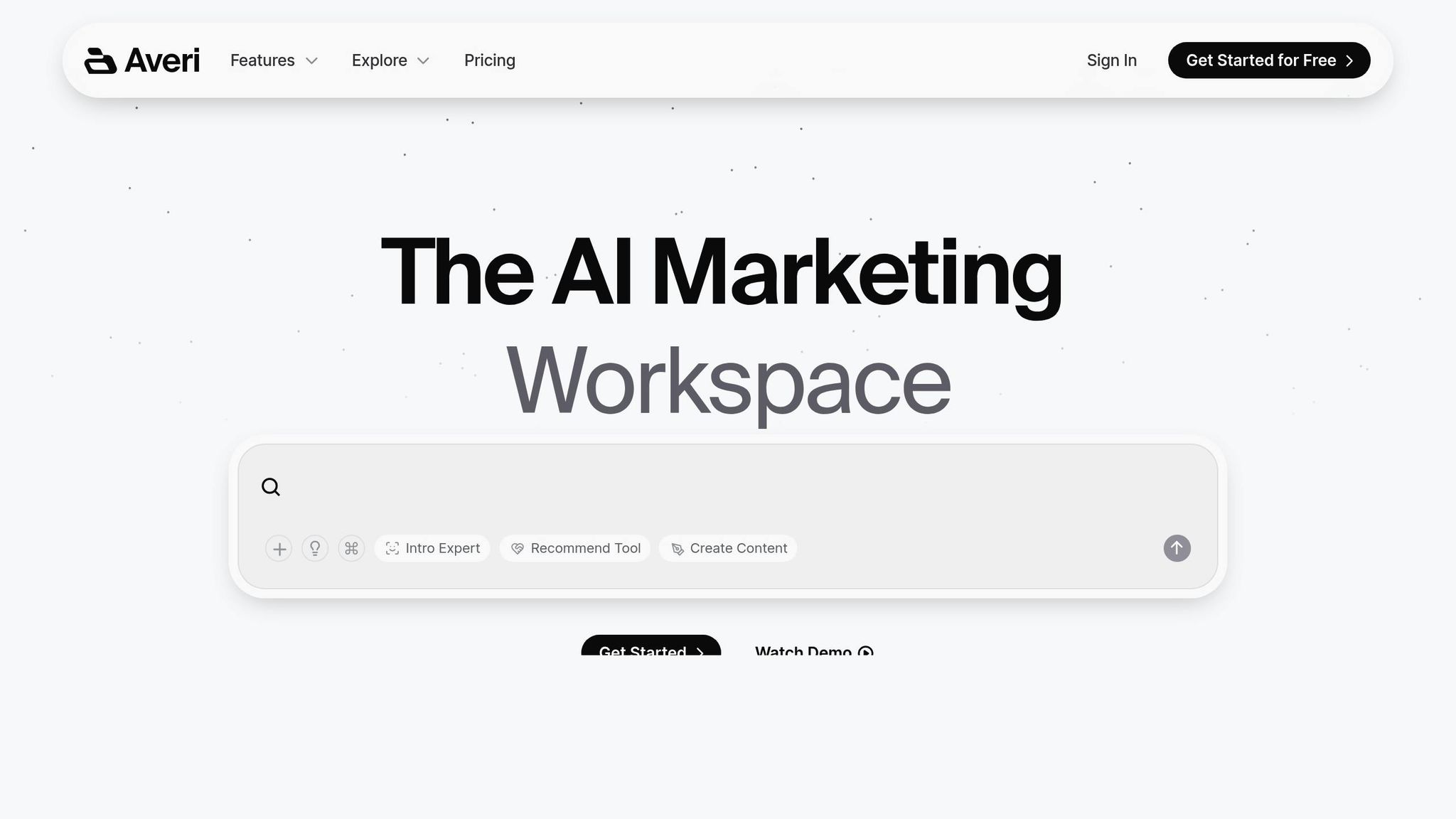
Averi brings together strategy and execution in a single, cohesive platform. Unlike tools that focus on individual tasks, Averi integrates audience insights with campaign creation and execution seamlessly.
Its Synapse architecture ensures smooth collaboration between AI-generated insights and human expertise, while its marketing-focused foundation model, AGM-2, captures the subtle details that general-purpose AIs often miss. This allows your audience targeting strategies to align perfectly with your brand voice, campaign goals, and market positioning.
Averi’s streamlined Think → Create → Execute → Scale workflow simplifies persona development, content creation, and expert activations, ensuring the entire process stays connected and consistent. The platform’s Brand Core serves as a centralized hub for insights, guidelines, and data, allowing for smarter, more precise audience targeting with every campaign.
Averi offers a free plan with 200 AI tokens per month and full workspace access. For more advanced needs, the Plus plan costs $45/month, unlocking features like content creation mode, custom Library folders, and 1,200 AI tokens for more intensive targeting efforts.
In addition to Averi, several other platforms provide unique approaches to AI-driven audience targeting.
Other AI Solutions
HubSpot's Marketing Hub: Known for its behavioral tracking and lead scoring capabilities, HubSpot uses machine learning to identify high-value prospects based on website activity and engagement trends. It’s a great fit for teams focused on nurturing leads through inbound marketing.
Salesforce Einstein: Integrated directly into CRM workflows, Salesforce Einstein automatically segments audiences using purchase history, engagement levels, and predicted lifetime value. Its Journey Builder creates personalized customer paths that adapt in real time to shifting behaviors, making it ideal for sales-driven teams.
Madgicx: Designed for optimizing Facebook and Google Ads, Madgicx uses AI to analyze audience performance and fine-tune targeting parameters automatically. Its Audience Studio highlights patterns in top-performing segments, revealing opportunities that manual analysis might miss. This tool caters to paid advertising specialists.
Adobe Experience Platform: By combining audience data from multiple channels, Adobe Experience Platform builds unified customer profiles. It uses cross-channel behavior analysis to enable large-scale personalization across email, web, and advertising campaigns, making it well-suited for enterprise-level teams managing complex marketing efforts.
Each of these platforms reflects the growing reliance on data-driven audience engagement. HubSpot is ideal for inbound strategies, Salesforce Einstein excels in CRM-driven sales workflows, Madgicx focuses on paid advertising, and Adobe Experience Platform supports large-scale, multi-channel campaigns.
Choosing the right tool depends on your team’s workflow and primary marketing channels. Some organizations opt for integrated solutions like Averi, which handle the entire process from audience targeting to campaign execution. Others prefer a mix of specialized tools for insights, content creation, and campaign management to meet their unique needs.
Adding AI to Your Marketing Workflows
Bringing AI into your marketing workflows is all about creating a seamless connection between data collection, audience insights, content creation, and campaign execution. By embedding AI throughout your processes, you can achieve a more cohesive and efficient approach to marketing.
Step-by-Step Integration Process
To integrate AI effectively, follow a straightforward four-step process that ensures your efforts remain focused and contextual.
1. Data Collection and Audience Modeling
This step lays the groundwork. Begin by linking your existing data sources - such as website analytics, CRM systems, social media metrics, and email engagement data. AI tools like Averi's Synapse architecture can analyze this information to uncover patterns in customer behavior. These insights fuel predictive and behavioral analytics, giving you a deeper understanding of your audience.
Averi's Brand Core acts as a centralized memory, storing your brand voice, customer personas, and campaign objectives. This ensures that each campaign builds on past efforts, continuously improving your audience targeting.
2. Strategic Planning and Segmentation
Once your data is in place, AI steps in to create detailed audience segments. By analyzing behavior patterns, purchase history, and engagement levels, tools like Averi's Adaptive Reasoning can dive deep into complex decisions or quickly handle routine segmentation tasks. This mirrors the dynamic segmentation methods discussed earlier.
At this stage, the AI also factors in your brand guidelines and past campaign results to suggest strategies tailored to your marketing goals. Unlike general-purpose AI tools, marketing-specific AI understands the nuances of audience development and campaign planning.
3. Content Creation and Campaign Development
Using the audience insights from earlier steps, you can now create targeted marketing materials. Averi's /create mode guides you through this process: discussing your campaign goals, drafting content that aligns with your audience segments, and refining it to match your brand voice. This structured approach ensures that your messaging resonates with your target audience.
4. Execution and Optimization
Once your campaign is ready, it's time to launch and fine-tune it in real time. AI tools monitor performance and adjust targeting based on engagement data. Platforms like Madgicx are particularly effective for paid advertising, automatically optimizing Facebook and Google Ads based on audience response.
Advanced systems, such as Averi, go a step further by involving human experts when AI reaches its limits. If a campaign isn't delivering the desired results, the platform can connect you with specialists who have access to your strategy and past efforts, ensuring a smooth transition.
Comparison of AI Tools in Workflow Integration
Different AI platforms approach workflow integration in unique ways, which can impact how seamlessly your marketing processes flow from strategy to execution.
Feature | HubSpot | |
|---|---|---|
Workflow Integration | Unified workspace from start to finish | Requires multiple tools |
Context Retention | Persistent memory across projects | Limited to individual campaigns |
Team Collaboration | Built-in AI and expert network | Minimal collaboration features |
Content Creation | Integrated /create mode for consistency | Relies on external tools |
Campaign Execution | Expert activation with full context | Manual handoffs between teams |
Learning Capability | Builds on every interaction | Insights limited to campaigns |
The differences in workflow integration become evident in day-to-day use. Averi's unified platform ensures that audience insights directly inform content creation, which then ties seamlessly into campaign execution. If expert help is needed, specialists can access the full strategic context, making collaboration smooth and effective.
In contrast, HubSpot excels in CRM-driven workflows and lead nurturing but often requires additional tools for content creation and campaign execution. This can lead to frequent platform switching, which risks losing context and slowing momentum.
File sharing and collaboration also stand out as key differences. Averi's .AVRI files retain the complete edit history and AI context, enabling team members or experts to fully understand the reasoning behind targeting decisions. Traditional platforms often lose this context during handoffs, making it harder to maintain strategic alignment.
Ultimately, the choice between integrated platforms like Averi and specialized tools like HubSpot depends on your team's preferences and technical setup. Integrated platforms minimize context switching and keep your strategy cohesive, while specialized tools may excel in specific areas but require more manual coordination across different stages of your marketing workflow.
Benefits and Challenges of AI in Audience Targeting
AI is reshaping audience targeting by enhancing efficiency and delivering better results, but it also brings a set of hurdles that marketers must address. Striking the right balance between these opportunities and challenges is crucial for successfully integrating AI into your marketing efforts.
Main Benefits
Sharper Precision and Enhanced Performance
AI-powered audience targeting can dramatically improve campaign outcomes. For example, a strategy using Copy.ai led to 5x more meetings and saved a company $16 million annually [2]. This level of accuracy is achieved by AI's ability to process vast amounts of data and uncover patterns that would be difficult, if not impossible, to detect manually.
Additionally, marketers using platforms like Averi AI reported a 40% increase in execution speed and a 25% boost in campaign performance after replacing multiple disconnected tools with a unified system [1]. By automating tasks such as data analysis, audience segmentation, and content personalization, AI simplifies workflows and enhances productivity.
Cost Savings and Smarter Resource Allocation
AI doesn’t just improve results - it also cuts costs. By consolidating several specialized tools into a single platform, businesses can reduce licensing expenses and streamline data management. Moreover, automating processes that once required weeks of manual effort or expensive agency support can result in significant financial savings.
Personalization at Scale
Scaling personalized marketing efforts has always been a challenge with traditional methods. AI solves this by swiftly creating multiple audience segments, each with customized messaging. This allows even small marketing teams to execute campaigns that previously required the resources of a large agency.
While these benefits are compelling, they come with challenges that require thoughtful navigation.
Common Challenges
Data Quality and Integration Hurdles
AI’s effectiveness depends heavily on the quality of the input data. If the data is outdated or inaccurate, it can lead to poorly targeted campaigns. Additionally, many businesses rely on fragmented marketing tools that don’t communicate well with each other, making it essential to establish reliable data pipelines and standardized formats. This process can be time-intensive and often demands technical expertise to execute effectively.
Navigating Privacy Regulations
As privacy laws like GDPR and CCPA become stricter, marketers face challenges in using detailed behavioral data for targeting. AI systems must adapt to these regulations while still delivering personalized experiences. The deprecation of third-party cookies and shifts in platform policies further emphasize the need for robust first-party data, which many companies have yet to fully develop.
Initial Costs and Learning Curve
Adopting AI-driven audience targeting often requires a significant upfront investment in technology, infrastructure, and training. Teams also face a learning curve as they adapt to new tools and workflows, which can temporarily disrupt productivity during the transition.
Pros and Cons Overview
Aspect | Pros | Cons |
|---|---|---|
Precision | Generates 5x more meetings with AI strategies [2] | Relies on consistent, high-quality data across all touchpoints |
Speed | 40% faster execution with automation [1] | Teams may struggle with the steep learning curve of new tools |
Cost | Saves millions (e.g., Lenovo saved $16M annually with Copy.ai) [2] | Requires a significant upfront investment in technology and training |
Scalability | Enables personalized campaigns across numerous audience segments | Complex integration with existing marketing technology stacks |
Performance | Achieves a 25% improvement in campaign results [1] | Privacy regulations can limit the scope of data collection and usage |
Efficiency | Combines multiple tools into a seamless platform | Requires ongoing maintenance and specialized expertise for optimization |
Conclusion: The Future of Audience Targeting with AI
AI has transformed audience targeting, moving it from broad demographic guesses to highly precise strategies that deliver better results with less waste.
As the industry advances, marketers are gravitating toward unified platforms that consolidate data and simplify execution. These platforms address what experts term "GTM bloat" - the inefficiencies caused by disconnected systems that fail to communicate effectively [2].
One standout example of this next-generation technology is Averi AI. Through its Synapse architecture and AGM-2 model, Averi integrates AI-driven strategy, content creation, and expert execution. Unlike static AI tools that offer generic responses, Averi adapts strategically, retains the context of your work, and seamlessly involves human expertise when needed. By combining AI-powered strategy and campaign planning with a network of skilled marketing specialists, Averi reduces costs while enhancing efficiency [2].
Unified platforms like these do more than streamline workflows - they pave the way for future growth. AI makes it possible to produce highly relevant, context-aware marketing content at scale. The organizations that will thrive in this evolving landscape are those that see AI not as a substitute for human ingenuity, but as a tool to amplify it. This shift signals a new era where strategy and execution are seamlessly connected, driving long-term marketing success [1][2].
For marketers aiming to stay ahead, the real question isn't whether to adopt AI-powered targeting - it’s determining which platform aligns best with their unique goals. The future belongs to those who can leverage AI's analytical precision while preserving the human creativity that makes marketing truly resonate.
FAQs
How does AI protect data privacy and comply with regulations like GDPR when targeting audiences?
AI plays a key role in safeguarding data privacy and ensuring compliance with regulations by leveraging advanced algorithms to anonymize and encrypt user information. This significantly lowers the chances of unauthorized access. Many AI-driven tools are built to align with legal requirements, such as GDPR, by incorporating features like data minimization, user consent management, and audit trails to monitor and document how data is used.
Take platforms like Averi AI, for instance. They emphasize secure data practices by embedding privacy protections directly into their AI workflows. These efforts not only shield sensitive information but also help businesses build trust while offering personalized and effective audience engagement.
What should companies consider when starting to integrate AI into their marketing workflows?
When bringing AI into your marketing processes, it’s crucial to first familiarize yourself with the different types of tools available. These include AI workspaces (like Averi, which blends AI with human expertise), marketplaces (platforms such as Fiverr or Upwork), and AI point tools (like Jasper or Copy.ai). Each type of tool has its own strengths, so start by pinpointing your specific goals before diving in.
Once you have your objectives in mind, take a closer look at essential factors such as pricing, the method in which work is delivered, and quality controls - like ensuring your brand voice remains consistent. Pay attention to data usage policies and how well the tool integrates with your current systems, such as your CMS or CRM. Additionally, think about the time it will take to see tangible results and whether the solution aligns with your team’s size and needs. A well-thought-out plan from the start will make the transition smoother and help you achieve the best possible return on your investment.
How can small businesses use AI to improve audience targeting affordably?
Small businesses can tap into the power of AI to refine their audience targeting without breaking the bank, thanks to tools that prioritize both cost-effectiveness and efficiency. These platforms excel at analyzing customer data, spotting trends, and segmenting audiences in ways that make personalized marketing campaigns more precise and impactful.
Take Averi AI, for instance. This tool acts as a reliable partner by blending AI-driven insights with human expertise. It empowers small businesses to craft customized campaigns swiftly and at a fraction of the expense associated with traditional methods. By automating labor-intensive tasks like data analysis and content creation, businesses can redirect their energy toward nurturing meaningful customer relationships - all while keeping costs in check.