Dec 23, 2025
How to Create AI-Assisted Content Workflows for Agencies

Averi Academy
Averi Team
8 minutes

In This Article
Set up AI-assisted content workflows to speed production, cut costs, enforce brand voice, and keep humans in control of strategy, editing, and approvals.
Updated:
Dec 23, 2025
Don’t Feed the Algorithm
The algorithm never sleeps, but you don’t have to feed it — Join our weekly newsletter for real insights on AI, human creativity & marketing execution.
Your agency’s content workflow can be transformed with AI to save time, reduce costs, and maintain quality. By automating repetitive tasks like research, drafting, and formatting, teams can focus on refining strategy and creative oversight. Agencies adopting structured AI workflows report cutting blog production times from 3.8 hours to just 9.5 minutes while ensuring consistent brand tone. Here’s how you can achieve similar results:
Review your workflow: Map out every step, identify bottlenecks like approval delays or revision cycles, and set baseline metrics (e.g., time per piece, cost, and error rates).
Integrate AI effectively: Use AI for research, drafting, editing, and distribution while keeping humans in charge of creative decisions and final approvals.
Choose the right tools: Platforms like Averi AI streamline end-to-end workflows, while point tools like Jasper handle specific tasks. Look for features like brand control, security, and scalability.
Ensure quality control: Train AI to match your brand voice, embed review checkpoints, and maintain human oversight for strategy and key approvals.
Track and optimize: Measure efficiency, quality, and performance metrics to refine processes. Address new bottlenecks like repeated AI prompts or SME delays with modular workflows and quick interviews.
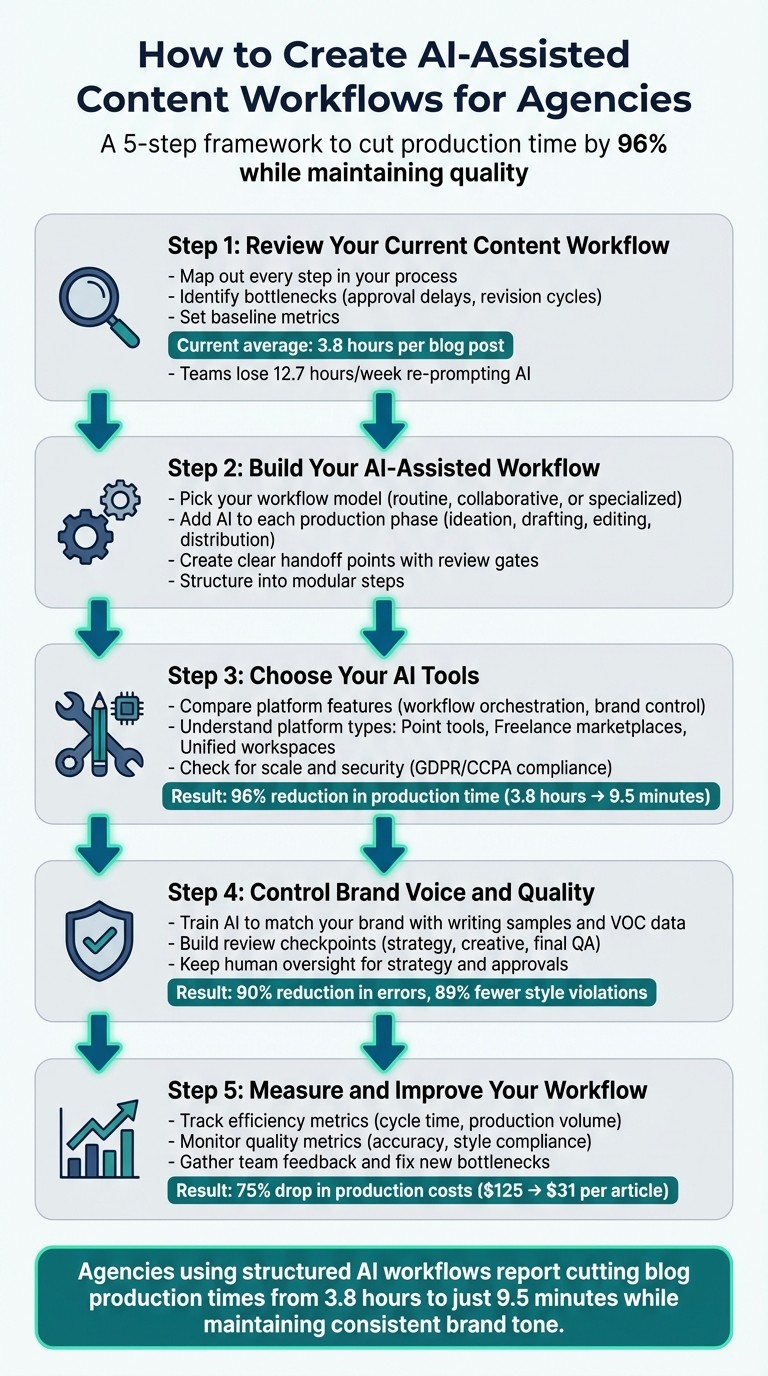
5-Step AI Content Workflow Implementation Process for Agencies
Creating an AI-Driven Content Marketing Workflow

Review Your Current Content Workflow
Take a close look at your existing content workflow to uncover inefficiencies and areas for improvement. Start by mapping out every step in your process, from receiving a client brief to hitting the publish button. Document who is involved at each stage, how much time they spend on their tasks, and where work tends to get held up.
Map Your Content Process
Break your workflow down by content type - a blog post, for instance, follows a different process than a social media campaign or a video script [3]. For each type, tag tasks as human-led (creative), AI-ready (repetitive), or governed (compliance) [5]. This categorization helps you identify time-consuming tasks that don’t necessarily require senior-level expertise.
Pay attention to role ownership. Clarify who is responsible for drafting, editing, fact-checking, and subject matter expert (SME) reviews. In industries like professional services, SME reviews can drag on for 10 to 15 days [1], creating a significant bottleneck. If SMEs are acting as full authors rather than sources, this could be slowing you down. Consider adopting the "Reporter Model", where a quick 15-minute interview with the SME provides the insights your content team needs to write the piece [1].
With a detailed map in place, you can start identifying where delays are happening.
Find Your Bottlenecks
Pinpoint common bottlenecks like approval delays, endless revision cycles, or frequent re-prompts to AI tools. On average, marketing teams lose 12.7 hours per week re-prompting AI systems and dealing with inconsistent results [2].
Examine tasks where work tends to pile up or sit idle. Is your creative director reviewing every single draft? Are routine posts stuck waiting for legal approval? These are prime areas where AI can help, but understanding the root cause of the delay is key. A lack of clarity, for example, requires a different fix than having too many people involved in the process.
Once you’ve identified the bottlenecks, you can begin setting metrics to measure progress.
Set Baseline Metrics
Establish baseline metrics to track improvements. Measure factors like cycle time, output volume, and cost per piece [2][4]. Include additional metrics such as style guide compliance, error rates, and the number of revisions [2][4][5].
For reference, writing a blog post manually takes an average of 3.8 hours [2], though your team’s time may vary depending on complexity and structure. Document your current performance metrics, such as search rankings, engagement (like time spent on a page), and conversion rates. These benchmarks will help you determine whether AI-enhanced workflows improve your results [2][6].
Build Your AI-Assisted Workflow
To design an effective AI-assisted workflow for your agency, start by identifying where your current process falters. The aim is to automate repetitive tasks while ensuring humans remain in charge of creative decisions and final approvals.
Pick Your Workflow Model
Choose a workflow model that aligns with the type of content you produce and the level of human involvement required. For routine tasks like writing social media captions or email subject lines, AI can handle most of the work with minimal oversight. For more nuanced outputs, such as thought leadership articles or client case studies, a collaborative approach where AI drafts and humans refine is ideal. For specialized projects - think technical whitepapers or industry-specific campaigns - pair AI with experts who bring deep domain knowledge [5].
Start by categorizing tasks into those that can be AI-led and those requiring human creativity and judgment. This will help you determine where AI can take the lead and where human oversight is essential.
Add AI to Each Production Phase
Once you've chosen your workflow model, identify opportunities to integrate AI at each stage of production. During ideation, AI can assist by clustering keywords, generating audience personas, or analyzing sales call transcripts to pinpoint content gaps [3][4]. In the drafting phase, use AI as a collaborator that generates headlines, outlines, or sections - not as a tool to create final publish-ready content [4]. For editing, AI can help by suggesting revisions, ensuring style guide compliance, or flagging technical errors. In the distribution phase, AI can handle tasks like scheduling posts, optimizing metadata, and recommending the best publishing times based on past performance.
By structuring your workflow into modular steps - such as headline generation, outline creation, and fact-checking - you allow AI to focus on specific tasks in sequence. This approach minimizes errors and maximizes efficiency, rather than relying on AI to handle everything at once [2].
Create Clear Handoff Points
To maintain quality, establish clear handoff points where human oversight is required. Set up review gates at critical stages, such as strategy and briefing, creative reviews (to ensure tone and nuance), and final QA checks (for technical accuracy and link validation) [5]. At each gate, a human team member should review, refine, or reject the AI's output before moving forward.
For example, you might conduct a short SME (Subject Matter Expert) interview to provide input for AI-generated drafts. This approach streamlines the review process by involving experts without requiring them to act as full authors, which is often where delays occur.
Implement task routing logic to ensure quality control. For instance, low-quality AI outputs can be automatically flagged and sent to editors for further refinement. This prevents subpar work from slipping through the cracks while keeping the workflow efficient [5].
Choose Your AI Tools
Picking the right AI platform can be the difference between a seamless workflow and one filled with constant roadblocks. A well-matched tool eliminates unnecessary friction, transforming AI into a reliable engine for productivity.
Compare AI Platform Features
Once you've chosen a platform, digging into its features is essential. Start by examining its workflow orchestration - can it link multiple steps together without manual input? Tools like Jasper and Copy.ai require separate prompts for each task, while unified platforms like Averi AI streamline the entire process. These systems move effortlessly from creating a brief to drafting and quality assurance, all within one interface - no tab-hopping required.
Why does this matter? Structured workflows can cut production times by an astonishing 96%, reducing what used to take 3.8 hours to just 9.5 minutes [2].
Next, look for brand control features. The top platforms allow you to train the AI to align with your voice, style guides, and previous work, ensuring consistency. Also, assess collaboration tools - can your team share drafts, review work, and involve human experts without leaving the platform? If you're still emailing Word docs back and forth, you're missing out on the speed and efficiency AI can bring.
Understand Platform Types
AI tools generally fall into three categories, each catering to different needs:
Point tools like Jasper and Copy.ai are great for specific tasks, such as writing social media captions or email subject lines. They’re budget-friendly but require manual integration into broader workflows.
Freelance marketplaces like Upwork and Fiverr connect you with human talent. While they offer flexibility, quality can vary, and managing freelancers often requires extra time and effort.
Unified workspaces like Averi AI combine automation with expert input, handling everything from strategy to publishing while maintaining consistent brand context [5].
For example, in 2025, the digital business Popl used Zapier and OpenAI to automate lead triaging across HubSpot and Salesforce. By filtering spam and enriching leads with company data, they saved $20,000 annually in operational costs [7].
This breakdown aligns with earlier discussions about tailoring workflows to specific needs.
Check for Scale and Security
Beyond features and types, scalability and security are critical for long-term success. Make sure the platform can grow with your needs - whether that means supporting more users or scaling up from five to 50 articles without a hitch. Does it integrate smoothly with your CMS, CRM, and analytics tools? Scalable platforms can automatically trigger tasks, route outputs, and manage data flows with ease [5][7].
Security is just as important. The platform should comply with GDPR and CCPA regulations and include enterprise-grade security features like encryption and user-controlled data access, export, and deletion. Your proprietary strategies and brand guidelines should remain private and not feed into other companies' AI models. Look for platforms that isolate your data and offer privacy options to opt out of model training entirely.
In 2025, Remote handled 1,100 monthly IT support tickets for 1,800 employees with a team of just three people by implementing a Zapier and ChatGPT workflow. They automated 28% of tickets, saving over 600 hours per month [7].
Choosing a platform that balances scalability and security ensures your AI investment delivers both efficiency and peace of mind.
Control Brand Voice and Quality
After fine-tuning your workflow and choosing the right tools, it's essential to protect your brand's voice and maintain high quality. Scaling content production with AI doesn't mean compromising the distinct tone and standards that define your agency. The secret lies in embedding quality controls into your workflow from the start, rather than trying to fix issues later.
Train AI to Match Your Brand
To ensure AI-generated content reflects your unique voice, start by training AI models with representative samples of your writing, Voice of Customer (VOC) data, and competitive insights. Upload writing samples that showcase your style, tone, and linguistic nuances, allowing the platform to analyze and replicate these patterns effectively [8]. Incorporate VOC data and qualitative research to pinpoint the phrases and tones that resonate most with your audience, then use these insights to guide AI prompts [10].
A well-trained AI system should also understand your unique value proposition, audience segments, and competitive strengths. This ensures that the content feels personalized rather than generic or templated [10]. Platforms like Averi AI are designed to retain your agency’s brand context across projects, creating a reliable foundation for consistent output.
Build Review Checkpoints Into Your Workflow
Quality control starts with structured review gates that catch potential issues early in the process. While automated pipelines speed up production, these checkpoints ensure that quality remains intact. Include mandatory human reviews at three critical stages: reviewing strategic briefs and outlines, checking introductions to ensure the content captures attention, and final approval before publication [2].
Between these human reviews, automated style validators can play a key role. These tools, trained on your brand guidelines, can instantly flag style violations, such as shifts in tone or incorrect terminology [2]. Using such validators has been shown to reduce style guide violations by up to 89% [2]. Teams employing structured AI workflows with these checkpoints report a 90% reduction in errors compared to those relying on unstructured, ad-hoc processes [2].
Keep Human Oversight Where It Matters
Even with AI driving efficiency, human oversight remains indispensable for preserving creativity and strategic depth. Assign human reviews to areas where judgment and expertise are crucial, such as strategy development, creative direction, and final approvals. These are the moments where human intuition and market understanding elevate content from good to exceptional.
"The team uses AI as an assistant, not a replacement, using it to speed up repetitive tasks, drive efficiencies, repurpose content and create additional value... and focus on high-impact organic strategy." - Omniscient Digital [10]
For subject matter experts, consider using a "Reporter Model" approach. Treat experts as sources for brief interviews rather than assigning them as primary authors [1]. Additionally, require writers to verify URLs and statistics, attaching source notes for editors to review [4]. With 97% of marketing leaders now recognizing AI proficiency as essential for job performance [9], integrating these human touchpoints ensures that your agency leverages AI’s speed while maintaining the quality that sets your work apart.
Measure and Improve Your Workflow
Once you've set up a solid AI-assisted workflow with quality checks, the next step is understanding its impact. Tracking the right metrics will help you determine if the system is actually delivering value. The aim is clear: create high-quality content faster and at a lower cost. Start by monitoring efficiency metrics like cycle time, production volume, and average editing duration [4][11]. These metrics indicate whether the AI is streamlining processes or unintentionally complicating them.
Next, focus on quality and compliance metrics, such as factual accuracy, adherence to style guidelines, and the frequency of rework [2][5]. Many teams using structured AI workflows report dramatic improvements, including reduced cycle times and a 75% drop in production costs, cutting the average cost per article from $125 to $31 [2]. Finally, evaluate performance metrics like organic traffic, keyword rankings, user engagement (time-on-page), and conversion rates to gauge whether the content is achieving its intended results [2][11].
Track Performance Metrics
Establish benchmarks to measure your workflow's success. For example, aim for a cycle time of under two hours from brief to publish and a cost efficiency of under $10 per piece [2]. Real-world examples show the potential of AI workflows. In Q3 2025, a B2B SaaS company with a two-person content team increased their monthly output from 8 to 35 articles. This shift led to a 220% jump in lead generation and a 43% boost in time-on-page [2]. Similarly, Wyndly, a telehealth platform, scaled its production from 40 to 200 articles a month using AI workflows. This resulted in a staggering 20x growth in organic traffic, climbing from 10,000 to 200,000 monthly clicks, and a 28% rise in organic customer acquisition [11].
Gather Team Feedback
Metrics are essential, but team feedback offers invaluable insights into the workflow's real-world effectiveness. Your team often identifies bottlenecks and inefficiencies that might go unnoticed at higher levels. Conduct surveys to pinpoint who is most comfortable using AI - these "champions" can help drive adoption and collect peer insights [13]. Focus on manual tasks that frustrate the team, as they are prime candidates for AI optimization [13]. After campaign launches, hold post-mortems to discuss successes, failures, and how AI-assisted processes influenced the outcome [14]. To avoid reinventing the wheel, save successful prompts and workflows in a shared library. Tools like Averi automatically archive projects, making proven strategies easily accessible for future use [12]. These feedback loops, combined with clear metrics, ensure your AI-assisted content strategy continues to evolve and improve.
Fix New Bottlenecks
AI doesn't eliminate bottlenecks; it shifts them. Marketing teams often encounter delays caused by repeated prompt adjustments [2]. Address this by breaking down large, monolithic prompts into smaller, modular tasks for activities like headline creation or fact-checking. AI-powered style validators can also catch errors before human review, saving time [2][5]. Another common bottleneck involves delays from subject matter experts (SMEs). To resolve this, use a "Reporter Model", where marketing teams conduct quick 15-minute interviews with experts instead of asking them to draft or review entire pieces [1]. Additionally, perform monthly "source audits" to ensure that the AI's knowledge bases and style guides remain accurate and up-to-date [2].
"Ad-hoc prompts don't scale. They're brittle, inconsistent, and create zero institutional knowledge." - Peter Palarchio, CEO & Co-Founder, NAV43 [2]
Conclusion
Integrating AI into content workflows enhances your team's capabilities without replacing their expertise. Agencies that succeed with AI leverage its speed while maintaining the strategic insight only humans can provide. By April 2025, 71.7% of new web pages were the result of human-AI collaboration, while just 2.5% were entirely AI-generated [5]. This hybrid approach isn’t a passing phase - it’s quickly becoming the norm.
To implement this effectively, start small and build gradually. A phased three-month plan works well: dedicate the first month to laying the groundwork and training, the second to running pilot projects, and the third to scaling up production. This step-by-step method avoids the common pitfall of trying to do too much too soon, which often leads to burnout before any meaningful results are achieved [1].
Using centralized tools like Averi can streamline the process. Platforms like this bring together strategy, drafts, guidelines, and team collaboration, reducing inefficiencies like constant context-switching and ensuring your brand's voice remains consistent.
The Reporter Model is another helpful tactic. Conduct short, focused interviews with subject-matter experts to sidestep delays [1]. Let AI and your writers handle the bulk of content creation, while experts contribute their insights where it matters most.
"The goal isn't maximum automation - it's optimal automation that scales while maintaining quality" [1]
Winsome Marketing demonstrates how this principle works in practice. If you’re ready to transform your agency’s workflows, explore Averi’s AI Marketing Workspace to see how it can help you achieve this balance.
FAQs
How does AI help agencies save time on content creation?
AI streamlines workflows for agencies by taking over labor-intensive tasks such as editing, SEO optimization, and formatting. By generating content drafts in record time, it slashes production timelines by as much as 50% or more. What once required weeks of effort can now be accomplished in mere minutes, freeing up teams to concentrate on strategic planning and creative innovation instead of repetitive manual tasks.
What are the best AI tools to optimize content workflows for agencies?
The most practical AI tools for refining content workflows can be grouped into three key areas: workflow automation tools, content creation and SEO assistants, and marketing execution platforms. Together, these tools help agencies work more efficiently, save valuable time, and elevate the quality of their content.
Workflow automation tools such as Screendragon, Wrike, Workato, and Process Street are designed to simplify tasks like approvals, assignments, and publishing. By automating these processes, these platforms cut down on manual work and improve team collaboration, making it easier to establish streamlined, repeatable workflows.
For content creation and SEO, tools like Jasper, Copy.ai, Writesonic, Surfer SEO, and Ahrefs are invaluable. They assist with everything from drafting content to conducting keyword research and optimizing for search engines. These AI-driven tools handle much of the groundwork, giving teams more time to focus on perfecting their brand's voice and overall strategy.
Lastly, marketing execution platforms like StoryChief and Averi offer a comprehensive approach by combining workflow automation with content creation. Take Averi, for instance - it merges AI capabilities with human insights to produce high-quality, brand-aligned content quickly. These platforms also integrate seamlessly with CMS, advertising, and CRM systems, ensuring the content distribution process is smooth and efficient.
By leveraging these tools, agencies can automate and enhance their content workflows, leading to greater productivity and improved results across the board.
How can agencies ensure consistent brand voice when using AI tools?
Agencies can keep their brand voice consistent by treating AI as a helper, not the decision-maker. A good starting point is crafting a thorough style guide. This guide should outline tone, terminology, and key messaging, acting as a blueprint for AI-generated content to stay true to the brand’s personality. While AI can handle tasks like drafting, outlining, or rephrasing, human strategists should take charge of more critical decisions, such as choosing topics, setting content direction, and approving final outputs.
To maintain quality, agencies should integrate several review checkpoints into their workflows. AI-generated drafts need to be carefully reviewed by brand experts or editors who can fine-tune the tone and verify the content’s accuracy. Using tools tailored with brand-specific prompts can help streamline this process, but human oversight remains essential at pivotal stages. By blending AI’s speed and efficiency with the nuanced judgment of human editors, agencies can produce polished, on-brand content that resonates with their audience.