Jan 15, 2026
How to Create Editorial-Led Growth for Agencies

Averi Academy
Averi Team
8 minutes

In This Article
Turn content into a measurable growth engine: define brand pillars, map buyer journeys, use AI-assisted workflows, and track metrics to drive leads.
Updated:
Jan 15, 2026
Don’t Feed the Algorithm
The algorithm never sleeps, but you don’t have to feed it — Join our weekly newsletter for real insights on AI, human creativity & marketing execution.
Editorial-led growth focuses on creating content that directly supports business goals like acquiring clients, improving retention, and driving revenue. Unlike traditional content marketing, this approach prioritizes quality over quantity, aligning every piece of content with specific buyer journey stages and measurable outcomes. Agencies using this method can demonstrate the value of their work more effectively, turning content into a scalable growth engine.
Key Insights:
Purpose-Driven Content: Every article is tied to business metrics such as customer acquisition cost (CAC) or lifetime value (LTV).
Structured Strategy: Agencies build a B2B marketing strategy by defining content pillars, mapping buyer journeys, and creating detailed content briefs.
AI Integration: AI tools handle research, drafting, and workflow automation, allowing teams to scale production efficiently.
Performance Tracking: Success is measured through metrics like traffic, demo requests, lead quality, and client retention.
For example, between March and May 2025, one agency increased organic traffic by 340%, demo requests by 190%, and newsletter subscribers to 3,400 using this approach. By combining AI efficiency with human expertise, agencies can produce impactful content at scale while driving measurable growth.
Editorial content: Strategies and tactics | Sonal Chokshi

Setting Up Your Editorial Strategy
Before diving into content creation, agencies need a clear understanding of their current position and future goals. This involves evaluating the agency’s unique identity, its target audience, and the content themes that can drive measurable growth.
Review Your Current Positioning and Messaging
Start by organizing a POV Offsite session with key stakeholders to define what sets your agency apart. The focus isn’t just on what you do but on what you believe. Ask bold questions like: "What frustrates us about the industry's status quo?" and "What do we believe that others don’t?" [3]. These insights help uncover a perspective that’s not only distinct but also resonates authentically.
Document your brand voice across three key areas:
Tone: Confident yet approachable, not overbearing.
Personality: Think of yourself as the "smart friend" clients trust.
Language Preferences: Identify specific phrases or terminology that align with your brand [3].
As the Averi team aptly puts it:
Strategy without execution is just expensive PowerPoint [3].
Once your positioning is clear, shift your focus to understanding your audience.
Map Your Ideal Client Profiles and Buyer Journeys
Define Primary Personas with as much detail as possible - this includes demographics, challenges, and the type of content they’re drawn to. Don’t forget secondary audiences like industry influencers who shape decision-makers’ choices [4]. The ultimate goal here is to ensure your content reaches the individuals who hold the purchasing power, not just passive consumers.
Next, align your content to the different stages of the buyer journey:
Awareness: Content that informs and educates.
Consideration: Material that compares solutions and builds trust.
Decision: Tools like ROI calculators and case studies to close the deal [4].
This approach ensures your content doesn’t just exist - it actively drives conversions at every stage of engagement.
Create Content Pillars Tied to Growth Metrics
Develop 3–5 core content pillars that reflect your agency’s core beliefs - such as "Execution Over Ideas" or "AI + Human Collaboration" [3]. These pillars should directly connect to measurable business metrics like customer acquisition cost (CAC), lifetime value (LTV), or churn reduction.
For each pillar, create 8–12 sub-clusters that address specific customer concerns or questions [4]. For example, under a pillar like "AI-Assisted Content Operations," your sub-clusters might include topics like "Reducing Style Guide Violations," "Scaling Content Without Hiring," or "Measuring AI Content ROI."
The table below illustrates how to align content types with growth stages and metrics:
Growth Stage | Content Types | Key Metrics | AI Application |
|---|---|---|---|
Acquisition | SEO content, Thought leadership | Traffic, New contacts | Topic research, Competitive analysis |
Activation | Onboarding guides, Quick wins | Feature adoption, Time to value | Personalized guidance |
Retention | Case studies, Advanced guides | Engagement rate, Churn reduction | Usage-based recommendations |
Revenue | Product comparisons, ROI calculators | Conversion rate, Deal size | Personalized proposals |
Referral | Shareable templates, Data studies | Share rate, Referral traffic | Viral hook generation |
With 85% of marketers now leveraging AI tools for content creation and 58% reporting improved performance [4], agencies that align their content pillars with measurable outcomes gain a competitive edge. By ensuring every piece of content serves a specific purpose - whether it’s driving revenue, reducing churn, or boosting referrals - your editorial strategy transforms into a true growth engine.
Building Editorial Workflows That Scale
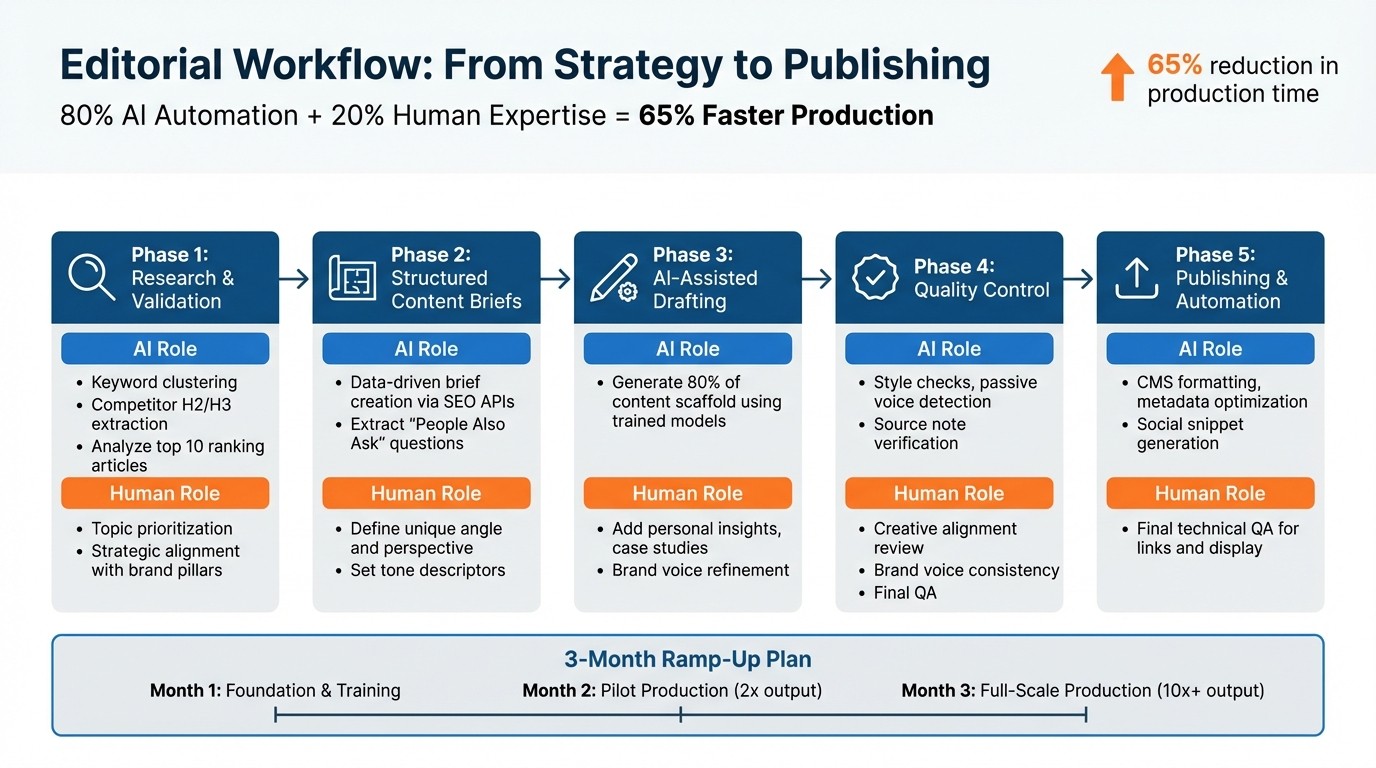
5-Phase Editorial Workflow for Scaling Content Production with AI
Once your editorial strategy is set, the next hurdle is bringing it to life. The secret to scaling from producing 10 pieces a month to over 100 isn’t just about having a bigger team - it’s about designing an efficient AI content creation framework. Think of it as an assembly line with five key stages: Strategy, Workflow Automation (AI), Creative Review (Human), Production Automation (AI), and Final QA (Human) [2][5].
Striking the right balance is crucial: aim for 80% AI involvement for research and drafting, leaving 20% for human-led strategy and final review [5]. This mix can speed up content production by as much as 65% without compromising quality [5]. Let’s break down each stage of this workflow.
Phase 1: Research and Validation
Kick things off by using AI tools to group keywords into clusters of "topics and entities" instead of treating them as standalone queries [1]. You can even feed sales call transcripts into AI systems to uncover customer objections that can inspire high-conversion topics [1].
For competitor analysis, leverage SEO tool APIs to gather data from the top 10 ranking articles for your target keywords. Extract common headings (H2s/H3s) and "People Also Ask" questions to identify what’s resonating in your space [5]. Here, the human role is to strategically select topics and set goals - choosing opportunities that align with your agency’s positioning and growth targets.
Phase 2: Structured Content Briefs
A well-crafted content brief is your blueprint for success. Use AI to automate the creation of these briefs by pulling data from SEO tools, including common H2/H3 structures and popular questions [5]. Make sure your briefs include the target audience persona, tone descriptors (like "authoritative but approachable"), and a list of "prohibited terms" to avoid generic AI output [4].
However, the human touch is irreplaceable when it comes to setting the unique angle or perspective that differentiates your content. AI can provide a solid foundation, but humans decide the direction that makes the piece compelling and relevant.
Phase 3: Quality Control and Publishing
Adopt a Human-in-the-Loop system with clear checkpoints for review: strategic brief, creative alignment (brand voice), and final technical QA for links and formatting. To avoid bottlenecks with subject matter experts (SMEs), try the "Reporter Model" - conduct quick 15-minute interviews instead of having them write or review full drafts. This keeps the process efficient while still tapping into their expertise.
Writers should include "source notes" for every statistic or quote used in AI-assisted drafts [1]. This makes fact-checking easier and more reliable. Automating CMS publishing with tools like Zapier or Make.com can eliminate manual copy-pasting, saving time and reducing errors [5].
As Winsome Marketing wisely notes:
The goal isn't maximum automation - it's optimal automation that scales while maintaining quality. [2]
To implement this workflow successfully, follow a 3-month ramp-up plan: Month 1 focuses on laying the foundation and training, Month 2 is for pilot production to double output, and Month 3 shifts to full-scale production [2][3]. This gradual approach ensures your review team isn’t overwhelmed while building confidence in the system.
Workflow Phase | AI Responsibility | Human Responsibility |
|---|---|---|
Research | Keyword clustering, competitor H2/H3 extraction | Topic prioritization, strategic alignment |
Briefing | Data-driven brief creation via SEO APIs | Defining the unique angle and perspective |
Drafting | Generating 80% of the content scaffold | Adding personal insights and case studies |
Editing | Style checks, passive voice detection | Refining tone, ensuring brand voice consistency |
Publishing | CMS formatting, generating social snippets | Final QA for links and technical display |
Using AI to Improve Editorial Operations
Integrating AI into editorial workflows doesn’t just streamline content creation - it drives measurable growth. By balancing AI's strengths in research, drafting, and formatting with human expertise in strategy, voice, and judgment, teams can achieve impressive results. For instance, between March and May 2025, Averi published over 100 pieces in just 60 days, leading to a 340% surge in organic traffic, a 220% boost in newsletter signups, and a 190% increase in demo requests [3]. These numbers highlight how targeted automation can transform editorial operations.
AI for Research and Topic Generation
AI-powered editorial tools excel at uncovering opportunities you might not notice. They can analyze keyword data from platforms like Ahrefs or Semrush, identify gaps in your existing content, and monitor competitors to determine what’s resonating in your industry [1]. But raw trend analysis alone won’t differentiate your brand. To align AI outputs with your strategy, train it on your Brand Pillars - your core values and unique perspectives - and integrate Voice of Customer (VOC) insights from client feedback and sales calls [3][4].
Peter Palarchio, CEO of NAV43, emphasizes the importance of structured AI inputs:
Ad-hoc prompts don't scale. They're brittle, inconsistent, and create zero institutional knowledge [1].
By feeding your AI 10–15 examples of your top-performing content, you can teach it to recognize quality and replicate your brand voice [4]. This enables the AI to analyze the top-ranking articles for any keyword, extract common themes, and create comprehensive, SEO-aligned content briefs [5].
AI-Assisted Drafting and Collaboration
Once you’ve developed a solid brief, AI can take over the initial drafting process. However, don’t expect it to perfectly capture your brand’s tone without guidance. A proven method is the Reporter Model: conduct quick, 15-minute interviews with subject matter experts to gather insights, then let AI organize those insights into a draft [2]. This approach minimizes the time experts spend in review cycles while ensuring their knowledge shapes the content.
From there, your team can refine the draft, adding unique perspectives, real-world examples, and case studies - elements AI can’t generate authentically. This process not only preserves your brand’s voice but also speeds up production. In fact, agencies leveraging AI report a 65% reduction in production time [5], while marketers using AI see a 70% improvement in ROI [4]. The goal isn’t to let AI take over entirely but to use it for the groundwork, freeing your team to focus on the finer details.
Workflow Automation for Publishing and Analytics
With drafting and collaboration streamlined, automation can further enhance your editorial workflow by simplifying publishing and analytics. Instead of manually uploading drafts to your CMS, AI can handle tasks like staging, tagging, optimizing metadata, and publishing directly to platforms like WordPress or Webflow [2][5]. It can also repurpose content into formats like social media posts, email subject lines, or newsletter summaries, ensuring consistency across all channels [1][4].
Automation doesn’t stop at publishing. AI can monitor your content archive, identifying outdated statistics or declining engagement. It can then initiate updates to keep older pieces relevant and competitive [1]. On the analytics side, 52% of SEO professionals report improved performance when using AI for on-page optimization [4]. Advanced systems go beyond presenting data - they suggest actionable next steps, like updating content, targeting specific keywords, or doubling down on high-performing topics. This creates a feedback loop where every piece of content contributes to smarter, more effective editorial strategies.
Measuring Editorial-Led Growth
Measuring results is the final step to ensure your AI-powered content strategy that balances human insight, delivers measurable growth. By tracking the right metrics, editorial efforts transition from being just creative endeavors to becoming powerful revenue drivers, connecting visibility to tangible business outcomes.
Visibility and Engagement Metrics
Start with the fundamentals: traffic, rankings, and click-through rates. These metrics act as early indicators, signaling that your content is gaining traction even before conversions happen. To assess content value, track metrics like time on page and scroll depth. Additionally, monitor keyword rankings on a weekly basis - waiting for monthly updates could mean missing early momentum shifts.
However, don’t stop at surface-level data. Visibility metrics become truly impactful when they predict downstream conversions. For instance, as shown in a previous case study, a 340% increase in traffic translated into a 190% rise in demo requests and a 130% growth in qualified leads [3]. The key is linking these engagement signals to actual conversions and revenue.
Conversion and Revenue Impact
The real measure of editorial success lies in lead quality, lead volume, and reduced customer acquisition costs (CAC). It’s not just about how many leads your content generates - it’s about the quality of those leads. A piece that delivers 100 low-quality leads is far less valuable than one that attracts 10 high-intent prospects.
One critical metric to track is your CLV-to-CAC ratio - a healthy benchmark in most industries is 3:1 [8]. If your editorial strategy is reducing acquisition costs while maintaining or improving lead quality, you’re on the right path. For example, in 2025, the telehealth platform Wyndly scaled its content production from 40 to 200 articles per month using AI-assisted workflows. The result? A 28% increase in organic customer acquisition [6].
Another forward-looking metric to monitor is your Lead Velocity Rate (LVR) - the month-over-month growth of qualified leads. Unlike lagging indicators like closed deals, LVR offers a clearer picture of future revenue potential [9]. If your LVR is climbing, it’s a strong sign your editorial strategy is gaining momentum.
Long-Term Effects of Editorial Strategies
The long-term benefits of an effective editorial strategy go beyond immediate results. Over time, a growing content archive boosts brand authority and becomes a consistent source of lead generation. Older content doesn’t just sit idle - it continues to attract traffic, generate leads, and even inform the creation of future AI-assisted drafts.
These long-term effects show up in metrics like retention rates and overall profitability. Retaining customers is far more cost-effective than acquiring new ones - it’s 70% cheaper to keep an existing customer than to find a new one [7]. High-quality editorial content helps keep your brand top-of-mind throughout the customer lifecycle. To measure this, track your client retention rate and aim to keep your churn rate at 10% or below [7].
As your content library expands, you’ll also notice improved performance in AI-driven search results. Your brand’s content will increasingly be cited in tools like ChatGPT, Perplexity, and other AI-generated summaries, further amplifying its reach.
Finally, the integration of AI into content strategies is proving its worth: 68% of businesses report an increase in content marketing ROI due to AI implementation [4]. Combining a strong editorial strategy with AI-powered execution doesn’t just create content - it builds a self-sustaining system that drives consistent, scalable growth.
Key Takeaways and Next Steps
Editorial-led growth transforms content into a powerful revenue engine. By treating production like an assembly line, this approach blends the speed of AI with human judgment where it counts most. The results speak for themselves: marketers leveraging AI report an average 70% boost in ROI [4], while 65% see improved SEO performance [5].
Start by defining 3–5 brand pillars and crafting a contrarian perspective through a focused stakeholder session [3]. Develop a three-phase workflow that includes research, structured briefs, and quality control. Use AI for tasks like topic generation, drafting, and automation. Track essential metrics, such as visibility indicators that tie directly to conversions and lead quality rather than sheer volume. To ensure consistency, implement a QA checklist for every piece of content [5]. These steps lay the groundwork for a streamlined, scalable content strategy.
Plan to scale over a three-month period [2][3]. Teams that incorporate structured AI checkpoints report a 90% reduction in errors compared to those using ad-hoc processes [2]. As your content library grows, it becomes a self-sustaining asset, continuously driving lead generation. Older pieces not only maintain traffic but also serve as a foundation for future content.
To get started, audit your current positioning, define one ideal client profile, and choose your first content pillar. Build one repeatable workflow before expanding further. Agencies succeeding with editorial-led growth aren’t waiting for perfection - they’re consistently producing, learning, and improving along the way.
FAQs
What makes editorial-led growth different from traditional content marketing?
Editorial-led growth reshapes the content creation process into a data-driven, goal-oriented system that directly supports an agency’s business objectives. Unlike traditional content marketing, which often prioritizes producing high volumes of content without a clear roadmap, this approach leverages AI-driven workflows to handle tasks like research, drafting, and formatting. Meanwhile, humans maintain control over strategy, tone, and final decisions, ensuring the content aligns with the brand's identity.
Here’s how editorial-led growth stands apart:
Structured workflows over scattered efforts: Editorial-led growth follows a consistent process - research, draft, edit, and publish - guaranteeing both quality and uniformity. Traditional content marketing often lacks this discipline, leading to uneven results and inefficiencies.
Impact-driven, not just output-driven: Every piece of content in an editorial-led strategy is tied to specific business goals, such as increasing traffic, generating leads, or driving revenue. In contrast, traditional methods frequently focus on quantity, with less emphasis on measurable outcomes.
Balanced human-AI partnership: While editorial-led growth uses AI to enhance efficiency in specific tasks, humans retain control over strategic decisions and brand voice. Traditional approaches sometimes lean too heavily on AI, which can lead to content that feels generic or misaligned with the brand.
This combination of AI-powered efficiency and human oversight allows agencies to deliver results that are both scalable and sustainable, moving beyond short-lived successes to create lasting growth.
How can agencies use AI to streamline and scale their content creation process?
AI has reshaped the once lengthy and labor-intensive editorial process, turning it into a streamlined and efficient system. Tasks such as research, outlining, drafting, formatting, and quality assurance can now be automated, cutting down production time significantly while ensuring the brand's voice remains consistent. For instance, a blog post that might traditionally take hours to craft can now be generated in just minutes with AI taking care of the groundwork.
Beyond speed, AI delivers data-driven insights that help agencies decide which topics to prioritize, enforce style rules, and scale up content production - all without sacrificing quality. This allows teams to establish a dependable workflow where humans focus on strategy and creative refinement, leaving repetitive tasks to AI. The payoff? Increased output, lower costs, and more opportunities for teams to channel their energy into innovation and compelling storytelling.
How can agencies track the success of their editorial-driven growth strategy?
Agencies looking to measure success should start by establishing clear baseline metrics. Track elements like the time required to research, draft, edit, and publish content, along with the cost per asset and quality control error rates, such as inconsistencies in brand voice. Once AI-assisted workflows are in place, keep an eye on improvements - faster production times or reduced costs can provide a clear picture of efficiency gains.
To assess the broader business impact, focus on key performance indicators (KPIs) such as organic traffic, keyword rankings, click-through rates, leads generated, and revenue directly linked to content. Metrics like traffic-to-lead ratios and cost-per-lead offer deeper insights into return on investment (ROI), moving beyond just measuring content volume.
Maintaining high-quality output is just as critical. Incorporate steps like style guide compliance, thorough fact-checking, and structured approval processes into your workflows. When production speeds up without compromising quality or ROI, it’s a strong indicator that your editorial strategy is on the right track.