Dec 15, 2025
How to Do Persona Development for Startups

Averi Academy
Averi Team
8 minutes

In This Article
Build data-driven customer personas in five steps: form hypotheses, collect analytics and interviews, create profiles, test, and apply to marketing.
Updated:
Dec 15, 2025
Don’t Feed the Algorithm
The algorithm never sleeps, but you don’t have to feed it — Join our weekly newsletter for real insights on AI, human creativity & marketing execution.
Persona development helps startups target their audience effectively by creating detailed profiles of ideal customers. These profiles include motivations, challenges, and behaviors, enabling startups to focus their limited resources on the right audience. Without personas, startups risk wasting time and money on ineffective campaigns.
Key Steps to Persona Development:
Start with Assumptions: Use initial ideas about your audience based on product knowledge and early interactions.
Segment Your Audience: Analyze existing customer data and explore social media or competitor insights to identify patterns.
Gather Data: Use tools like Google Analytics for quantitative data and conduct interviews or surveys for qualitative insights.
Build Profiles: Combine data into structured personas, including demographics, behaviors, challenges, goals, and product fit.
Test and Refine: Validate personas through campaigns, analyze results, and update profiles regularly.
Integrate Personas: Store personas in a central location and use them to personalize marketing campaigns.
By following these steps, startups can create precise marketing strategies that resonate with their audience and improve ROI.
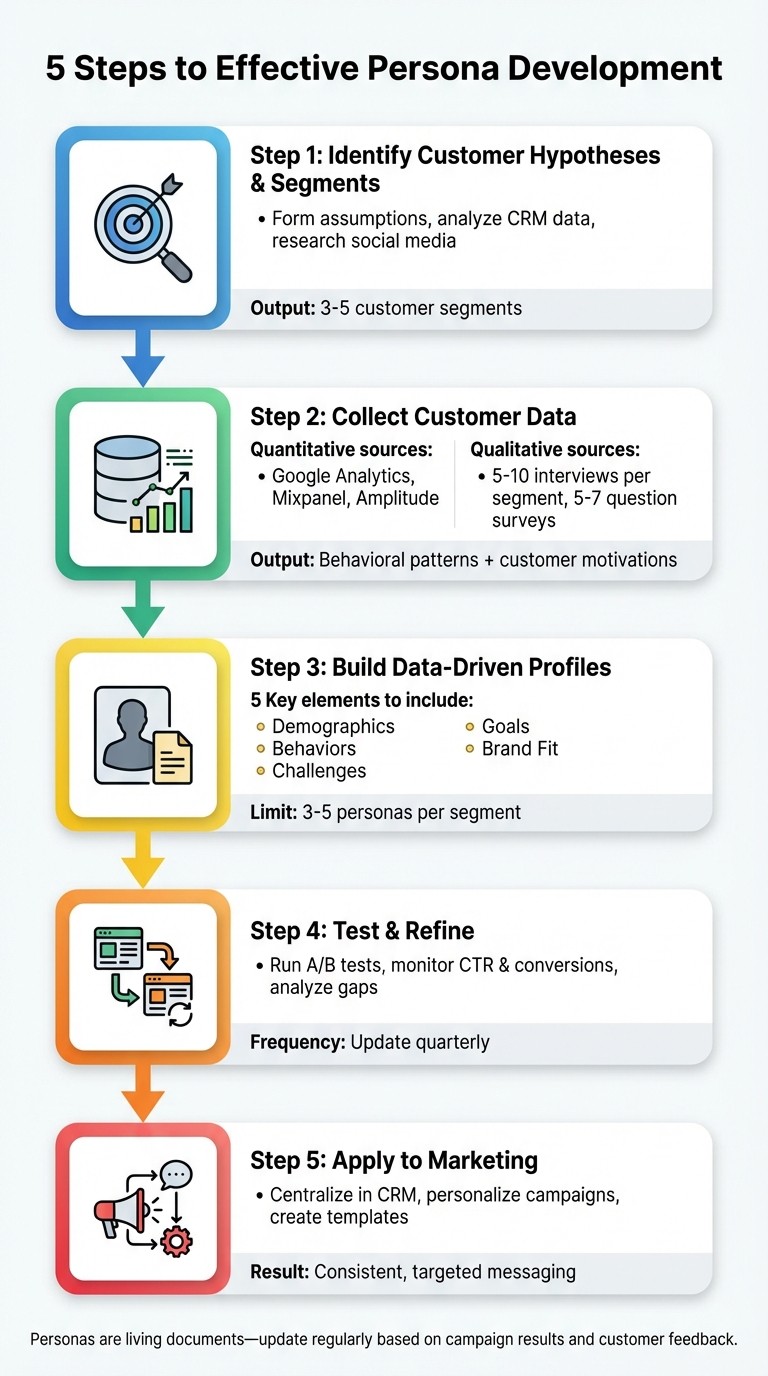
5-Step Persona Development Process for Startups
How to Create A User Persona in 2024 [FULL GUIDE]

Step 1: Identify Your Customer Hypotheses and Segments
Before crafting effective personas, it’s essential to start with a clear idea of who your customers might be. Begin by forming initial assumptions based on your product knowledge, market research, and early customer interactions. These educated guesses will shape your data collection and help you design questions that validate - or challenge - your understanding as real data comes in.
Once you’ve outlined these assumptions, the next step is to translate them into well-defined customer segments by analyzing both existing and potential customer data.
Segment Your Existing and Potential Customers
Start by diving into your current customer data to uncover meaningful patterns. Review CRM records to identify common traits - things like company size, industry, job titles, purchasing habits, or even frequent support inquiries. Even if your data is limited, it can still highlight important trends.
For potential customers, turn your attention to social media and competitor audiences. Look at who’s engaging with content in your industry, the kinds of questions they ask, and the frustrations they voice. Platforms like LinkedIn groups, Reddit threads, and Twitter conversations can reveal authentic language and pain points that might otherwise go unnoticed.
Keep your segments manageable - three to five is ideal. This focused approach ensures you can dedicate time and resources to uncovering the most valuable insights, laying a strong foundation for building detailed, data-backed personas later.
Step 2: Collect Customer Data for Your Personas
Once you’ve defined your segments, the next step is gathering the right data to craft detailed customer personas. The key is to blend hard numbers with personal insights - quantitative data tells you what your customers are doing, while qualitative feedback helps you understand why they behave that way. For smaller or lean teams, this doesn’t mean launching massive research efforts. Instead, focus on being intentional with your tools and questions. Below, we break down how to approach both quantitative and qualitative methods effectively.
Leverage Analytics Tools for Quantitative Data
Your existing tools can provide a wealth of actionable insights. For example, Google Analytics can show how users navigate your website - what pages they spend the most time on, where they drop off, and which content drives them to take action. You can also dig into demographic details like age, location, and device usage, as well as behavioral patterns such as session duration or return visits.
If you’re tracking product usage, platforms like Mixpanel or Amplitude can help you understand which features resonate most with users and where they might be running into issues. For instance, if a particular group of users completes onboarding faster than others, that behavior could reveal valuable insights. Similarly, if 30 users from the same industry repeatedly request a specific feature, it’s a clear sign of an unmet need.
Dive Deeper with Customer Interviews and Surveys
While analytics can pinpoint trends, direct conversations with customers provide the context behind those numbers. Aim to interview five to ten people from each segment to identify recurring themes. Keep the conversations relaxed and open-ended - ask about their daily challenges, the solutions they’ve tried before, and what success looks like from their perspective.
For surveys, brevity is key. A short set of five to seven targeted questions can yield meaningful results. Focus on uncovering motivations and obstacles with questions like, “What almost stopped you from signing up?” or “What’s the biggest problem you’re trying to solve right now?” If you record interviews (with permission), you’ll capture the exact words and phrases your customers use, which can later shape your messaging and tone in marketing efforts.
Step 3: Build Data-Driven Persona Profiles
With your quantitative and qualitative data in hand, the next step is to transform those findings into structured persona profiles that can steer your marketing strategies. This is the stage where raw information evolves into practical, actionable insights. To make this process efficient, consider using AI tools to analyze and synthesize your data.
Leverage AI for Smarter Data Analysis
Sorting through data manually is not only time-consuming but also prone to bias. AI platforms can seamlessly integrate information from various sources - like CRM records, survey results, website analytics, and interview transcripts - into a unified, searchable system. This approach helps you uncover patterns that might otherwise go unnoticed, such as shared pain points across customer groups or similarities in behavior among certain demographics.
For instance, AI tools can enrich incoming leads by pulling in firmographic details, job titles, and company data, then analyze this information to pinpoint traits that align with your top-performing customers. Tools like Averi AI allow you to input your data and extract insights into customer behaviors, goals, and challenges. They can even connect what customers say during interviews to what they do when interacting with your product, ensuring your personas are rooted in both qualitative narratives and hard data. Once you've gathered these insights, it's time to organize them into clear, actionable profiles.
Crafting Effective Persona Profiles
A well-rounded persona profile includes five key elements:
Demographics: Age, location, job title, and company size.
Behaviors: How they research solutions, their preferred communication channels, and purchasing habits.
Challenges: The specific problems they’re looking to solve.
Goals: What success means to them and how they measure it.
Brand Fit: Why your product or service is the ideal solution for their needs.
To maintain focus, limit your personas to three to five per segment - enough to represent your core audience without overwhelming your strategy.
Humanize each persona by assigning them a name and a short narrative. For example, you might create "Startup Sarah", a 32-year-old marketing manager at a 15-person SaaS company. Sarah juggles five tools, works with a $3,000 monthly budget, and needs to demonstrate ROI to her CEO within 90 days. This level of detail helps your team ask questions like, "Would this campaign resonate with Startup Sarah?" during planning.
Store these profiles in your Brand Core or central repository, ensuring they’re accessible for all marketing efforts. As campaigns roll out and more customer data becomes available, revisit and refine these profiles to keep them relevant and effective.
Step 4: Test and Refine Your Personas
Once you've built your persona profiles using data, it's time to put them to the test. Testing personas in live campaigns allows you to see how well they align with actual customer behavior and adjust them as needed. This step ensures your personas are grounded in reality, not just assumptions.
Validate Personas Through Targeted Campaigns
Start by running A/B tests that focus on key traits of your personas, such as prioritizing speed versus cost efficiency. Use multiple channels - like email campaigns or social media ads - and monitor metrics such as click-through rates and conversions. The persona that generates more engagement provides a clearer reflection of what drives your audience. These insights will help fine-tune your profiles for better accuracy.
AI-powered platforms can make this process faster and more efficient. Instead of spending weeks creating content manually, tools like Averi AI can generate tailored emails, landing pages, and social posts for each persona in just seconds. This allows you to run multiple tests quickly, helping you refine your assumptions without stretching your budget.
Update Personas Based on Campaign Results
Once you've gathered campaign data, use it to adjust your persona profiles. Analyze performance metrics to identify gaps. For instance, if a persona segment shows low engagement, look deeper - are users clicking but not converting? Are they leaving immediately? Use this information to tweak demographics, messaging, or pain points. For example, if your "budget-conscious" persona responds better to ROI-focused messaging than cost-saving language, update their profile to reflect this preference.
Keep in mind that personas should evolve over time. As your product and market change, so will your audience. Treat your personas as living documents, updating them regularly based on campaign results, customer feedback, and new data. Store these updated profiles in a shared repository, such as your Brand Core, so your entire team operates with the same understanding of your target audience.
Step 5: Apply Personas to Your Marketing Workflows
Now that you’ve developed detailed, data-driven personas, it’s time to ensure they’re put to work in your marketing efforts. Personas are only as effective as their application. If they’re not integrated into your daily workflows, you risk creating content that feels generic and misses the mark for your audience.
Centralize Persona Data for Easy Access
Store all persona-related data in one central location, such as your CRM, a knowledge base, or a tool like the Averi AI Library. This ensures your team has consistent, easy access to customer insights whenever they’re working on content or strategy. When everyone pulls from the same source, it becomes much simpler to create materials that align with your audience’s needs.
For even greater efficiency, consider platforms with strong integration features. These systems can transfer persona data directly from your CRM into content creation tools, minimizing manual input and keeping messaging consistent across all channels.
With personas centrally stored, you’re ready to use them effectively.
Personalize Campaigns with Persona Insights
Leverage your personas to craft campaigns and content that speak directly to each audience segment. Feed persona insights into AI tools to create tailored messaging. For instance, if one persona values quick results, highlight fast implementation and time-saving benefits. If another is focused on ROI, emphasize measurable outcomes and cost efficiencies.
AI can also help scale this personalization. Instead of manually writing separate emails or social posts for each audience, AI-powered workflows can generate content that’s hyper-relevant to each persona. Whether you’re working on Account-Based Marketing strategies, blog posts, or social media plans, this approach ensures your messaging resonates.
To maintain focus, establish templates and processes that reference specific personas. By aligning every campaign with these insights, you’ll ensure your marketing stays consistent and firmly rooted in what your customers care about most.
Conclusion: How to Get Started with Persona Development
A Quick Recap of Persona Development
Creating customer personas doesn’t have to feel like an uphill battle. Start by forming initial hypotheses about your audience using tools like Lean Canvas. Then, back these assumptions with real data - both numbers and customer stories. AI tools can help you turn this information into detailed persona profiles, capturing key details like demographics, challenges, goals, and behaviors. Test these personas through focused campaigns to see if they resonate and adjust them based on what drives actual results. Once they’re fine-tuned, weave these personas into your marketing efforts, ensuring they shape every piece of content and campaign. Begin with a small, manageable approach and refine your profiles as more data becomes available.
But creating personas is just the beginning - keeping them relevant over time is equally important.
Keeping Your Personas Fresh and Relevant
Once your personas are built, regular updates are vital to staying in sync with your audience. Aim to review and refresh persona data every quarter. This helps you stay ahead of changes in customer behavior, new challenges they might face, or the emergence of entirely new segments.
Leverage AI-powered platforms to make this process easier. These tools can continuously analyze customer insights and alert you when updates are needed, eliminating the need for constant manual effort. By automating persona maintenance, you ensure your profiles stay accurate and your marketing stays effective.
Platforms like Averi AI can serve as a central hub for your persona data, keeping everything organized and accessible for your team. Whether you’re crafting content or planning a campaign, having up-to-date customer insights at your fingertips ensures your strategies hit the mark every time.
FAQs
What are the biggest mistakes startups make when developing customer personas?
Startups often stumble into a few common traps when crafting customer personas. A frequent misstep is leaning too much on assumptions rather than grounding decisions in actual data. This approach risks producing personas that don’t accurately represent the intended audience. Another issue arises when startups overlook the importance of including a variety of customer segments, leading to a limited or skewed view of the market.
On the flip side, some personas are too generic, making them ineffective tools for shaping marketing or product strategies. Another all-too-common mistake is failing to revisit and refresh personas regularly. Customer behaviors and preferences evolve, and outdated personas can leave teams out of sync with their audience.
The solution? Rely on data to build personas that genuinely reflect your customers, and make it a habit to review and update them periodically to stay aligned with shifting trends and needs.
How often should startups revisit and update their customer personas?
Startups need to revisit and refine their customer personas every 3 to 6 months. This helps them stay in tune with shifting customer preferences, emerging market trends, and evolving business objectives.
For startups, this practice is especially crucial since their target audience and market landscape often change quickly. By regularly updating personas, teams can base their decisions on current data, fine-tune their messaging, and adjust strategies to support growth effectively.
What are the best tools for automating persona development and upkeep?
AI-driven platforms such as Copy.ai, GTM AI, and tools equipped with AI copilots are transforming how brands approach persona development. These technologies can handle tasks like automating research, analyzing customer data, and crafting detailed customer profiles on a large scale. They also excel at keeping personas relevant by updating insights as fresh data becomes available.
For startups, these tools are a game-changer. They streamline workflows, enhance precision, and ensure personas stay aligned with marketing and growth strategies - all while being manageable for lean teams with limited resources.