Jan 13, 2026
How to Scale Your Marketing Without Hiring a Full Team for Ecommerce Brands

Averi Academy
Averi Team
8 minutes

In This Article
Use AI and automation to run email, SMS, and ad workflows, boost conversions, and save hours—scale ecommerce marketing without hiring a full team.
Updated:
Jan 13, 2026
Don’t Feed the Algorithm
The algorithm never sleeps, but you don’t have to feed it — Join our weekly newsletter for real insights on AI, human creativity & marketing execution.
Scaling your ecommerce marketing doesn’t require a large team - it requires smarter systems. By automating repetitive tasks like email flows, ad optimization, and customer segmentation, you can achieve the results of a full marketing department without the hefty overhead.
Here’s the key takeaway: AI-powered tools save time, improve efficiency, and drive conversions. For example, brands using automation report 2–3x higher engagement, 20% better conversion rates, and save 2.5 hours daily on average. With the right setup, you’ll focus on strategy while the tools handle execution.
Key Steps to Scale Without Hiring:
Identify time-consuming tasks: Audit your weekly marketing activities to find areas for automation.
Set clear goals: Align automation efforts with measurable targets like higher conversion rates or increased average order value.
Leverage AI tools: Use platforms like Klaviyo, GetResponse, or Omnisend to automate email, SMS, and ad workflows.
Track and optimize: Monitor performance metrics in real-time and let AI systems adjust campaigns automatically.
By following these steps, you can reduce manual work, grow your business, and focus on what matters most - delivering value to your customers.
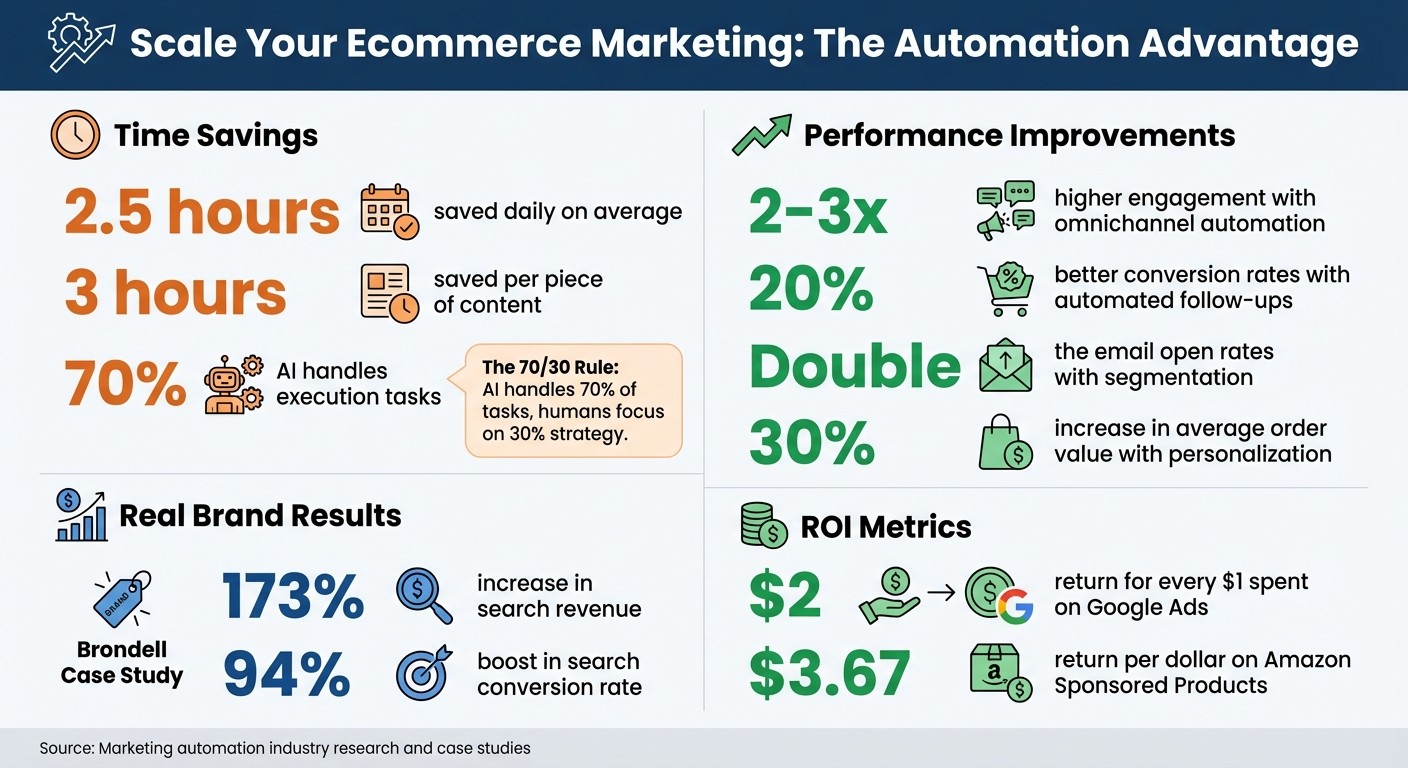
Key Statistics for Scaling Ecommerce Marketing with Automation
How AI is Revolutionizing eCommerce Marketing Automation - EP 42
Evaluate Your Marketing Needs and Identify Gaps
Before diving into automation, take a step back and examine how your time is currently spent. Identify tasks that don’t directly contribute to revenue. Start by listing all the marketing activities you manage in a typical week - things like creating content, running email campaigns, tweaking ad settings, segmenting customers, generating performance reports, and scheduling social media posts. Track the hours each task consumes and assess whether it actively drives revenue. This exercise will help you pinpoint where automation can make the biggest impact.
Review Your Core Marketing Tasks
Breaking your tasks into categories can help uncover opportunities for automation. Consider organizing them into three tiers:
Tier 1: Tasks that require human creativity and judgment, such as strategic planning, brand positioning, and building relationships, should stay hands-on.
Tier 2: Tasks like drafting content, designing campaigns, or analyzing data can be partially automated. AI can handle up to 70% of these processes, leaving you to fine-tune the results [1].
Tier 3: Repetitive, time-consuming tasks - like scheduling posts, pulling metrics from tools like Google Analytics or Klaviyo, and adjusting bids - are perfect for full automation.
Some common roadblocks in marketing include manual customer segmentation, reactive ad optimizations, and compiling reports. For instance, Brondell integrated AI with BigCommerce and saw their search revenue jump by 173% and conversions improve by 94% [3]. Similarly, automating tasks like abandoned cart recovery can save hours each day. Tools like Klaviyo, which use behavior-triggered flows, have been shown to double email open rates [2].
Define Your Marketing Goals
To ensure your automation efforts align with your broader business objectives, set SMART goals - specific, measurable, achievable, relevant, and time-bound. Swap vague aspirations for concrete targets, such as "recover 15% of abandoned carts within 30 days" or "increase website traffic by 65% in three months", as Linz Shop successfully demonstrated [3]. Research shows that automated, targeted follow-ups can lead to 20% higher conversion rates compared to manual outreach [4].
Focus on revenue-driving priorities, like boosting average order value by 30% using personalized product recommendations, cutting customer acquisition costs, or improving retention through win-back campaigns [2]. Keep tabs on metrics like conversion rates, email open rates, and customer lifetime value in real time. Predictive AI tools can even help forecast churn or optimize inventory management [5]. By clearly linking your goals to automation, you’ll avoid digitizing inefficient processes and instead focus on tasks that truly drive results.
Use AI Tools to Automate Marketing Operations
Once you've pinpointed where automation fits into your strategy, the next step is finding tools that work smoothly with your operations. Think of AI as your co-writer, not a replacement. Many successful brands rely on AI to handle the first 70% of content creation, saving an average of 3 hours per piece and 2.5 hours daily. This leaves the final 30% - the critical touch of brand voice and strategic insight - for human refinement [1]. This division of labor not only reduces manual effort but also boosts efficiency. Now, let's dive into how AI can simplify planning and speed up content creation.
Automate Content Planning and Strategy
AI tools can analyze your website's data to craft content calendars, develop SEO strategies, and even conduct competitor analysis. Platforms like Averi can generate full marketing plans by examining your site's metrics, predicting trends, and offering optimized schedules - similar to how Klaviyo utilizes data for predictive flows [2][5]. Instead of spending hours researching keywords or keeping tabs on competitors, AI continuously monitors your market. It identifies high-potential topics, tracks industry trends, and organizes content ideas into categories like how-to guides, comparison pieces, and listicles. All you need to do is review and approve the suggestions, transforming what used to take a week into a quick 10-minute decision. This streamlined planning naturally paves the way for faster content production.
Create Content Faster with AI
When it comes to drafting blog posts, product descriptions, or ad copy, AI can significantly cut down the time spent on initial drafts. To ensure quality, feed your brand guidelines into the tool, let AI produce the first version, and then refine it to match your tone and style. Tools like Klaviyo's AI copilots adapt messaging based on your brand's voice, helping you achieve higher engagement without requiring complete rewrites [5][10]. In a single session, you can generate a month's worth of social media posts or multiple ad variations. A quick human review ensures everything aligns with your brand before publishing.
Connect AI Tools to Your Existing Platforms
Integrating AI tools directly with platforms like Shopify, Webflow, or WordPress eliminates the need for manual content transfers. This setup involves linking your AI tool via API, mapping critical data fields, and setting up direct-publish rules. Klaviyo, for example, seamlessly integrates with Shopify to enable behavior-triggered content workflows, saving significant time [2][4]. Other tools like GetResponse and Omnisend offer native ecommerce integrations, starting at $13.30 per month or even with free plans, syncing product catalogs and order data for automated content generation [6][9]. Businesses using these AI-driven workflows often see up to 20% higher conversion rates from targeted content and a 30% boost in average order values through personalized recommendations [2][4].
Automate High-Impact Marketing Channels
Once your AI tools are integrated with your platforms, the next step is to streamline the channels that generate the most revenue. For most ecommerce brands, email, SMS, and paid ads are the heavy hitters. These channels not only deliver quick results but also tend to be the most time-intensive when managed manually. Fortunately, they’re perfectly suited for automation. Let’s explore how to automate email/SMS flows and paid ads to see immediate results.
Build Email and SMS Automation Flows
Behavior-triggered flows are a game-changer for cutting down repetitive tasks. Automate sequences like abandoned cart reminders, post-purchase follow-ups, and re-engagement campaigns. These flows can trigger automatically based on actions like browsing, adding items to a cart, or making a purchase - all while pulling the necessary data without manual input [2][4].
Batch creation is another way to save time. With AI, you can draft an entire quarter’s worth of email campaigns - such as welcome series, win-back emails, or product launch announcements - in just a single afternoon. Once created, schedule them for automated delivery. Your role shifts from weekly content creation to simply reviewing and approving, making the process far more efficient [1].
Automated segmentation ensures your customer lists stay up to date. Set rules once - like grouping customers who’ve purchased in the past 90 days, VIP buyers who’ve spent over $500, or first-time visitors who didn’t convert - and the system will automatically adjust these lists. With these dynamic segments in place, you’ll have the foundation to seamlessly transition into optimizing paid ad campaigns.
Automate Paid Ad Management and Tracking
Paid ads, much like email and SMS, thrive on automation. Managing bids, creative assets, attribution, and budgets manually is time-consuming, but automation tools can handle these tasks in real time. Start by syncing your CRM contact lists directly to platforms like Google Ads, Meta, and LinkedIn. Tools such as Zapier (starting at $29.99/month) or Make (starting at $10/month) make this connection seamless, enabling retargeting without the hassle of manual exports or outdated audience data [12].
AI-driven systems take it further by automatically A/B testing ad creatives and landing pages, adjusting bids based on performance triggers. For instance, if your return on ad spend (ROAS) drops below a certain threshold, the system can pause underperforming ads and reallocate the budget to those performing well. These optimizations are critical, especially when you consider that Google Ads typically generate $2 for every $1 spent, while Amazon Sponsored Products deliver $3.67 per dollar [11].
"If you don't track numbers, you're not doing marketing – you're just posting on the internet and hoping for the best." – Aliaksandr Vlasenka, Head of Marketplace Growth, Netpeak [11]
Consolidated dashboards simplify performance tracking by aggregating data from platforms like Google, Meta, and Amazon. These dashboards highlight key metrics, flag anomalies, and eliminate the need to log into multiple accounts [1]. Additionally, tools that integrate with lead ad submissions - such as Facebook Lead Ads - can automatically update your CRM, send SMS follow-ups, and notify your team via Slack [12].
The ultimate goal is to move from reactive management - where you’re constantly checking dashboards and tweaking bids - to a proactive system. Let automation handle the heavy lifting, alerting you only when human input is genuinely needed. This allows you to focus on strategy while the system optimizes itself in the background.
Track Performance and Improve Using Data
Success in automation hinges on leveraging real-time performance data. For ecommerce brands operating with lean resources, this means creating dashboards that automatically highlight key insights and establishing optimization loops to fine-tune campaigns. These efforts build on earlier steps to streamline your marketing channels.
Monitor Campaign Results
Tracking performance data is essential for refining your AI-driven workflows. By connecting analytics platforms to a unified dashboard, you can monitor key metrics like content rankings, clicks, and impressions in real time. Tools such as Averi's analytics make this process seamless, helping you spot underperformers early. For instance, if a blog post garners over 10,000 monthly impressions but maintains a click-through rate (CTR) below 2%, it’s a clear sign to revisit elements like the headline or meta description [2][4]. This kind of automated tracking has enabled brands to improve conversion rates by addressing weak points, such as high-traffic abandoned cart pages with low completion rates [2][4].
Keeping an eye on CTR and content rankings allows you to quickly identify gaps and make adjustments. Take Brondell, for example - an ecommerce brand that integrated AI-powered analytics with BigCommerce. By closely monitoring onsite performance and acting on the data, they achieved a 173% increase in search revenue and a 94% boost in search conversion rate [3]. These real-time insights naturally feed into automated systems, further driving campaign success.
Set Up Automated Optimization Systems
Once your performance tracking is in place, the next step is building systems that respond dynamically to the data. Platforms like GetResponse (starting at $13.30/month) and Drip allow you to run A/B tests on email timing and subject lines, automatically adjusting based on open rates and engagement metrics [7][8]. Users of Drip, for example, report a 30% increase in average order values thanks to automated personalization, which tweaks offers in real time for less engaged segments [2][4].
Automation also enables you to set triggers for ad campaigns. For example, you can pause ads if the cost-per-click (CPC) exceeds $5.00 or if the return on ad spend (ROAS) falls below a set threshold, reallocating budgets to better-performing campaigns. Clearly define which decisions your AI tools will handle - such as routine bid adjustments - and which require your input, like major strategic shifts.
"Automation won't just trigger messages; it'll generate and evolve them", says Ben Zettler, a marketing automation expert [5].
George Tselios adds, "The gap in 2026 will be between brands with data and those guessing", recommending brands collect data from 5-7 touchpoints to enable effective segmentation in tools like Klaviyo [5].
The ultimate aim is to create a closed-loop system, where analytics seamlessly feed into optimization tools that refine campaigns automatically. This setup turns data into actionable improvements, allowing you to focus on reviewing weekly summaries, approving significant changes, and shaping long-term strategy - while your marketing essentially runs itself.
Conclusion
Growing your ecommerce marketing efforts doesn’t have to mean working harder - it’s about working smarter with automation. By identifying gaps and leveraging AI for tasks like content creation, campaign management, and automated workflows, you can achieve the results of a full marketing team at a fraction of the cost. The numbers back this up: businesses using segmentation report double the open rates, while omnichannel automation leads to 2–3x higher engagement [2]. Take Brondell, for example - they saw a 173% jump in search revenue and a 94% boost in conversion rates by incorporating AI-powered tools and integrations [3]. These results show the potential of this approach and set the stage for actionable steps.
One key strategy is the 70/30 Rule: let AI handle 70% of repetitive, execution-heavy tasks - like first drafts, data analysis, and scheduling - while reserving 30% for human expertise in strategy and creativity [1]. This blend of automation and human input saves marketers an average of 2.5 hours daily and 3 hours per piece of content [1]. Experts agree this shift is critical: as automation evolves, the competitive edge by 2026 will belong to brands that leverage data effectively, leaving guesswork behind [5].
To put this into practice, start with these steps:
Audit your tools: Review your current marketing stack and experiment with free trials of platforms like Omnisend for multi-channel automation [9].
Implement quick wins: Set up abandoned cart and product recommendation workflows - automated follow-ups alone can increase conversion rates by 20% [4].
Leverage AI tools: Use platforms like Averi to simplify content planning and creation, or try GetResponse (starting at $13.30/month) for A/B testing and optimization [7].
Scale with advanced features: As your systems mature, incorporate predictive segmentation, self-adjusting campaigns, and dashboards that highlight performance insights automatically.
The brands that excel in 2026 will rely on AI as their co-pilot, combining privacy-first personalization with seamless omnichannel experiences. They won’t need larger teams; they’ll need smarter systems. With the right mix of automation and human oversight, you can achieve steady growth, reduce churn, and reclaim valuable time to focus on what truly matters - building your product and serving your customers. The tools are in place, and the strategy is proven. Now’s the time to scale your marketing.
FAQs
What’s the best way to decide which marketing tasks to automate first?
To figure out which marketing tasks to automate first, start by listing all the recurring activities you handle regularly. These might include creating content, scheduling social media posts, or generating reports. Focus on tasks that are repetitive, time-intensive, and don’t need much creative input - like drafting variations of ad copy or compiling analytics data.
Then, take a close look at how much time and money each task requires. Prioritize those that offer the biggest potential return on investment. For example, automating processes like ad testing or budget allocation can deliver faster, scalable improvements. Start with one high-impact task, track the time saved and any performance boosts, and use those results to guide your next steps. By beginning with manageable changes and expanding gradually, you can improve efficiency and results without overwhelming your workflow.
What are the best AI tools to help ecommerce brands automate their marketing efforts?
AI tools such as Averi AI offer ecommerce brands a powerful way to streamline their marketing efforts without the need for a full in-house team. This platform integrates key marketing tasks - content creation, ad design, campaign management, and performance tracking - into one cohesive system. By doing so, brands can launch and manage campaigns more efficiently. Averi AI also leverages advanced AI-driven workflows to handle tasks like testing ad variations, optimizing budgets, and pinpointing the best-performing creatives automatically.
Beyond tools like Averi AI, ecommerce businesses can also tap into AI-powered workflow solutions to simplify multi-channel campaign management, delegate tasks, and analyze data effectively. These tools help maintain consistent messaging across platforms while automating time-consuming tasks, cutting down on both effort and costs. Together, these AI-driven resources provide a scalable way to grow marketing operations without the need for a large team.
How can I ensure my AI-driven marketing aligns with my business goals?
To ensure your AI-driven marketing efforts align seamlessly with your business goals, think of automation as a living, adaptable system rather than a one-and-done solution.
Begin by setting specific goals and measurable KPIs. For instance, if your aim is $250,000 in monthly revenue or achieving 15% year-over-year growth, break these down into actionable metrics like return on ad spend (ROAS), customer acquisition cost (CAC), or conversion rates. A shared dashboard can be invaluable here, giving you and your team a real-time view of progress and keeping your AI efforts focused.
Next, craft AI workflows designed around your objectives. Integrate your AI tools with platforms like your CRM, ad networks, and analytics systems. This connection allows your AI to adapt campaigns on the fly, using performance data to concentrate on strategies that deliver results.
Lastly, prioritize human oversight where it matters most. Regularly review AI-generated content, such as ad copy or audience targeting, to ensure it aligns with your brand’s voice and overall strategy. By blending automation with human input, you can keep your marketing efforts both efficient and strategically aligned with your business goals.