Jan 12, 2026
How to Scale Your Marketing Without Hiring a Full Team for Media & Entertainment

Averi Academy
Averi Team
8 minutes

In This Article
How media and entertainment teams can scale marketing without hiring a full staff by using AI, automation, and a single workspace to cut costs and boost efficiency.
Updated:
Jan 12, 2026
Don’t Feed the Algorithm
The algorithm never sleeps, but you don’t have to feed it — Join our weekly newsletter for real insights on AI, human creativity & marketing execution.
Scaling your marketing efforts in the media and entertainment industry doesn't have to mean hiring a large team. By leveraging AI and automation, small teams can handle high-volume campaigns, cut costs, and boost efficiency. Here’s a quick summary of how to do it:
Automate repetitive tasks with marketing automation tools: Use AI for audience segmentation, content creation, scheduling, and performance tracking.
Centralize workflows: Manage campaigns with a single workspace to reduce tool-switching and streamline collaboration.
Combine AI and human expertise: Let AI handle data-heavy tasks while your team focuses on strategy and approvals.
Reduce costs: Replace full-time hires with AI tools and on-demand experts, saving up to 50% on marketing budgets.
AI tools like Averi and platforms like HubSpot or Adobe Experience Cloud make it possible to launch more campaigns with fewer resources. Start by automating common tasks, measure time saved, and gradually expand to more complex workflows. This approach allows you to focus on storytelling and big-picture goals while AI handles the heavy lifting.
Identifying Your Marketing Workflows
Common Marketing Workflows in Media and Entertainment
Media and entertainment companies juggle a variety of marketing workflows, each with its own rhythm and level of complexity. For instance, launching a film, TV show, or streaming series involves a blend of audience research, strategic positioning, and asset planning - think trailers, key art, and promotional materials. Add to that the coordination of content production, channel strategies across social media, email, paid ads, and PR, followed by campaign execution and performance tracking. When it comes to live events like concerts, festivals, or sports, the process shifts to market analysis, ticketing strategies, pre-sale announcements, phased promotions (like teasers and lineup reveals), influencer partnerships, real-time event coverage, and post-event marketing.
Streaming platforms and OTT services, on the other hand, operate on continuous workflows. These include onboarding new titles, segmenting audiences, creating multiple versions of assets (such as thumbnails or trailers), pushing campaigns through owned channels like in-app notifications and emails, and managing paid acquisition, personalization, and retention efforts. Gaming launches focus heavily on community engagement via platforms like Discord, Reddit, and Twitch, followed by alpha and beta testing invites, developer updates, live launch events, in-game activities, and reactivation campaigns. Music releases bring their own unique cadence - pre-save campaigns, teaser clips on platforms like TikTok and Instagram Reels, playlist pitching, release-day promotions, user-generated content challenges, and extended engagement through remixes and collaborations.
Understanding these diverse workflows is key to deciding how to divide tasks between human expertise and AI-driven automation.
Which Tasks Need Humans vs. Which Can Be Automated
The divide between tasks requiring human creativity and those suited for AI is more defined than many might think. Humans thrive in areas demanding strategic thinking, creativity, and relationship management. For example, crafting brand and campaign strategies - like defining audience priorities, shaping narratives, or setting positioning strategies - requires human judgment. Similarly, high-level creative work, such as developing the visual identity for a new series or festival or creating emotionally resonant long-form content, is best handled by people. Tasks like managing relationships with talent, influencers, and sponsors, handling crises or reputation issues, and making final editorial decisions on major creative assets also demand human expertise.
AI, on the other hand, shines in data-heavy, repetitive, or rules-based tasks. It can efficiently handle audience segmentation by analyzing behavior and engagement data, personalize content recommendations, and run A/B testing on creatives and messaging. AI also plays a key role in campaign pacing, bid optimization, and repurposing content - such as breaking down trailers into shorter clips or generating multiple versions of copy. It can enrich metadata and streamline performance reporting by consolidating data from various sources. While AI lays the groundwork and offers options, humans step in to make nuanced decisions and address unique scenarios.
Using a Single Workspace to Manage Everything
Bringing these varied workflows and task assignments together becomes far more manageable with a centralized workspace. A unified platform allows teams to plan, execute, and measure campaigns seamlessly from start to finish. For media and entertainment professionals, this means having access to centralized briefs and templates that outline objectives, KPIs, timelines, and budgets. It also includes an organized asset library to store trailers, key art, logos, scripts, and compliance-approved copy, all with version control. Workflow and approval pipelines ensure smooth collaboration, with clear tracking and designated approvers, such as talent representatives or legal teams.
Integrated performance dashboards pull data from multiple sources - social media platforms, email campaigns, ad channels, and streaming services - into a single view, eliminating the need to toggle between tools. This setup reduces unnecessary context switching and boosts efficiency. Acting as a coordination hub, the workspace connects existing systems like CMSs, CRMs, and ad platforms, ensuring that when human experts step in, they have everything they need at their fingertips - briefs, assets, brand guidelines, and performance insights. In the fast-paced world of media and entertainment, where campaigns span multiple formats, channels, and stakeholders, this level of coordination can make all the difference in hitting the market quickly and effectively.
Setting Up AI-Powered Workflows
Converting Manual Tasks to Automated Processes
Start by documenting your current workflow and identifying tasks that can be automated. For media and entertainment teams, this often includes organizing audience lists, scheduling posts, and sending follow-up emails. Once you've outlined the steps, determine the triggers and conditions that will activate each automated workflow. Examples might include a user watching 75% of a trailer, adding a new title to your catalog, or a subscriber staying inactive for 30 days.
Platforms like Averi, HubSpot, or Adobe Experience Cloud allow you to build these workflows by setting up sequences that automatically guide users through multi-step processes. For instance, if someone watches most of a trailer but doesn't convert, the system could send a teaser email, follow up with an SMS reminder two days before the release, push a notification on launch day, and recommend similar titles a week later based on their genre preferences and viewing history. AI-generated content and personalized recommendations can be integrated at every stage, leveraging behavioral data like past viewing habits, device usage, and customer lifetime value. This creates a "release machine" that operates seamlessly, saving your team from manually managing each campaign step while ensuring timely and relevant outreach. Once these workflows are in place, human oversight becomes essential to maintain quality and compliance.
Combining AI Output with Human Review
The best approach combines AI for speed and scale with human expertise for precision and creativity. AI can draft campaign briefs, complete with objectives, audience insights, sample messages, and channel suggestions, by analyzing past performance and current audience data. It can also generate multiple content variations - email subject lines, social media posts, ad copy, and push notifications - tailored to different viewer preferences and engagement levels.
Humans step in to validate and refine this output. Strategists review AI-generated goals, fine-tune audience definitions, and decide which concepts to pursue. Editors polish the language, ensure cultural appropriateness (avoiding spoilers, respecting U.S.-specific references, and handling sensitive topics), and confirm compliance with legal standards, such as content ratings and data privacy requirements. After launch, AI monitors performance metrics like open rates, conversions, and churn impact, offering suggestions for adjustments or budget shifts. This partnership allows AI to handle repetitive tasks and massive data analysis while humans focus on creative direction, positioning, and risk management - critical for high-stakes entertainment campaigns.
Tools That Support Marketing Automation
Various marketing automation platforms like HubSpot and Adobe Experience Cloud provide scalable solutions for orchestrating user journeys and analyzing results, while Averi offers a more integrated approach.
Averi combines AI-driven planning, content creation, and human expertise in a single workspace. Its Brand Core feature stores your brand voice, guidelines, and customer profiles, ensuring the AI maintains consistency across all projects. The Library organizes your marketing plans, past campaigns, and saved content, so every new initiative builds on your existing work. Averi also connects you with vetted experts, eliminating the need to re-brief or juggle multiple tools. This setup is particularly effective for lean media and entertainment teams that need to move quickly without compromising on quality or losing sight of their brand identity across numerous campaigns.
Automating Content and Campaign Execution
Using AI to Create Marketing Content
AI tools have become a powerhouse for generating all kinds of promotional materials that media and entertainment teams rely on, such as social media posts, email sequences, push notifications, ad copy, and landing page text. To ensure the output aligns with your brand, you can guide these tools by providing key inputs like your brand voice, examples of high-performing content, audience details, metadata, and specific campaign goals.
For instance, a U.S.-based streaming service can upload details such as a show’s synopsis, MPAA rating, target demographic (e.g., women aged 25–34), and tone preferences like "witty, punchy, no spoilers" into a platform like Averi. In return, the system generates over 10 variations of captions and email subject lines tailored to that audience. This technique works across multiple channels, whether it’s Instagram captions aimed at Gen Z, detailed email synopses for subscribers over 35, or concise push notifications featuring character names for fans of similar titles. AI takes care of the volume, while an editor fine-tunes the content, ensuring it aligns with U.S. holidays, uses appropriate regional slang, and avoids sensitive topics. This streamlined approach integrates effortlessly into the broader campaign management process.
Running Complete Campaigns from Start to Finish
AI now goes beyond content creation, enabling the smooth execution of entire campaigns from planning to optimization. The process covers every stage: planning, creating content, scheduling, and dynamic adjustments. By analyzing past campaigns and audience behavior, AI suggests the best themes, target audiences, and timing for a new movie, game, or series launch. It even identifies the most effective content formats - like short clips, behind-the-scenes footage, or creator collaborations - and recommends the right platforms, such as TikTok or YouTube Shorts, based on where similar campaigns performed well.
Once the plan is approved, AI drafts copy, selects trailer snippets, and creates thumbnails and taglines. Platforms like Averi serve as centralized hubs, scheduling and optimizing posts across multiple channels while factoring in U.S. time zones and campaign timelines. For example, if a U.S. theatrical release is on the horizon, AI can propose a complete four-week pre-launch calendar, generate all necessary posts and emails, schedule them automatically, and even adjust budgets to amplify high-performing creatives. This level of automation eliminates the need for a large marketing team to manage every detail manually.
Improving Campaign Results with AI Analysis
After a campaign launches, AI doesn’t stop working. It monitors key metrics like engagement, click-throughs, conversions (streams started, tickets sold, subscriptions), and viewing behavior to make real-time adjustments. By analyzing performance, it fine-tunes pacing to avoid ad fatigue, reallocates budgets to top-performing creatives, pauses underwhelming assets like trailers or thumbnails, and identifies new audiences similar to high-value viewers - such as users who binge-watch entire seasons within a week.
AI also simplifies A/B and multivariate testing by generating and rotating variations of email subject lines, thumbnails, headlines, calls to action, and opening hooks. For media and entertainment brands, testing high-impact elements often yields quick improvements. Examples include tweaking email subject lines for premiere announcements, testing trailer thumbnails on YouTube or streaming platforms, experimenting with the first three seconds of social video ads (e.g., different hooks, cast highlights, or quotes), and optimizing calls to action like "Watch tonight", "Add to your list", or "Get tickets now." AI identifies statistically significant differences in open rates, click-through rates, and other engagement metrics, automatically promoting the most effective variants while logging valuable insights. This constant cycle of optimization drives better results without requiring manual analysis or round-the-clock oversight.
Creating an AI-Driven Content Marketing Workflow

Managing Costs: Tools, Teams, and Budgets
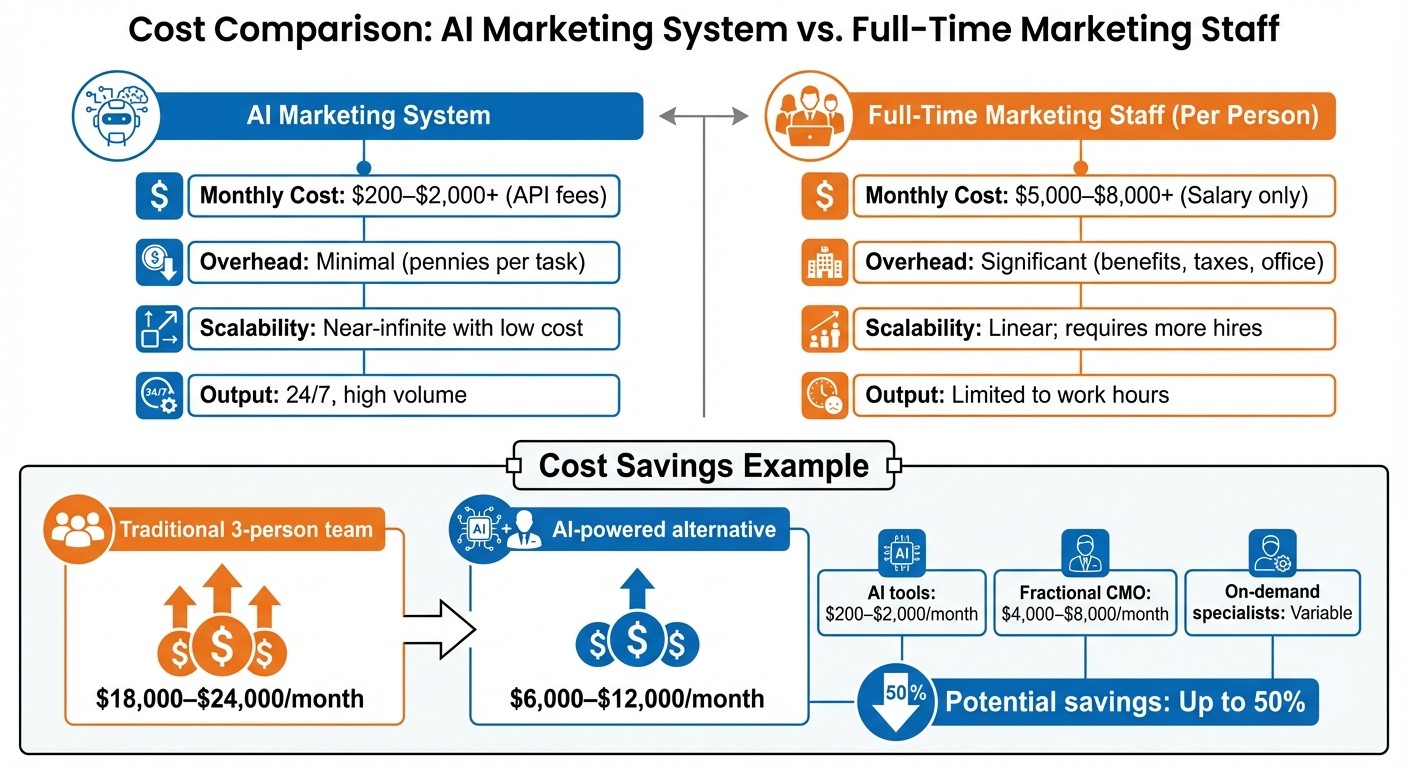
AI Marketing Tools vs Full-Time Staff Cost Comparison
Cost Comparison: AI Tools vs. Full-Time Teams
When it comes to marketing budgets, AI tools offer a clear financial advantage over hiring full-time staff. AI systems typically cost under $2,000 per month, while a single marketing hire comes with a monthly salary of $5,000–$8,000, not including additional expenses like benefits, taxes, and office space. And here’s where it gets even more compelling: AI systems can scale their output with minimal extra cost, whereas human teams require more hires to increase productivity.
For businesses in media and entertainment juggling multiple campaigns, platforms, and releases, this cost structure can be a game-changer. For instance, replacing a three-person team (costing $18,000–$24,000 monthly) with a combination of AI tools ($200–$2,000/month), a fractional CMO ($4,000–$8,000/month), and on-demand specialists could reduce expenses to $6,000–$12,000 monthly - all while maintaining or even exceeding the original team's output.
Cost Factor | AI Marketing System | Full-Time Marketing Staff (Per Person) |
|---|---|---|
Monthly Cost | $200–$2,000+ (API fees) | $5,000–$8,000+ (Salary only) |
Overhead | Minimal (pennies per task) | Significant (benefits, taxes, office) |
Scalability | Near-infinite with low cost | Linear; requires more hires |
Output | 24/7, high volume | Limited to work hours |
This dramatic cost difference supports a gradual shift toward automation.
Adopting Automation in Stages
To make the most of these savings, start automating the tasks that demand the most time. For many media companies, this includes social media scheduling, drafting email campaigns, and compiling performance reports. Begin with these core tasks, measure the time saved, and then expand automation to more complex processes like campaign planning and audience segmentation.
Set aside $1,000–$3,000 per month to test new AI tools without disrupting your primary operations. This budget allows you to experiment with features like voice generation for trailers, prompting strategies for multi-channel campaigns, or automated video categorization for your content library. Once you see what delivers results, integrate those tools into your permanent workflow and use the freed-up funds to explore the next set of possibilities.
Building a Small Team Supported by AI
By combining cost savings with automation, you can create a lean but highly effective marketing setup. Consider adopting a "studio model": a small team of 2–4 core members who oversee brand strategy and approvals, supported by AI tools and freelance specialists. This flexible structure lets you scale up during major campaigns and scale down when things are quieter - without the financial burden of full-time salaries.
Here’s how to allocate your resources smartly: let AI handle repetitive, high-volume tasks like drafting posts, scheduling content, and tracking performance metrics. Meanwhile, your human team can focus on strategy, creative direction, and building relationships with talent, partners, and media outlets. When specialized skills are needed - such as editing a trailer or running a paid ad campaign - bring in fractional experts via platforms like Averi. These specialists can seamlessly jump into projects since they’ll already have access to your brand guidelines, past work, and campaign details. This eliminates the usual back-and-forth, keeping workflows smooth and efficient.
Conclusion
Key Strategies for Scaling Marketing
Scaling your marketing efforts without the need for a large team boils down to three core strategies: workflow automation, a centralized platform, and AI-driven content creation. Automation takes care of repetitive tasks like audience segmentation, scheduling social posts, triggering emails, tagging metadata, and generating performance reports [1][2]. A unified platform eliminates tool overload, reducing the need for additional hires. Meanwhile, AI speeds up tasks like drafting content and refining audience targeting. Together, these strategies streamline operations, making it possible to achieve more with fewer resources.
It's time to embrace a fresh perspective: think of AI and automation as tools that enable a smaller, focused team to outperform larger ones. With 73% of marketing executives already using generative AI [4] and the media industry ranking among the top five sectors ready for automation [3], the shift is well underway. Automating workflows and leveraging AI for content creation and insights not only trims staffing needs but also enhances campaign engagement. By integrating these tools, your marketing can become more consistent, data-driven, and personalized - all without ballooning your budget or team size. This approach allows your team to focus on what truly matters: storytelling, partnerships, and big-picture strategy.
Practical Steps to Begin with AI-Powered Marketing
Now that the strategies are clear, the next step is to put them into action. Start by mapping out your current workflows and identifying 2–3 time-intensive tasks - such as managing social media posts, running email campaigns, or compiling reports. Test an AI platform like Averi to handle these tasks from start to finish. Set measurable goals for the trial, such as tracking weekly time saved, boosting engagement, or lowering acquisition costs, and run the test for 30–60 days. Incorporate human oversight at key points to ensure quality, then gradually expand automation to other areas.
The most effective way to implement AI is to treat it as a collaborative partner. Let AI handle repetitive tasks like segmentation or drafting content, while your team focuses on refining the brand voice and steering the overall strategy. This balance allows you to harness AI's speed and efficiency without compromising creativity or cultural relevance. Companies that hesitate to adopt AI risk falling behind - facing higher costs, slower execution, and less engaging campaigns compared to competitors who embrace these tools. Early adopters, on the other hand, gain a lasting edge as their teams become skilled at blending AI capabilities with human expertise.
Ready to streamline your marketing and scale smarter? Sign up for Averi's AI Marketing Workspace today.
FAQs
How can AI tools like Averi help media and entertainment businesses save on marketing costs?
AI tools, like Averi, are transforming marketing by cutting costs and saving time. They handle tasks that often drain resources, such as transcription, translation, SEO adjustments, and tailoring content for various platforms. This not only reduces the hours spent on manual work but also removes the need to bring on extra staff, speeding up the rollout of campaigns.
By simplifying workflows and taking over repetitive tasks, these AI-driven solutions free up teams to concentrate on more creative and strategic efforts. The result? A smarter allocation of resources and the ability to scale campaigns more effectively.
What tasks are best suited for AI, and which ones need human expertise?
AI shines when it comes to tackling repetitive, data-heavy, and time-sensitive tasks. Think about automating transcription, translation, SEO adjustments, content repurposing, generating ad variations, managing budgets, or scheduling social media posts. By handling these responsibilities, AI not only trims costs but also accelerates workflows, freeing up teams to concentrate on more impactful projects.
On the other hand, tasks that demand creativity, strategic thinking, and brand consistency are where humans truly excel. This includes crafting compelling stories, preserving a brand’s unique voice, interpreting insights generated by AI, and ensuring that content aligns with cultural and contextual nuances. The most effective workflows come from blending AI’s speed and precision with human creativity and judgment, creating a partnership that balances efficiency with thoughtful execution.
How can an AI-powered workspace help media and entertainment companies streamline their marketing efforts?
An AI-powered workspace brings all the moving parts of a media campaign - briefs, assets, approvals, analytics, and distribution - into a single, streamlined hub. Gone are the days of juggling multiple tools and dealing with inefficiencies like data silos or constant platform switching. By centralizing everything, teams save both time and effort.
Automation is another game-changer. Tasks like transcription, translation, SEO tagging, and content resizing can be handled by AI, freeing up teams to focus on what they do best: creativity and storytelling. These AI-driven workflows not only speed up processes but also maintain consistent branding and provide real-time performance insights across platforms like YouTube, TikTok, and Instagram.
With this level of integration, companies can reduce software expenses, manage budgets more effectively, and scale campaigns without the need to expand their teams. For media and entertainment businesses producing high-volume, multi-platform content under tight deadlines, this approach is a perfect fit.
Related Blog Posts
How to Scale Your Marketing Without Hiring a Full Team for Media & Entertainment Companies
How to Scale Your Marketing Without Hiring a Full Team for Consulting Firms
How to Scale Your Marketing Without Hiring a Full Team for Consumer Apps
How to Scale Your Marketing Without Hiring a Full Team for B2B SaaS