Nov 11, 2025
How to Scale Your Marketing Without Hiring a Full Team for Real Estate

Averi Academy
Averi Team
8 minutes

In This Article
Learn how real estate professionals can scale their marketing efforts using AI tools without needing a large team, saving time and costs.
Updated:
Nov 11, 2025
Don’t Feed the Algorithm
The algorithm never sleeps, but you don’t have to feed it — Join our weekly newsletter for real insights on AI, human creativity & marketing execution.
Scaling real estate marketing doesn’t require a large team. By using AI-powered tools, real estate professionals can automate tasks like lead generation, content creation, and campaign management. These platforms save time, reduce costs, and help agents maintain a professional presence while focusing on client relationships.
Key Takeaways:
Unified AI Platforms: Tools like Averi AI centralize workflows, ensuring consistent branding and efficient marketing.
Automation Benefits: AI can handle lead follow-ups, create property descriptions, and manage campaigns, reducing manual effort.
Challenges: Integration and setup require organizing brand assets and learning the system.
This approach allows solo agents and small brokerages to compete with larger firms without the overhead of a full team.
Top 6 A.I. Tools for Realtors in 2025 (And Exactly How to Use Them)

Why Real Estate Professionals Need Marketing Automation
In the fast-paced world of real estate, where every second counts, marketing automation has shifted from being a helpful tool to an essential strategy. With the pressure to manage numerous leads and deliver personalized, immediate responses, real estate agents and brokerages can no longer afford delays. Automation helps professionals scale their efforts without requiring a full team, providing a competitive edge in an increasingly demanding market.
Common Real Estate Marketing Challenges
Real estate professionals face several hurdles when it comes to marketing effectively. Here’s a closer look at the most pressing issues:
Fragmented Marketing Efforts: Many agents rely on a mix of disconnected tools, which makes it difficult to streamline data, align marketing activities, or establish consistent processes. Without a dedicated team to oversee these tools, lead information often gets scattered across platforms, brand messaging becomes inconsistent, and valuable time is wasted switching between systems instead of fostering client relationships [1].
Manual Lead Management: Researching leads, enriching data, and crafting personalized outreach manually can eat up hours - time that could be better spent on property showings or negotiations.
Inconsistent Response Times: Delays in responding to inquiries can mean the difference between closing a deal and losing a client. Quick, reliable communication is critical.
Personalization at Scale: Buyers today expect messages tailored to their unique needs, whether they’re first-time buyers, investors, or families upgrading to a larger home. For solo agents, creating personalized content for multiple buyer personas and market segments can be overwhelming.
AI-powered marketing tools offer solutions to these challenges, automating and simplifying key processes to help agents focus on what they do best - building relationships and closing deals.
How AI Marketing Solutions Address These Problems
AI marketing platforms transform the way real estate professionals manage leads and execute marketing strategies. By automating the lead lifecycle - from the first interaction to conversion - these tools drastically reduce response times and boost efficiency. Instead of manually researching each prospect, agents can leverage AI to instantly gather insights about a lead’s preferences and market interests.
One of the standout benefits of these platforms is Unified Workflow Management. AI-powered systems consolidate multiple tools into a single, streamlined process, automating marketing tasks and standardizing best practices. This is especially valuable for solo agents or small teams managing large volumes of leads. With workflows powered by AI, agents can ensure no lead slips through the cracks.
The results can be transformative. Jean English, Former Chief Marketing Officer at Juniper Networks, highlighted the impact of AI-driven personalization strategies:
"Thanks to Copy.ai, we're generating 5x more meetings with our personalized, AI-powered GTM strategy." [1]
AI also simplifies content creation. From property descriptions to SEO-optimized blogs and social media posts, these platforms generate high-quality drafts quickly, allowing agents to maintain consistent communication with their audience without sacrificing quality or time.
Another game-changer is Intelligent Task Automation, which ensures every lead receives prompt and personalized attention. These systems can automatically schedule follow-ups, send tailored property recommendations, and qualify leads based on predefined criteria. This level of automation doesn’t just save time - it also helps agents deliver a highly personalized experience at scale.
Ashley Levesque, VP of Marketing at Banzai, shared her experience with AI workflows:
"I didn't even know AI workflows were something that I was lacking until someone said, 'Did you know you could do all of this with Copy.ai?'" [1]
For real estate professionals, embracing AI marketing tools means achieving the kind of consistent, professional marketing that rivals larger brokerages - without the need for extensive resources or a full team. The key lies in selecting platforms that seamlessly integrate these capabilities, eliminating the need for patchwork solutions. By doing so, agents can focus on what truly matters: building relationships and closing deals.
Best AI Tools for Real Estate Marketing
Leveraging automation in real estate marketing has never been more accessible. With the right AI tools, agents and agencies can simplify lead generation, content creation, and campaign management. Below, we explore standout platforms designed to elevate real estate marketing efforts, whether you're a solo agent or part of a larger team.
Averi AI: A Unified Marketing Workspace
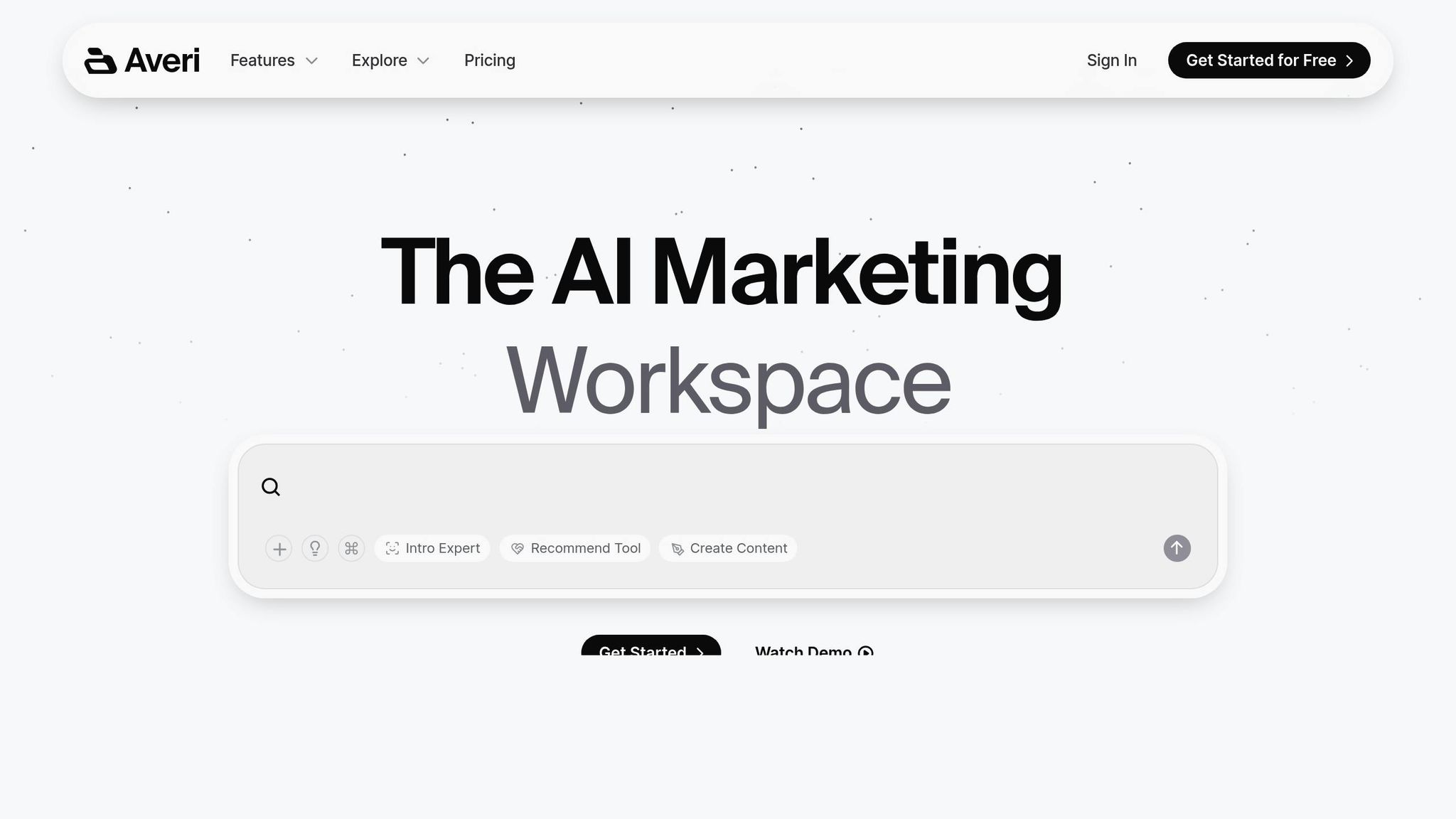
Averi AI takes a unique approach by offering a fully integrated marketing workspace that combines strategic planning and execution. Unlike tools that focus on one specific task, Averi's Synapse system seamlessly connects AI-driven automation with human expertise, ensuring both speed and quality in marketing efforts. This setup directly addresses common challenges like fragmented workflows and inconsistent branding that many real estate professionals face.
The platform employs a Think–Create–Execute–Scale process. Agents start by engaging in strategic discussions with the AI, defining their marketing goals, audience demographics, and brand identity. From there, the system transitions into the /create phase, where users can generate everything from property descriptions to email campaigns and social media posts - all within a collaborative environment.
Averi's Brand Core feature ensures consistent messaging by centralizing key elements like brand voice, mission statements, and customer profiles. This guarantees that whether content is AI-generated or created with human input, it aligns with the brand's identity. For tasks that require a human touch, the Human Cortex feature connects agents with a network of over 2,500 vetted marketing experts, eliminating the need for lengthy onboarding or briefings.
The platform also includes a Library system that stores marketing plans, customer profiles, and past campaigns, allowing agents to build on prior work and save time on future projects. For those new to AI marketing, Averi offers a Free Plan with 200 AI tokens per month, providing full access to the workspace. For more advanced needs, the Plus Plan, priced at $45 per month, includes 1,200 AI tokens, /create mode access, and tools for managing multi-tab campaigns.
Other AI Tools for Real Estate
While Averi provides an all-in-one solution, other AI tools cater to specific marketing needs. For instance, Copy.ai specializes in generating SEO-optimized content, social media posts, and inbound marketing materials - ideal for agents focusing on targeted campaigns.
Choosing the right tool depends on your marketing goals and resources. Solo agents may find an integrated platform like Averi invaluable for streamlining tasks, while larger teams might benefit from pairing specialized tools with their existing systems. Whether you're looking for comprehensive solutions or niche tools, AI offers powerful options to enhance your real estate marketing.
How to Set Up AI Marketing Automation in Real Estate
Implementing AI marketing automation in real estate starts with creating a system that organizes your brand assets and simplifies processes, all without disrupting your current operations. By taking a structured approach, real estate professionals can achieve smoother implementation and quicker results. The first step is to ensure your brand elements are properly organized, setting the stage for effective AI integration.
Step 1: Organize Brand Assets and Guidelines
Your AI tools rely on well-structured brand assets to produce relevant and consistent content. If these foundational elements are disorganized, even the most advanced systems can generate content that feels generic or off-brand.
Gather your logos, color schemes, fonts, photography standards, and templates into a centralized location. This repository should also include documented guidelines for your brand voice. For example, how do you address first-time homebuyers versus luxury property investors? What tone should be used for different types of communications? Defining these nuances ensures your AI tools generate content that aligns with your brand.
Modern platforms, such as Averi, offer specialized features like their Brand Core system, which centralizes voice guidelines, mission statements, and customer profiles. This type of setup ensures consistency across both AI-generated and human-created content.
In addition to these assets, compile customer profiles and market data. Include information about your typical buyers and sellers, as well as details about the neighborhoods you serve. Documenting past campaign results and lessons learned can also be invaluable. This historical data helps train AI systems to understand your market better, enabling them to generate content that is both relevant and effective.
Step 2: Automate Lead Generation and Follow-Up
Automating lead generation can revolutionize how real estate professionals attract and nurture potential clients. The aim is to establish systems that work around the clock, qualifying leads and keeping them engaged without requiring constant manual effort.
Start by integrating automated lead capture tools into your digital platforms. For example, AI-powered chatbots on your website can answer common questions about properties or neighborhoods while simultaneously collecting visitor contact information. Similarly, your social media profiles can be configured to automatically respond to inquiries with useful details and next steps.
AI excels in lead scoring and qualification. Systems can analyze behaviors - such as viewing multiple listings, downloading guides, or engaging on social media - to prioritize follow-ups. For instance, a lead actively engaging with property information would be marked as a higher priority than someone who only fills out a basic contact form.
For follow-up, create personalized email workflows tailored to each lead’s behavior and preferences. A first-time homebuyer, for example, might receive content focused on navigating the buying process, while an investor might get information about market trends. While AI handles the initial stages of engagement, make sure there are clear handoff points for more complex conversations, allowing you or your team to step in when needed. With lead generation streamlined, you can shift your focus to producing and managing impactful content.
Step 3: Automate Content Creation and Campaign Management
Content creation is often one of the most time-consuming aspects of real estate marketing. AI can significantly reduce this burden by generating personalized, on-brand content at scale, freeing up time and resources.
Start by automating property marketing. AI tools can analyze property details, neighborhood statistics, and market trends to craft engaging listings, social media posts, and email campaigns. These tools ensure consistency while highlighting each property’s unique features.
With AI orchestration, your core messaging can be adapted seamlessly across multiple channels - whether it’s Facebook, Instagram, email, or your website - eliminating the need for manual adjustments. For instance, launching a new property might automatically generate everything from social media posts to email blasts and even print materials.
"Copy.ai has been phenomenal in transforming the way we develop marketing content. By automating workflows that would typically take weeks and cost thousands of dollars through agencies, they've saved us $16 million dollars this year alone." - Roman Olney, Head of Global Digital Experience, Lenovo [1]
From the outset, integrate performance tracking into your campaigns. Monitor metrics like engagement rates, lead quality, and conversion rates across all your marketing efforts. AI tools can analyze this data to determine which messages resonate most with different audience segments, allowing you to refine future campaigns.
One efficient strategy is to create template workflows for recurring scenarios, such as new listings, open houses, or seasonal updates. Once these templates are set up, launching a new campaign can be as simple as entering property details and letting the system handle the rest. This approach streamlines marketing efforts, delivering professional results without requiring a large team.
AI Workspaces vs. Marketplaces vs. Point Tools: A Comparison
When it comes to scaling your real estate marketing, you have three main options to consider: AI workspaces, which blend AI capabilities with human expertise; talent marketplaces, where you can hire freelancers; and specialized point tools for specific tasks. Each approach comes with its own set of advantages, limitations, and ideal use cases, making it essential to choose the one that best aligns with your goals and resources.
AI workspaces function as all-in-one marketing platforms, seamlessly integrating strategy, content creation, and execution. By consolidating everything under one roof, they eliminate the inefficiencies of switching between disconnected tools. Talent marketplaces, on the other hand, offer access to skilled freelancers but require significant coordination and management. Meanwhile, point tools excel at handling specific tasks, such as crafting social media captions or email subject lines, but they often operate in isolation, leading to inconsistent messaging and extra manual effort. Below, we break down the strengths and ideal applications of each option to help you make the right decision.
Comparing Features and Use Cases
AI Workspaces: These platforms provide a centralized environment where workflows are automated, brand voice is preserved, and operational speed is enhanced through built-in analytics.
Talent Marketplaces: While they give you access to human expertise, they also demand substantial time and effort to manage multiple contributors effectively.
Point Tools: These tools are highly effective for specific tasks but lack the integration needed for a cohesive marketing strategy.
Comparison Table
Feature | AI Workspaces (e.g., Averi) | Point Tools (e.g., Jasper, Copy.ai) | |
|---|---|---|---|
Quality Control | Built-in systems ensure brand consistency | Relies on manual vetting and feedback | Basic templates with limited customization |
Workflow Integration | Unified platform with seamless workflows | Requires manual coordination | Operates independently, lacking integration |
Scalability | Handles complex, multi-channel campaigns | Limited by freelancer availability | May require multiple subscriptions |
Learning Capability | Improves over time through project-based learning | No cross-project learning | Does not adapt or retain memory |
Brand Consistency | Enforces a centralized, consistent tone | Dependent on clear instructions and revisions | Limited ability to maintain uniformity |
Data Security | Offers enterprise-grade security | Varies based on freelancer practices | Basic security measures |
This comparison highlights how AI workspaces offer a more streamlined and cohesive solution compared to the fragmented approaches of talent marketplaces and point tools.
Cost and Efficiency Considerations
While point tools might appear cost-effective initially, relying on multiple tools can lead to higher cumulative expenses and operational inefficiencies. Similarly, talent marketplaces require ongoing oversight, which can become costly in terms of both time and money. AI workspaces, by integrating various functionalities into a single platform, often provide better value in the long run.
For solo agents, AI workspaces simplify efforts by combining multiple tools into one cohesive system. Small brokerages, on the other hand, benefit from their ability to scale marketing campaigns while maintaining consistent brand messaging. By adopting an AI workspace, you can bypass the challenges of juggling disconnected tools and freelancers, creating a more efficient and unified marketing strategy.
Real Examples: Scaling Marketing for Real Estate Professionals
These examples highlight how AI-driven marketing automation can expand real estate operations without requiring additional staff.
Example 1: Solo Agent Streamlining Lead Management
A solo real estate agent turned to an AI-powered platform to simplify lead management. Using tools like Inbound Lead Processing, the platform enriched incoming leads and launched personalized follow-ups automatically. Tailored outreach drafts sped up the process of qualifying leads, significantly reducing response times. This allowed the agent to focus on building relationships and closing deals, instead of getting bogged down in administrative tasks.
This approach works well for individual agents, but scaling across multiple channels requires a more unified system, as seen in the next example.
Example 2: Small Brokerage Managing Multi-Channel Campaigns
A small real estate brokerage leveraged an AI-powered platform to bring all its marketing efforts under one roof. By centralizing brand messaging, the brokerage ensured consistency while still allowing individual agents to adapt content to suit their local markets. The platform’s content creation tools handled everything from blog posts and social media updates to email newsletters and ad copy, eliminating time-consuming manual work or the need to hire external agencies.
Automated workflows further streamlined operations by segmenting and routing leads, enabling the brokerage to scale its campaigns seamlessly without increasing headcount.
These examples show how AI marketing automation fills resource gaps, helping real estate professionals achieve scalable and consistent marketing results.
Pros and Cons of AI-Powered Marketing Automation
Expanding on earlier discussions, AI-powered marketing automation brings a mix of opportunities and challenges to the real estate industry. While it offers undeniable benefits, there are also hurdles that professionals should weigh carefully before diving in.
Below is a table that captures the primary advantages and limitations of using AI-driven marketing automation in real estate.
Benefits and Drawbacks Table
Benefits | Drawbacks |
|---|---|
Cost Savings & Resource Efficiency: Reduces the need for large in-house marketing teams or pricey agencies. A single agent can handle tasks like lead nurturing, content creation, and campaign management - jobs that would typically require multiple team members. | Multiple Unintegrated Tools: Using various unconnected tools can create inefficiencies and a lack of strategic cohesion, leading to only marginal improvements rather than meaningful results. |
24/7 Automated Responsiveness: AI tools can instantly respond to leads, send follow-up emails, and nurture potential clients at all hours, ensuring no opportunities slip through the cracks. | Data Integration Challenges: Disparate data formats and unlinked systems can limit AI's effectiveness, making it harder to craft a seamless market strategy. |
Scalable Operations: Handles hundreds of leads simultaneously without increasing workload, turning manual processes into automated, tailored interactions. | Setup Complexity & Learning Curve: Setting up AI systems involves organizing assets, training the system, and adapting it to local market nuances, which can be time-consuming and complex. |
While the benefits of AI-powered marketing automation - like cost reduction and scalability - are clear, addressing integration and setup challenges is key. Consolidating tools into a centralized AI platform can help streamline operations, reduce data silos, and simplify workflows.
Conclusion: Building Scalable Real Estate Marketing
AI-driven automation is reshaping real estate marketing, offering an opportunity to achieve more without the need for significant overhead. Across industries, companies are seeing measurable benefits. For instance, Roman Olney at Lenovo saved $16 million by implementing automated workflows, while Jean English at Juniper Networks reported achieving five times more meetings using AI-powered strategies [1].
These success stories highlight the importance of integrated platforms. For real estate professionals, the key to staying competitive lies in moving away from fragmented tools and embracing comprehensive solutions. Instead of managing a mix of disconnected AI tools, many agents and brokerages are opting for platforms like Averi AI, which combine strategy, content creation, and execution into a single, streamlined workspace.
The process begins with organizing brand assets, defining a clear voice, and centralizing data. Once this foundation is in place, AI workflows can take over, automating tasks like lead nurturing and content creation. This allows professionals to scale operations that would otherwise demand a larger team.
By combining AI automation with efficient workflows, real estate professionals can grow their businesses while maintaining the personal connections that are vital in this industry. While transformation doesn’t happen overnight, the long-term benefits make the effort worthwhile. Those who adopt these tools position themselves to thrive in an increasingly competitive market.
Take the next step toward scalable real estate marketing - explore the AI Marketing Workspace and see how Averi AI can guide your marketing efforts from planning to execution, all in one seamless platform.
FAQs
How can solo real estate agents use AI tools to compete with larger firms?
AI-powered marketing tools are a game-changer for solo real estate agents, enabling them to expand their reach and effectiveness without the need for a full team. These tools take over labor-intensive tasks such as lead generation, personalized communication, content creation, and campaign management, freeing up agents to concentrate on closing deals.
With AI in their corner, agents can craft polished, highly targeted marketing strategies that compete with those of larger firms - all while keeping costs low. The result is not just a significant time savings but also reliable, top-notch outcomes that fuel tangible growth.
What are the first steps to start using AI marketing automation for real estate?
To dive into AI marketing automation for real estate, start by pinpointing which parts of your marketing could use a boost. Areas like lead generation, tailored outreach, content creation, and campaign management are great places to begin. From there, explore tools that fit your objectives - platforms such as Averi AI can help simplify processes and free up your time.
After selecting the right tools, focus on setting up workflows. Begin by outlining specific goals, integrating your CRM or other software, and tailoring templates for emails, ads, or social media posts to suit your strategy. Before rolling out on a larger scale, test these workflows with a smaller campaign to ensure everything operates seamlessly. This method not only enhances efficiency but also allows you to concentrate on scaling your real estate business effectively.
What are some common challenges real estate professionals face when using AI tools for marketing?
Integrating AI tools into real estate marketing comes with its own set of hurdles. One of the most common is the learning curve - getting comfortable with the tools and incorporating them into your existing processes can take some effort. Another challenge lies in ensuring that AI-generated content reflects your brand's voice and connects with your audience in a meaningful way. On top of that, there are data privacy concerns, particularly when dealing with sensitive client information.
To tackle these issues, consider starting with tools that have user-friendly interfaces to ease the learning process. Look for platforms that allow extensive customization, so the content feels tailored to your brand. Lastly, always stay compliant with data protection regulations to safeguard client trust. With a thoughtful approach, AI can become a powerful addition to your marketing efforts.