How to Scale Your Marketing Without Hiring a Full Team for Real Estate Firms

Averi Academy
Averi Team
8 minutes

In This Article
Learn how real estate firms can scale marketing efforts efficiently with AI automation, reducing costs and improving lead engagement.
Updated:
Trusted by 1,000+ teams
Startups use Averi to build
content engines that rank.
Real estate firms can now scale their marketing efforts without building costly in-house teams by leveraging AI-powered automation. Tight budgets and limited resources often leave firms with two choices: hire expensive agencies or overburden agents with marketing tasks. AI tools offer a third option - automating lead generation, content creation, and campaign management to save time and reduce costs.
Key Takeaways:
AI marketing platforms handle tasks like property descriptions, social media posts, and email campaigns, reducing the need for multiple specialists.
Tools like Averi AI combine automation with expert oversight, ensuring quality content and consistent messaging.
Lead generation automation includes AI chatbots, personalized follow-ups, and CRM integration to nurture prospects efficiently.
Campaign management tools simplify multi-channel posting, optimize ads, and provide real-time analytics for smarter decisions.
AI solutions are affordable, starting at $45/month, and deliver measurable outcomes like higher lead engagement and time savings.
By automating repetitive tasks, AI allows agents to focus on building client relationships and closing deals. Whether you're a small firm competing with larger brokerages or a mid-sized team looking to grow, AI-powered systems provide a scalable, cost-effective approach to modern marketing.
Top 3 AI-Driven Realtor Tools That Will Change Your Business
Benefits of AI-Powered Marketing for Real Estate
AI-powered marketing is reshaping the real estate industry by streamlining processes and delivering measurable outcomes. From capturing leads to optimizing campaigns, this technology creates efficient, 24/7 workflows that maintain high-quality performance across all marketing channels.
Generate More Leads Automatically
AI tools are revolutionizing lead generation by automating initial contact and follow-up processes.
AI chatbots serve as the first point of interaction for potential clients, instantly responding to inquiries on websites and social media. These chatbots qualify leads by asking targeted questions about budget, timeline, and property preferences, then pass on the most promising prospects to agents. Operating around the clock, they ensure no lead slips through the cracks, even during off-hours.
Automated follow-up sequences take personalization to the next level. For instance, if a prospect engages with content about luxury condos but ignores listings for single-family homes, the system tailors future emails to focus on high-end properties. This level of customization, which would be nearly impossible to manage manually, keeps leads engaged.
CRM integration keeps everything connected. When someone downloads a neighborhood guide, the system automatically updates their profile, schedules follow-ups, and enrolls them in a campaign featuring similar properties. This seamless coordination ensures every lead is nurtured effectively, maximizing conversion opportunities.
With these tools working together, real estate firms can provide timely responses, relevant information, and consistent follow-up without requiring agents to step in until prospects are ready to schedule a showing or make an offer. It’s a streamlined approach that turns potential clients into serious buyers.
Manage Campaigns More Easily
AI simplifies campaign management by centralizing and automating key marketing activities, saving time and ensuring consistency.
Multi-channel automation enables firms to post consistent messaging across platforms like Facebook, Instagram, LinkedIn, and email - all from a single dashboard. Agents no longer need to juggle multiple accounts, making it easier to maintain brand consistency while reducing the workload.
Dynamic content creation generates tailored property descriptions, social media posts, and newsletters. The AI adapts its messaging to suit different audiences, crafting casual posts for first-time buyers and more polished materials for luxury investors. This ensures the tone and content resonate with the intended demographic.
Automated A/B testing takes the guesswork out of campaign optimization. By experimenting with different headlines, images, and calls-to-action, the system identifies what works best and allocates more resources to high-performing content. Underperforming elements are paused automatically, improving results over time without requiring marketing expertise.
Workflow orchestration connects all the moving parts of a campaign. For example, when a new listing is added, the system can generate property descriptions, create social media posts, send targeted emails, and launch ads - all without manual intervention. Tasks that once required a dedicated marketing coordinator are now handled seamlessly.
By automating these processes, real estate professionals can focus on what they do best - building relationships and closing deals - while the technology handles the heavy lifting behind the scenes.
Better Data and Smarter Decisions
AI doesn’t just automate tasks; it also provides actionable insights to refine strategies and improve outcomes.
Real-time analytics offer a clear view of what’s working. Agents can track which campaigns generate the most qualified leads and follow them through to closing. This transparency allows firms to allocate resources more effectively, focusing on the activities that deliver the best results.
ROI tracking links marketing spend directly to revenue, helping firms identify which campaigns attract the highest-value clients. For businesses with tight budgets, this level of precision ensures every dollar is used wisely.
Predictive insights take things a step further by analyzing historical data, seasonal patterns, and market conditions. For instance, the system might recommend ramping up luxury property marketing in December, when high-net-worth individuals are planning year-end investments. These proactive adjustments keep firms ahead of the curve.
Performance benchmarking compares campaign metrics - like lead generation rates and email open rates - against industry standards and past performance. This helps firms identify areas for improvement and set realistic goals, ensuring continuous growth.
With these tools, real estate firms gain a deeper understanding of their marketing efforts. The ability to make data-driven decisions translates into more effective campaigns, better client engagement, and a higher return on investment. AI-powered analytics give agents the insights they need to fine-tune their strategies and maximize their impact.
How to Scale Marketing with AI: Step-by-Step Guide
Scaling your marketing efforts with AI requires a thoughtful plan that builds on your current tools and addresses specific challenges. This guide provides a practical approach to transforming your marketing setup into a streamlined, AI-powered engine tailored for lean real estate teams. The key is to take it step by step, ensuring your technology aligns with your goals and operational needs.
Review Your Current Marketing Tools
Before diving into AI solutions, take stock of your current tools and processes. Understanding what works and identifying gaps will help you avoid unnecessary expenses and focus on solving real problems.
Start by mapping your entire marketing workflow. List out all tools you use, how much time each task takes, and where bottlenecks occur. For instance, if writing property descriptions or managing social media eats up hours, those tasks are ripe for automation. Similarly, if leads are falling through the cracks between initial contact and follow-up, automated nurturing sequences could be the answer.
Evaluate whether your tools can integrate seamlessly. Many real estate teams juggle separate systems for CRM, email marketing, social media, and analytics. If these tools don’t share data effectively, you may be wasting time with manual transfers.
Also, consider costs beyond subscription fees. Factor in setup time, integration expenses, and potential short-term productivity dips. With $3.2 billion invested in AI real estate technology in early 2024 and 75% of top U.S. brokerages already adopting AI tools [1], the competitive pressure is clear. But rushing into complex solutions without preparation can lead to setbacks.
Once you have a clear picture, choose an AI tool that directly addresses your specific needs.
Pick the Right AI Tools
The AI marketing world offers several options, each suited for different needs and team structures. Picking the right one can save time, money, and frustration.
AI workspaces like Averi AI act as all-in-one marketing departments. They combine strategy, content creation, and execution, often with human expertise when needed. These platforms are ideal for firms seeking comprehensive marketing capabilities without hiring additional staff.
Freelance marketplaces such as Upwork or MarketerHire connect you with specialists for specific tasks. While useful for well-defined projects, this approach requires more oversight to maintain consistent messaging.
Single-purpose AI tools like Jasper or Copy.ai excel at specific tasks like content creation or social media scheduling. These tools are often more affordable but may require multiple platforms, which can create integration challenges.
For many real estate teams, an AI workspace offers a unified solution, simplifying content, campaigns, and analytics. Once you’ve chosen the right tool, focus on setting up workflows to automate high-impact tasks.
Set Up Automated Marketing Workflows
Start with repetitive tasks that directly influence revenue. Automating these processes not only delivers quick returns but also frees up time for building client relationships.
Automate tasks like lead capture, follow-up sequences, content distribution, and campaign optimization. For example, set up systems to respond instantly to website inquiries, social media messages, and email leads. Configure tools to generate property descriptions, schedule social media posts, and distribute listings automatically when new properties are added to your CRM. Advanced tools can even tailor messages for specific audiences - for instance, casual messages for first-time buyers and detailed analysis for seasoned investors.
Create workflows that adapt to prospect behavior. If someone engages with emails about luxury properties but ignores other content, the system can adjust messaging to match their interests. Use automated A/B testing to refine email subject lines, social media posts, and ad designs. Let the system pause underperforming campaigns and allocate resources to successful ones, making adjustments without requiring deep expertise.
Test every workflow thoroughly before scaling. The goal is to build reliable systems, not to implement everything at once.
Track Results and Make Improvements
AI-powered analytics can provide deep insights, but the key is knowing which metrics to prioritize. Focus on data that connects directly to business outcomes, avoiding vanity metrics that don’t drive revenue.
Measure lead quality alongside quantity. Track which campaigns generate prospects who schedule showings and close deals. AI systems can identify patterns in successful leads, like preferred property types or price ranges, and refine targeting to focus on the most profitable activities.
Monitor efficiency across the entire sales funnel. Go beyond click-through rates and email opens - track how leads move from first contact to closing. AI tools can pinpoint where prospects drop off and suggest adjustments, such as tweaking call-to-action messaging or follow-up timing.
Leverage predictive insights for planning. Advanced AI tools analyze historical data, seasonal trends, and market conditions to recommend the best timing for campaigns.
Finally, set up clear, ROI-focused reporting. Link marketing spend directly to closed deals, making it easier to allocate budgets and prioritize campaigns. Let the AI handle the heavy data analysis while you focus on actionable insights during regular review sessions. This approach keeps your team focused on decisions that matter, while the system manages the numbers.
Top AI Marketing Tools for Real Estate
Building on the step-by-step guide, these AI tools can simplify and enhance your real estate marketing efforts. The goal is to choose tools that align with real estate workflows, helping automate lead generation and follow-ups without the need for additional hires.
Averi AI: A Full-Scale Marketing Solution
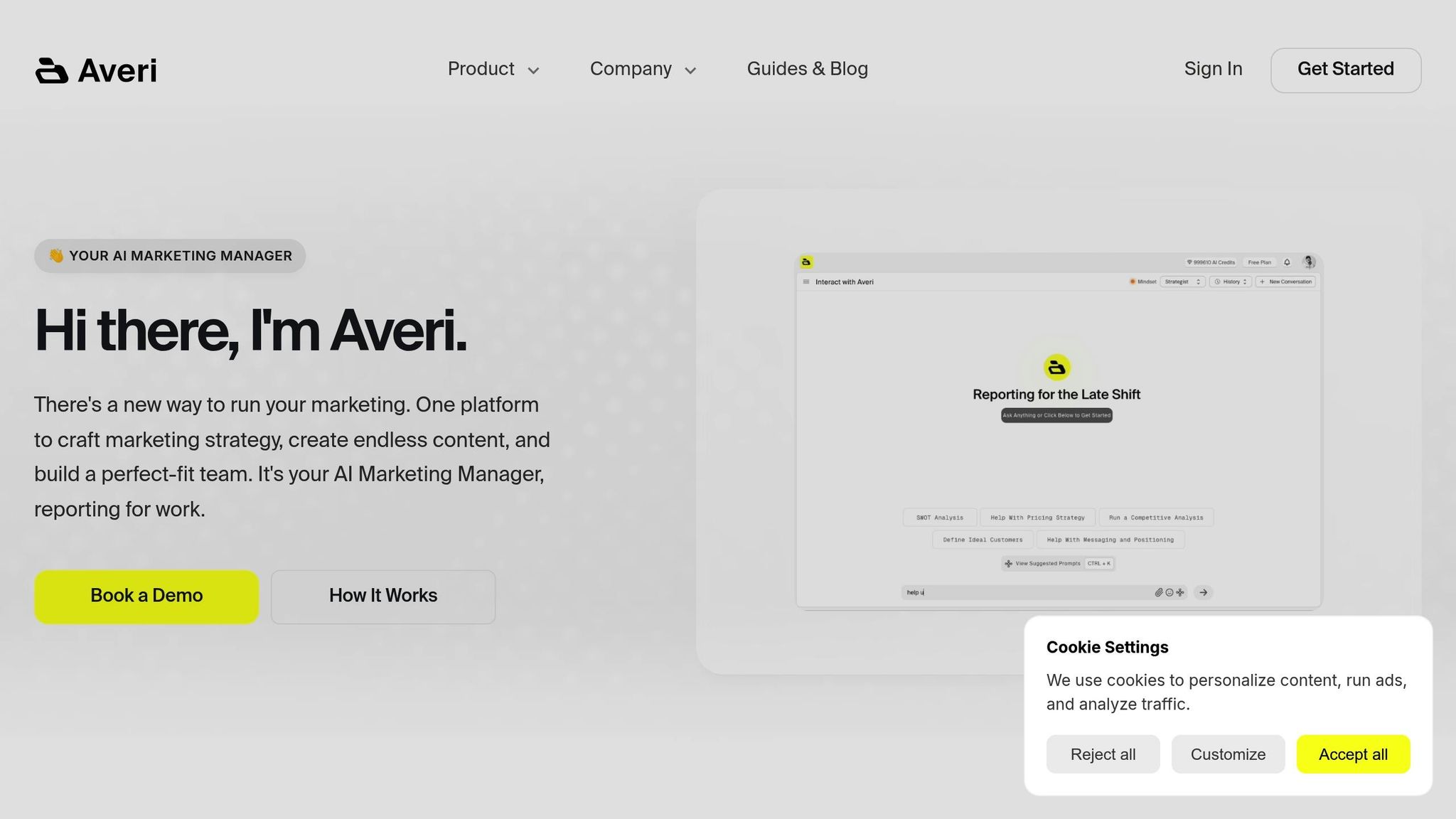
Averi AI serves as a comprehensive marketing workspace, designed to handle multiple aspects of real estate marketing. Instead of focusing on single tasks, Averi functions as an all-in-one marketing department.
Key features include:
Synapse: This feature automates task routing, adjusts the depth of analysis, and incorporates human oversight when necessary. It excels at producing polished property descriptions, managing consistent social media campaigns, and crafting effective email sequences.
AGM-2 Model: By collaborating with advanced language models, AGM-2 generates content that is strategy-aware and aligned with your brand. This is especially critical in real estate, where generic AI outputs often miss the nuances of local markets or unique property features.
Adaptive Reasoning: This feature selects the appropriate "gear" for each task - handling simple updates quickly while dedicating more effort to complex projects like market positioning. It’s a valuable tool for balancing routine updates with larger campaigns.
Command Bar and Adventure Cards: These tools reduce the number of clicks required for tasks and suggest proactive next steps, easing decision fatigue.
Human Cortex: When specialized tasks arise, Averi taps into a network of over 2,500 vetted experts for expert assistance.
Averi AI is available with a free plan and a Plus plan priced at $45/month. It also offers enterprise-grade data security, ensuring compliance with GDPR and CCPA. Importantly, your data remains private and is never used to train other customers’ models, which is crucial for firms handling sensitive information.
While Averi AI provides a robust, all-in-one solution, additional tools can help address specific needs.
Additional Tools to Consider
To complement Averi AI, these specialized tools can enhance your CRM, email automation, chatbot functionality, and social media management:
Follow Up Boss: An AI-powered CRM with automated lead scoring
BoomTown: CRM with AI-driven lead nurturing capabilities
Market Leader: AI tools for market analysis and property valuations
Hootsuite and Buffer: Platforms for AI-assisted social media scheduling
The best approach is to select tools that integrate smoothly with your existing systems. Many successful real estate teams start with a comprehensive option like Averi AI and then add specialized tools as needed. This ensures a balance between functionality and simplicity, helping you tackle challenges without overwhelming your workflow.
AI Workspaces vs. Marketplaces vs. Single Tools
When it comes to scaling marketing automation in real estate, firms have three main options to consider: AI workspaces, talent marketplaces, and single-purpose AI tools. Each serves a distinct purpose, and the right choice depends on your firm's size, budget, and specific needs.
AI workspaces, like Averi, act as an all-in-one marketing solution, combining AI-driven strategies, content creation, and human expertise into a unified platform. By blending advanced AI capabilities with expert oversight, these platforms ensure consistent brand messaging and comprehensive support.
Talent marketplaces, such as Fiverr, Upwork, and MarketerHire, connect businesses with freelance specialists. These platforms offer flexibility and access to creative talent but require significant coordination and oversight. The results can sometimes vary in quality and consistency.
Single-purpose AI tools, like Jasper or Copy.ai, are designed to tackle specific tasks, such as writing property descriptions or creating social media posts. While they are budget-friendly and efficient, they often leave gaps in strategic planning and broader campaign management.
Each of these options has its strengths, making it important to evaluate them based on how they align with your marketing objectives.
Main Differences and When to Use Each
The primary distinction lies in how work is delivered. AI workspaces handle entire campaigns, from strategy to execution, within a single platform. Talent marketplaces, on the other hand, rely on coordinating multiple freelancers, while single-purpose tools focus on executing isolated tasks. These differences make each option suitable for specific scenarios.
AI workspaces typically operate on a subscription model, with pricing tiers to fit various needs. Talent marketplaces charge per project, and single-purpose tools require individual subscriptions, often tied to specific features.
In terms of speed, AI workspaces can quickly produce comprehensive strategies and implementation plans. Talent marketplaces often take longer due to the need for coordination and revisions, while single-purpose tools deliver results quickly but only for narrowly defined tasks.
Data security and integration are also critical factors. For instance, Averi ensures enterprise-grade data protection and doesn’t use customer data to train external models. It also integrates seamlessly with major CRM systems and marketing platforms. Other options may vary in their security practices and integration capabilities.
Here’s how to decide:
Opt for AI workspaces if you need a complete, streamlined solution for strategic planning and campaign execution without hiring additional staff.
Use talent marketplaces for one-off projects where human creativity is key, and you’re comfortable managing multiple freelancers.
Choose single-purpose AI tools for repetitive, well-defined tasks that require quick and efficient execution.
Feature Comparison Chart
To help you decide, here’s a quick comparison of the key features:
Selecting the right option depends on your team’s size, priorities, and current growth stage. Each approach has its place, so weigh your choices carefully to align with your goals.
Conclusion
Key Insights for Real Estate Firms
AI-powered marketing automation is reshaping the competitive landscape for real estate firms, making it easier to grow and thrive. These tools eliminate the barriers of limited budgets and the hunt for skilled marketing staff by offering advanced capabilities at a fraction of the cost.
Consider this: 63% of top-performing sales teams already use CRM automation to boost productivity. Real estate firms leveraging these technologies report 28% higher lead engagement and save over two hours daily on routine tasks[2]. These gains don’t just streamline workflows - they directly contribute to closing more deals and increasing revenue.
AI systems work tirelessly, ensuring leads are qualified and campaigns are optimized 24/7. Unlike human teams with limited hours, AI chatbots engage prospects around the clock, automated workflows nurture leads continuously, and real-time analytics provide actionable insights whenever needed. This constant activity ensures no lead is overlooked and every opportunity is maximized.
Moreover, AI tools offer enterprise-grade functionality without the hefty price tag. What once required multiple full-time employees can now be managed efficiently with a few automated solutions.
Beyond automation, these tools elevate existing processes. Predictive analytics allow agents to anticipate market trends and client preferences, while automated reporting transforms hours of manual effort into quick, actionable insights. Together, these enhancements enable smarter, more strategic marketing decisions, setting the stage for a transformative approach to real estate marketing.
Next Steps to Embrace AI
To harness these benefits, start by evaluating your current marketing operations. Identify time-consuming tasks like lead qualification, follow-up emails, campaign reporting, and social media management. Pinpoint areas where automation could have the greatest impact.
Instead of diving in headfirst, begin with a pilot program. Try tools like Averi AI's free plan to see how an AI marketing workspace can simplify strategy and content creation. Alternatively, test automated CRM workflows with platforms like Follow Up Boss or HubSpot to see how they integrate with your current systems without requiring a significant upfront investment.
When choosing tools, prioritize those that integrate seamlessly with your existing CRM and systems. A smooth data flow ensures a consistent client experience and minimizes disruptions.
Equip your team to make the most of these tools. Many platforms provide extensive training and support resources to ease the transition and maximize effectiveness.
Finally, establish clear metrics for success from the outset. Whether you’re tracking lead response times, conversion rates, or hours saved on administrative tasks, having defined goals will help you measure ROI and refine your strategy as you scale.
The real estate industry is undergoing rapid change, and firms that adopt AI-powered marketing automation now will gain a clear edge over competitors. The question isn’t whether to adopt these tools - it’s how quickly you can implement them and start reaping the rewards. Use the steps outlined here to integrate these solutions into your operations and elevate your marketing efforts.
FAQs
How can real estate firms use AI to create content that stays true to their brand's voice and quality?
Real estate firms can preserve their brand's voice and uphold quality in AI-generated content by customizing AI tools to match their distinct tone, style, and guidelines. Incorporating regular human oversight is essential to ensure the content stays aligned with the brand’s values and maintains accuracy.
To strengthen consistency even further, develop clear brand standards and establish rigorous fact-checking procedures. These steps help produce reliable, high-quality content that embodies your firm’s unique identity and builds trust with your audience.
What challenges might real estate firms face when integrating AI tools with their CRM systems?
Integrating AI tools with CRM systems in real estate firms can be tricky, especially when dealing with data inconsistencies or outdated records. These issues can undermine the accuracy and usefulness of AI-driven insights. Additionally, ensuring seamless data exchange between systems like email marketing platforms or MLS systems often proves challenging due to differences in data formats.
Another major hurdle is data privacy and security. Real estate firms handle sensitive client information, making robust security measures a must. Protecting this data from breaches and staying compliant with privacy regulations are non-negotiable priorities. Tackling these challenges early on is key to achieving a smooth integration and unlocking the full potential of AI tools in the real estate space.
What are the best ways for small real estate firms to choose affordable AI tools for marketing?
Small real estate firms can find budget-friendly AI tools by honing in on their specific marketing goals and considering key aspects like cost, integration ease, and data security. Start by pinpointing tools that work well with your current systems, such as CRMs, CMS platforms, or advertising tools, to ensure a smooth adoption process.
For economical options, explore AI-driven lead generation platforms like CINC or Fello, along with marketing automation solutions such as HubSpot AI Marketing Hub. These platforms are often praised for their effectiveness and affordability, especially for small businesses. Typically, small-scale AI tools come with costs ranging from $10,000 to $50,000, depending on the features and complexity you require.
By conducting a thorough cost-benefit analysis, you can identify tools that not only align with your budget but also support your firm's marketing objectives and future growth.
Related Blog Posts

Zach Chmael
CMO, Averi
"We built Averi around the exact workflow we've used to scale our web traffic over 6000% in the last 6 months."
Your content should be working harder.
Averi's content engine builds Google entity authority, drives AI citations, and scales your visibility so you can get more customers.