Jan 12, 2026
How PLG Companies Use Content Marketing

Averi Academy
Averi Team
8 minutes

In This Article
How product-led companies use tutorials, templates, SEO content, and in-product tools to drive sign-ups, first value, and long-term retention.
Updated:
Jan 12, 2026
Don’t Feed the Algorithm
The algorithm never sleeps, but you don’t have to feed it — Join our weekly newsletter for real insights on AI, human creativity & marketing execution.
Product-led growth (PLG) shifts the focus from traditional sales to letting the product itself drive user acquisition, activation, and retention. Content marketing plays a key role in educating users, guiding them to value, and supporting self-service adoption. By offering resources like tutorials, templates, and SEO articles, PLG companies help users experience the product's benefits firsthand. Here's a quick breakdown:
Acquisition: Create content that addresses user problems and ties solutions to your product (e.g., tutorials, comparison pages, interactive tools).
Activation: Simplify onboarding with templates, walkthroughs, and guides to help users quickly reach their first "Aha moment."
Retention/Expansion: Use feature-specific content and personalized tools to deepen engagement and encourage upgrades.
PLG companies like Zapier, Rows, and Typeform excel by aligning content with user needs at every stage. Tools like Averi streamline content creation and publishing, making it easier to scale these efforts efficiently.
How to incorporate product-led content into every step of the funnel
How Content Supports Each PLG Stage
Content plays a crucial role in guiding users through every stage of the product-led growth (PLG) journey. Each phase calls for tailored content that meets user needs and drives meaningful outcomes.
Acquisition: Attracting New Users
At the acquisition stage, content weaves your product into solution-driven narratives, demonstrating its value even before users sign up [6][7]. Instead of relying on generic educational posts, this strategy showcases how your product directly addresses real-world challenges.
Take Ahrefs, for example. They use a "business potential" scoring system (0–3) to prioritize content topics, focusing on "3s" - problems where their tool is indispensable. Articles like "how to get backlinks" include step-by-step instructions that highlight Ahrefs' capabilities for each tactic [7].
"If your product can truly help someone out with their problems, you're doing them a disservice by not letting them know." - Si Quan Ong, Content Marketer, Ahrefs [7]
Zapier adopts a similar method with their "best [topic] apps" blog series. These articles integrate specific automation workflows, allowing readers to explore solutions using Zapier while learning about other tools [8]. Screencastify targets users in the decision-making phase with comparison pages like "Loom vs. Screencastify", capturing bottom-of-funnel traffic [8].
Interactive tools also attract organic search traffic while highlighting product capabilities. Rows, for instance, launched public calculators in 2023 (e.g., Email Marketing ROI, Aspect Ratio) at rows.com/calculators. These tools, built using their embed feature, demonstrate flexibility and drive engagement [3]. Eraser took a similar approach with DiagramGPT, an AI sidecar product that accounted for 30% of their total product sign-ups [2].
Once interest is captured, the next step is to convert sign-ups into engaged users through effective activation strategies.
Activation: Getting Users to First Value
Templates, tutorials, and guided walkthroughs help users achieve their first "Aha moment" by simplifying the onboarding process.
Rows observed that new workspaces typically install around 1.5 templates within the first seven days [3]. However, they also found that overly complex templates - those with multiple inputs, formulas, or tables - led to poor retention rates. By shifting to simpler, categorized templates with clear instructions (e.g., Marketing, Sales, Product), Rows significantly improved both Week-1 and Week-3 retention metrics [3].
"The more complex the template is - more inputs needed, more formulas, more tables - the lower the retention rate is for those who install it." - Henrique Cruz, Head of AI, Rows.com [3]
Typeform connects education to product action with resources like their "Survey Design 101" guide. This guide teaches survey design principles and ends with a "Start creating" call-to-action, seamlessly linking learning to product usage [6]. Supermetrics employs "product-lite" templates that let users integrate their own data for free, offering a hands-on experience before committing to paid plans [8].
Once users are activated, content continues to play a key role in keeping them engaged and prompting further growth.
Retention and Expansion: Keeping Users Engaged
Retention-focused content strengthens user engagement and uncovers additional value, which ultimately drives revenue [4].
Feature-specific content hubs encourage users to explore related solutions, creating natural opportunities for expansion and higher-tier upgrades [8]. Platforms like Atlassian University position brands as trusted resources, boosting loyalty and increasing the likelihood of user upgrades [6]. Self-service tools - such as knowledge bases, FAQs, and feature guides - empower users to solve problems on their own, reducing churn [5].
Personalized content can have a big impact. Rows found that offering users the ability to customize workspaces with vanity URLs or branding increased their sense of ownership, leading to higher retention rates [3]. Additionally, usage-based alerts notify users when it's time to upgrade, ensuring smooth transitions to higher plans [5].
Through these strategies, content not only supports user retention but also lays the groundwork for long-term growth and loyalty.
Content Types That Work for PLG Companies
Successful product-led growth (PLG) content empowers users to explore and engage with a product independently, guiding them through their journey without heavy-handed sales tactics. PLG companies leverage targeted content to educate users and encourage self-service adoption. The most effective formats solve real problems while naturally highlighting the product's strengths.
Blog Posts and SEO Content
Well-crafted, SEO-driven blog posts attract organic traffic by addressing the exact questions potential users are asking. The secret? Focus on topics where your product is the ideal or only solution to the problem at hand.
Take Zapier, for example. As of May 2025, their product-led blog attracts over 2.6 million organic visits monthly by embedding "related Zaps" directly into their articles [9]. This seamless integration allows readers to discover workflow solutions and instantly implement them using Zapier's automation tools. By blending education with action, Zapier turns blog readers into active users.
Rows adopted a similar strategy in 2023, publishing "how-to" articles for niche use cases, like "How to add charts to Confluence pages." These posts showcased the "Embed" feature while solving specific problems, effectively driving user acquisition [3]. The takeaway? Focus on content that positions your product as indispensable, not just helpful.
"Product-led content is content that helps the reader solve their problems using your product." – Si Quan Ong, Content Marketer, Ahrefs [7]
Comparison pages are another powerful tool, especially for users in the decision-making phase. Articles like "Product A vs. Product B" capture high-intent traffic and help prospects evaluate options without requiring a sales call [8].
In addition to written content, visual and interactive tutorials can simplify the path to product adoption.
Product Tutorials and Explainer Videos
Videos and step-by-step tutorials are invaluable for onboarding new users, helping them reach their first "Aha moment" quickly. These formats don’t just explain how the product works - they show it in action.
Visual elements like screenshots and walkthroughs embedded in blog posts spark curiosity about the product interface while demonstrating practical applications [8]. This visual approach reduces friction by showing users exactly how to accomplish tasks.
When it comes to tutorials, clarity is key. Straightforward instructions make it easier for users to get started and stick around [3].
Interactive tools also play a vital role in educating users. For instance, Eraser, a whiteboard tool for engineering teams, introduced DiagramGPT, an AI-powered feature that generated 30% of their total product sign-ups [2]. These tools offer immediate value while subtly showcasing the broader capabilities of the main product.
Case Studies and User-Generated Content
To build trust and credibility, case studies and user-generated content (UGC) are essential. Customer success stories highlight tangible results, helping prospects see how the product delivers value in real-world scenarios [5][8].
UGC goes a step further by fostering social proof and encouraging organic sharing. Rows found that when users could personalize their workspaces with vanity URLs or branding, they were more likely to share their creations publicly [3]. This sense of ownership boosts both engagement and word-of-mouth promotion.
"People feel more compelled to share their work if they can leave their personal mark on it." – Henrique Cruz, Head of AI, Rows.com [3]
Public template galleries and community-shared workflows serve dual purposes. They provide ready-made solutions for new users while showcasing the product's flexibility through real-world examples. This strategy not only supports new users but also turns existing ones into advocates, spreading the word through their own creations.
How to Build a PLG Content Strategy
Creating a content strategy for product-led growth (PLG) isn't about producing more material - it’s about crafting content that resonates with the users who drive your growth. In a PLG model, the focus shifts from selling to executives to enhancing the everyday experiences of end users.
Step 1: Identify Your Target Users
Start by defining what your users aim to achieve - their key goals or "jobs-to-be-done." For example, Todoist discovered that professionals wanted to sync their work calendars, while students needed tools to track exam dates. By tailoring onboarding experiences to these needs, they boosted user engagement [4].
Dive into your product analytics to uncover where users drop off. Tools like session replays, heatmaps, and form analysis can reveal the friction points your content should address.
When prioritizing content topics, consider using Ahrefs' "business potential" framework. This scoring system (from 0 to 3) rates a topic based on how essential your product is to solving a specific problem, with 3 being indispensable. Focus on those scoring 2 or 3. As Si Quan Ong from Ahrefs explains:
"If your product can truly help someone out with their problems, you're doing them a disservice by not letting them know." [7]
Once you’ve identified user goals, align each piece of content to the relevant stage of the user journey.
Step 2: Map Content to User Journeys
Organize your content to align with the different stages of the user journey - Acquisition (driving sign-ups), Activation (helping users reach that "Aha moment"), and Retention (keeping them engaged). This ensures every piece of content serves a clear purpose tied to user outcomes.
Consider building content clusters around specific product features to guide users from curiosity to mastery. Zapier, for instance, generates over 2.6 million organic visits monthly by embedding "related Zaps" directly into its blog posts. This approach helps readers implement automation solutions on the spot [8].
Match content formats to the appropriate funnel stage. For awareness, thought leadership pieces work well; for consideration, workflows and case studies are effective; and for conversion, comparisons and templates can seal the deal. To encourage retention, focus on creating knowledge bases and showcasing advanced use cases.
Step 3: Track and Improve Content Performance
Once your content is live, measure its effectiveness using metrics that matter in a PLG framework. Look beyond traffic and rankings - track sign-ups, activation rates, and retention. For in-product content, monitor metrics like bounce rates (e.g., installs with no activity), Week-1 retention, and Week-3 retention [3].
Use funnel analysis to evaluate how users move from blog visits to activation. This can help you identify seasonal trends or problem areas. If data reveals an issue - such as a confusing onboarding process or an underperforming article - act quickly to address it. For instance, Golf Digest Online used session replays to uncover an "incomplete entry" error that led to sign-up abandonment. Fixing this issue immediately recovered lost conversions [4].
Using Averi to Streamline Content Workflows
Manual vs Automated Content Workflow Comparison for PLG Companies
For PLG companies, creating consistent, high-quality content is a critical part of driving user acquisition and activation. However, with limited resources and lean teams, managing editorial workflows often becomes a daunting task. In fact, these teams spend over 20 hours a week on manual content creation tasks alone [10]. This is where automation tools like Averi step in to redefine how content workflows are managed.
How Averi Simplifies Content Creation
Averi is designed to take the complexity out of content workflows, handling everything from strategy to publishing. The process begins by training the platform on your brand specifics, ideal customer profiles (ICPs), and competitors. Using this information, Averi builds a detailed content plan while researching trending keywords and competitor strategies to suggest relevant topics.
Once a topic is approved, Averi's AI generates a first draft. This draft is then refined in a collaborative workspace, where team members can comment and edit in real time. After final approval, Averi takes care of publishing directly to platforms like Webflow, Framer, or WordPress, removing the need for manual formatting. Additionally, built-in analytics track content performance and offer optimization suggestions, such as strategies to improve rankings - like moving an article from position #8 to page one.
"We built Averi around the exact workflow we've used to scale our web traffic over 6000% in the last 6 months. It's intuitive, efficient, and highly customizable."
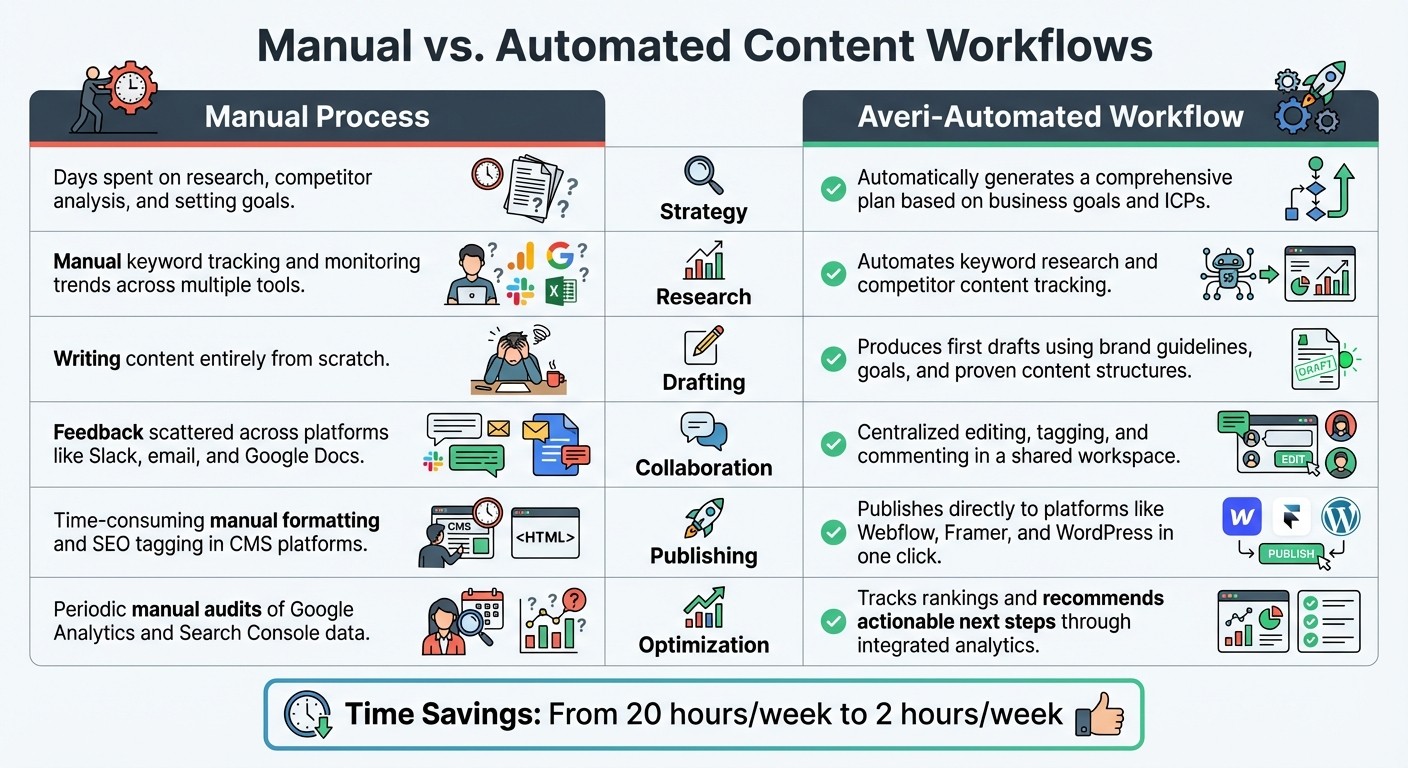
This insight from Zach Chmael, CMO at Averi, highlights the platform's efficiency [10]. By automating much of the manual labor, users can reduce their content creation time from 20 hours to just 2 hours per week, focusing primarily on approvals [10].
Comparing Manual and Automated Workflows
To understand the impact Averi has on content workflows, take a look at how it compares to traditional, manual processes:
Workflow Stage | Manual Process | Averi-Automated Workflow |
|---|---|---|
Strategy | Days spent on research, competitor analysis, and setting goals. | Automatically generates a comprehensive plan based on business goals and ICPs. |
Research | Manual keyword tracking and monitoring trends across multiple tools. | Automates keyword research and competitor content tracking. |
Drafting | Writing content entirely from scratch. | Produces first drafts using brand guidelines, goals, and proven content structures. |
Collaboration | Feedback scattered across platforms like Slack, email, and Google Docs. | Centralized editing, tagging, and commenting in a shared workspace. |
Publishing | Time-consuming manual formatting and SEO tagging in CMS platforms. | Publishes directly to platforms like Webflow, Framer, and WordPress in one click. |
Optimization | Periodic manual audits of Google Analytics and Search Console data. | Tracks rankings and recommends actionable next steps through integrated analytics. |
Averi doesn’t stop at simplifying workflows; it also optimizes content for Generative Engine Optimization (GEO). By structuring articles to be recognized by AI-powered search engines like ChatGPT, Perplexity, and Google, Averi ensures your content remains visible wherever users are searching. This dual optimization approach helps brands stay ahead in a rapidly evolving digital landscape.
Conclusion
Content marketing plays a central role in driving product-led growth (PLG) by streamlining self-service acquisition, activation, and retention. When executed effectively, it educates users on a large scale, accelerates their journey to that pivotal "Aha moment", and keeps them engaged well beyond the initial sign-up. However, many teams still face the challenge of juggling labor-intensive, manual processes.
This is where automation tools like Averi step in to make a real difference. By managing tasks such as strategy development, research, drafting, publishing, and performance tracking, Averi transforms content marketing into a streamlined, self-sustaining system. Teams can reduce reliance on manual efforts, freeing up valuable time to concentrate on product innovation and meaningful customer interactions. These efficiencies pave the way for a more precise, data-driven approach to content marketing.
"You need to have a data-driven environment, so you're not just working from intuition or the opinions of the highest-paid person in the organization." – Elena Verna, Former Head of Growth, Amplitude [1]
The foundation of PLG success lies in adopting a structured, analytics-focused content strategy. By monitoring metrics such as impressions, search rankings, and conversion rates, teams can continuously refine their approach. This ensures that every piece of content contributes measurable value throughout the user journey.
If you're ready to build a content engine that boosts visibility while allowing you to focus on perfecting your product, consider Averi. It handles everything from strategy to publishing, so you can simply review, approve, and let the system take care of the rest.
FAQs
How can product-led growth (PLG) companies use content marketing to boost user retention?
PLG companies can strengthen user retention by crafting content that clearly demonstrates product value while simplifying the overall user experience. Offering product-focused resources - like step-by-step tutorials, in-app documentation, templates, and case studies - helps users uncover key features and achieve their goals more efficiently, which can significantly reduce churn. Placing these materials strategically in help centers, onboarding emails, or as in-product tooltips ensures they’re easily accessible when users need them most.
Content driven by the community, such as user-generated tutorials, shared templates, and success stories, adds a sense of connection and illustrates how others are leveraging the product to its fullest potential. Publishing and promoting this type of content regularly - through email campaigns or in-app notifications - keeps users engaged and motivated. Leveraging tools like AI-powered content platforms can further simplify the creation and personalization of such materials, enabling companies to deliver timely, relevant content that nurtures long-term loyalty.
How does content support user activation in a product-led growth (PLG) strategy?
Content is essential for helping new users move from simply signing up to actively engaging with a product. During the activation phase, resources like in-product tutorials, step-by-step guides, FAQs, templates, and use-case examples give users the tools they need to quickly grasp the product's value and overcome any initial hurdles.
By delivering clear and actionable materials, content helps users uncover key features, adopt best practices, and address immediate needs. This speeds up their journey to the all-important "first-value" moment - when they see real, tangible benefits from the product - without needing constant support from sales or customer service teams. Well-designed, product-focused content not only increases activation rates but also fosters consistent and meaningful engagement, making it a scalable and efficient growth engine for PLG strategies.
How does Averi simplify and enhance content marketing for PLG companies?
Averi simplifies content marketing for product-led growth (PLG) companies by automating the entire journey - from planning to publication. Once the brand setup is completed, its AI engine takes over, analyzing trends, identifying relevant keywords, and spotting gaps in competitors' strategies. It then crafts tailored outlines, drafts, and SEO-friendly content, removing the need for manual effort.
To ensure quality and consistency, the platform integrates human expertise by passing content to specialists who fine-tune it to match the brand's voice. Once polished, the content is published directly to your CMS or landing page tool. Averi also features built-in analytics that monitor key performance indicators like traffic and conversion rates. These insights are fed back into the AI, enhancing the quality of future content. This approach allows small teams to efficiently create high-quality tutorials, case studies, and community-focused pieces, all while continuously improving outcomes.