Dec 23, 2025
A Practical Guide to Building a Self-Running Content Engine

Averi Academy
Averi Team
8 minutes

In This Article
Build a self-running content engine with AI and human oversight: define brand core, automate workflows, publish consistently, track performance, and scale.
Updated:
Dec 23, 2025
Don’t Feed the Algorithm
The algorithm never sleeps, but you don’t have to feed it — Join our weekly newsletter for real insights on AI, human creativity & marketing execution.
Want to simplify content creation and get better results? A self-running content engine can handle up to 80% of your content process with AI, freeing up your time and cutting costs. It’s not just about creating content - it’s about building a system that continuously improves and delivers measurable results.
Key Takeaways:
What it is: An automated system for content planning, creation, publishing, and optimization.
Why it matters: Saves time, reduces costs, and scales production while maintaining quality.
Who it’s for: Startups, small businesses, and lean teams without a dedicated content department.
How it works: Define your brand, select tools, automate workflows, and refine based on performance data.
Proven results:Averi's two-person team published 100+ pieces in 60 days, boosting traffic by 340% and demo requests by 190%.
By combining AI with human expertise, this system helps you focus on strategy while automation handles the heavy lifting. Ready to stop juggling tools and start building a content engine that works for you?
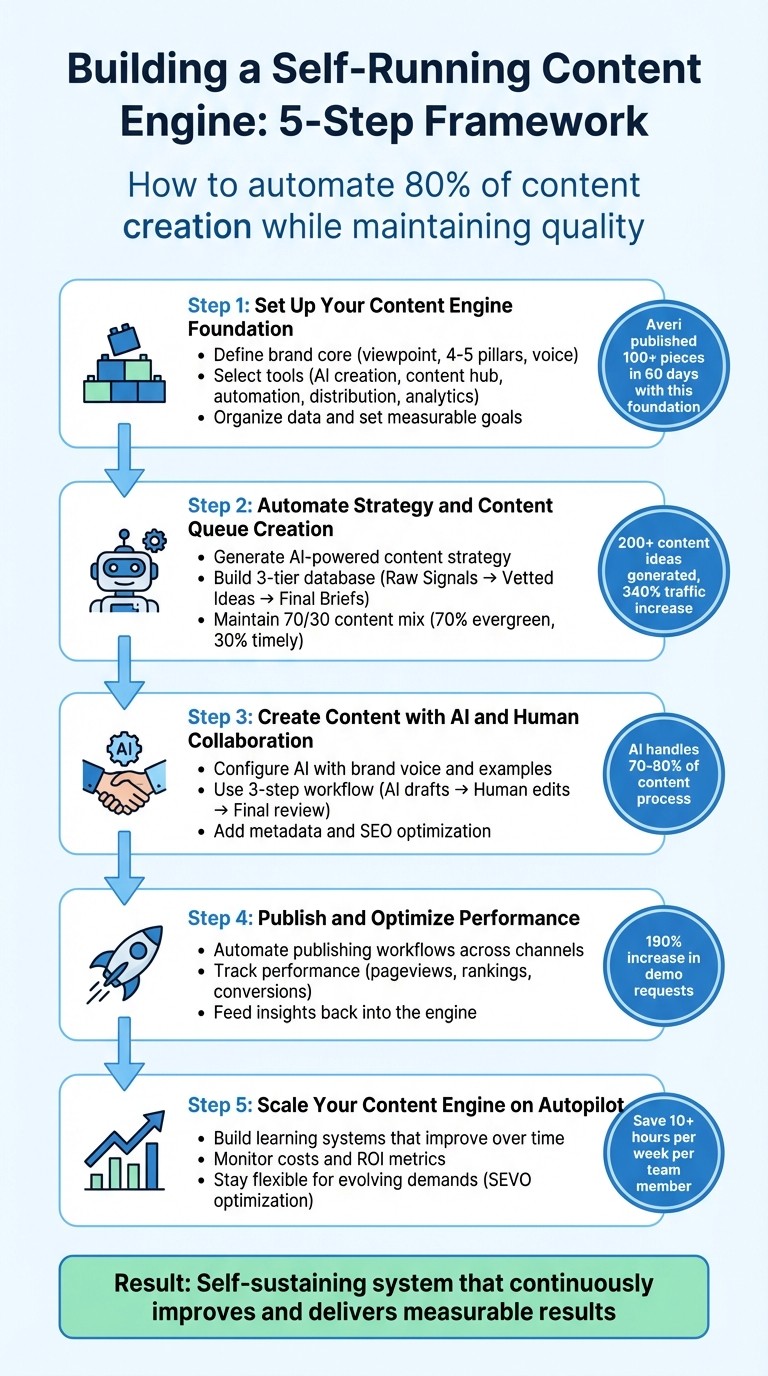
5-Step Process to Build a Self-Running Content Engine with AI
Ultimate AI For Content Creation Workflow [TUTORIAL]
Step 1: Set Up Your Content Engine Foundation
To launch a self-sustaining content engine, you need a solid groundwork that ensures every piece of content aligns with your goals and brand identity. Before diving into automation, focus on laying this critical foundation - it will guide your strategy, creation, and optimization efforts moving forward.
Define Your Brand Core
Your brand core is the heart of your content engine. It shapes how your content sounds, what it communicates, and who it speaks to. Establishing this core ensures every piece of content reflects your brand’s identity.
Start by clarifying your viewpoint - what your brand stands for and what it opposes. Pinpoint the frustrations you're addressing, the beliefs that set you apart, and the emotions you want your audience to experience when engaging with your content [1]. Then, outline 4-5 brand pillars to guide your messaging. For instance, Averi’s brand pillars include “AI + Human collaboration” and “Execution over ideas” [1].
Next, define your brand voice in terms of tone, personality, language, and topics. For example:
Tone: Confident but approachable
Personality: The "smart friend"
Language: Direct and conversational
Topics: Clear boundaries on what to discuss and avoid
Finally, craft a contrarian tagline or "flag" - a bold, memorable statement that sets you apart. Averi’s team, for example, used "Don't Feed the Algorithm" during their 60-day content sprint [1].
This step is non-negotiable. Averi’s two-person team dedicated time to defining their brand core before launching their engine, enabling them to publish over 100 pieces of content in just 60 days - all while maintaining a consistent voice and achieving impressive results [1].
One practical way to get started is by hosting a brand clarity offsite. Dedicate a full day with key stakeholders - free from distractions like phones or Slack - to answer foundational questions about your brand's identity and beliefs [1]. This upfront effort will save you countless hours of revisions later.
Select Your Tools and Platforms
With your brand core defined, the next step is choosing tools that streamline your content workflow. The goal is to create a connected system where strategy, creation, publishing, and performance tracking all happen seamlessly - without juggling multiple disjointed platforms.
For AI-driven content creation, platforms like Averi AI combine AI capabilities with human expertise and built-in brand voice training [5]. This reduces the need for manual prompting while producing on-brand content from the start.
You’ll also need a content hub to organize your workflow. Tools like Notion and Airtable are excellent for planning, tracking progress, and storing audience research insights [1][2]. For automation, platforms like Make.com or n8n.io can connect your listening tools (e.g., Reddit or YouTube) to your content hub [2]. If you're managing high-volume tasks, n8n.io’s pricing model - based on workflow execution rather than individual tasks - can be more cost-effective [2].
For distribution, select tools that align with your preferred channels. Beehiiv and ConvertKit work well for newsletters, WordPress or Webflow for blogs, and Buffer for social media scheduling [1]. Finally, integrate analytics platforms like Google Analytics to track traffic, conversions, and the impact on your sales pipeline [1][4].
Here’s a quick overview of recommended tools:
Tool Category | Recommended Platforms | Purpose |
|---|---|---|
AI Creation | Brand voice training; CMS/CRM integration | |
Content Hub | Airtable, Notion | Planning, tracking, and audience insights |
Automation | n8n.io, Make.com, Zapier | Connecting tools and streamlining workflows |
Distribution | Beehiiv (Newsletters), Buffer (Social), WordPress (CMS) | Scheduling and analytics |
Analytics | Google Analytics, Custom Dashboards | Tracking performance metrics |
The key is to select tools that work together smoothly. Your stack should simplify execution, not create extra coordination headaches.
Organize Data and Set Goals
Data is the fuel that powers your content engine. The more context you provide, the smarter and more effective your engine becomes over time.
Begin by collecting raw data from your audience. Use platforms like Reddit and YouTube to uncover insights about their needs and interests, grounding your content strategy in actual demand rather than guesswork [2]. Automation tools can route this data into your content hub, where a no-code chatbot can analyze it for recurring themes and pain points [2].
Next, train your AI platform by uploading brand documents, style guides, and examples of successful campaigns. This ensures the content generated is aligned with your brand’s strategy from the outset [5]. To keep your engine dynamic, connect real-time data sources like Google Analytics, your CRM, and social media profiles. This provides ongoing context for tracking performance and adjusting goals [5].
Lastly, ensure every content brief is tied to measurable outcomes. Map each piece to specific business goals, funnel stages, and Ideal Customer Profiles (ICPs) [4]. This keeps your engine focused on creating work that drives results - not just vanity metrics.
A helpful tip: close the loop by feeding performance data (e.g., pageviews, keyword rankings, conversions) back into your content hub. This feedback refines your listening strategy, helping you focus on high-potential opportunities [2]. With clear data and well-defined goals, your content engine will continuously improve its performance.
Step 2: Automate Strategy and Content Queue Creation
Once you've established a strong foundation, the next step is to automate your strategy development and streamline the creation of actionable content ideas. Say goodbye to the guesswork of brainstorming topics manually. Instead, build a system that consistently identifies high-value content opportunities and organizes them into a ready-to-go production queue.
Generate Your Content Strategy
Leverage AI to analyze your existing assets and competitors, crafting a content strategy that pinpoints SEO keywords, content gaps, and recommended channels for distribution [5]. This goes beyond basic keyword research. Tools like Averi's AGM-2, trained on successful marketing campaigns, can deliver highly targeted and relevant outputs [5].
Enhance your strategy by integrating real-time audience data. Automation platforms such as n8n.io or Make.com can extract high-intent queries from platforms like Reddit and YouTube, channeling these insights into your content hub [2]. For example, searching for [your topic] site:reddit.com reveals raw, unfiltered pain points your audience is actively discussing [2]. Once gathered, route this data into tools like Airtable or Notion. From there, a custom AI bot trained on your "Raw Signals" database can identify recurring themes without the need for manual sorting [2].
To ensure every content brief is actionable, align it with measurable goals - whether it's targeting specific stages in the funnel, account-based marketing (ABM) objectives, or revenue-driven KPIs [4]. During setup, feed your AI platform brand guidelines, style guides, and examples of past successful campaigns. This ensures all strategy outputs reflect your unique perspective and brand voice from the start [5].
With a robust strategy in place, the next step is to channel these insights into an efficient content queue.
Build a Smart Content Queue
Structure your content workflow using a three-tier database system: "Raw Signals", "Vetted Ideas", and "Final Briefs" [2]. This setup keeps your process organized and ensures nothing falls through the cracks.
Follow a 70/30 content mix, with 70% evergreen topics and 30% timely pieces [1]. Automation tools will continuously feed new signals into your queue, but prioritize topics based on factors like search volume, alignment with business objectives, and gaps in your competitors' strategies. Between May and July 2025, the Averi team used this method to generate over 200 content ideas aligned with their brand pillars. They published more than 100 pieces, leading to a 340% boost in organic traffic [1].
Establish a consistent production rhythm to keep the momentum going. For instance, finalize topics every Monday and publish content every Friday [1]. This steady cadence ensures your content engine runs smoothly and positions you to execute your strategy effectively.
Step 3: Create Content with AI and Human Collaboration
Blend the speed of AI with the judgment of human expertise to build a workflow that scales content production without losing the essence of your brand.
Configure AI-Powered Content Creation
Start by defining your brand’s tone, personality, and style. Document these elements and feed them into your AI platform, along with examples of your best-performing content - whether emails, blog posts, or social media updates. This guidance helps AI produce drafts that align closely with your brand’s voice.
Use detailed prompts that clearly outline your team’s persona, target audience, and core values. For instance, specify that "AI should enhance human creativity, not replace it." This clarity ensures the drafts are nearly ready for publication. Platforms like Averi's Synapse system can even determine which tasks are better suited for AI - such as research, initial drafts, or creating outlines - and which require human expertise, like strategic planning or quality checks.
For high-volume content, such as social posts, product descriptions, or email campaigns, AI can handle much of the heavy lifting. Tools like ChatGPT, Writesonic, or AGM-2 can draft content, Canva or Leonardo AI can create visuals, and platforms like WordPress or Buffer can manage distribution.
Use Human Expertise for Refinement
While AI can create a strong foundation, humans are essential for adding the finishing touches. Implement a three-step workflow: AI drafts the content based on your brief, a human editor fine-tunes it for brand alignment and accuracy, and a final reviewer, such as your Head of Content, gives the final approval.
For larger teams, consider structuring cross-functional groups that include strategists, producers, editors, and AI QA specialists. This setup ensures accountability and guarantees that every piece of content passes the "Does This Sound Like Us?" test before publication. Such collaboration creates a self-sustaining system, enabling consistent and scalable content production.
Task Category | AI Responsibility | Human Responsibility |
|---|---|---|
Strategy | Trend identification, competitive analysis | Creative direction, positioning |
Creation | First drafts, outlines, variations | Editorial judgment, storytelling, unique insights |
Optimization | Metadata, internal links, SEO formatting | Quality assurance, brand voice checks, fact-checking |
Distribution | Multi-channel scheduling, format adaptation | Community engagement, relationship building |
Human editors bring what AI cannot: personal anecdotes, original data, expert interviews, and bold opinions that make content resonate. As Despina Gavoyannis, Senior SEO Specialist at Ahrefs, explains:
"AI speeds up content creation, but human oversight ensures quality" [6].
Once the content is polished and approved, the focus shifts to optimizing and preparing it for publication.
Add Metadata and Optimization
After refining the content, automate the technical details to streamline the final production phase. AI tools can generate and insert metadata, internal links, and FAQs, ensuring the content is optimized for both traditional search engines and AI-powered platforms like ChatGPT, Claude, Perplexity, and Google AI Overviews.
Incorporate SEO elements - such as target keywords, meta descriptions, and Schema markup - into your automated content briefs within tools like Airtable, Notion, or Averi's Library. This approach ensures optimization is seamlessly integrated into the workflow rather than being an afterthought. For instance, use clean headings and definitive statements to optimize for Google AI Overviews, bullet-pointed FAQs for Bing Copilot, and clear author bylines with E-E-A-T signals (Experience, Expertise, Authoritativeness, Trustworthiness) for ChatGPT.
Continuously analyze performance data to refine your AI prompts and optimization strategies. Businesses adopting this method have reported a 340% increase in organic traffic by maintaining consistency and staying true to their brand voice [1].
Step 4: Publish and Optimize Performance
Once your content is polished, it’s time to publish and establish a system to continuously refine it based on performance insights.
Automate Publishing Workflows
Streamline your publishing process by connecting your content hub - whether it’s Airtable, Notion, or Averi's Library - with automation tools like Make.com or n8n.io. These platforms can handle tasks like publishing content to your CMS (e.g., WordPress or Webflow) or distributing it through social media tools (Buffer, Hootsuite) and email platforms (Beehiiv, ConvertKit).
Set up CMS integrations for quick deployment and configure automation rules to share content across platforms like LinkedIn, Pinterest, and X as soon as an article goes live. You can also use these workflows to reformat long-form content into drafts tailored for email subscribers.
To keep everything organized, use relational databases with fields like "Published URL" to trigger follow-up actions. For instance, filling this field could send a Slack notification, post updates to social media, or update analytics dashboards. Don’t forget to include error-handling mechanisms and rate-limit controls to ensure smooth performance, even at scale. These automations not only save time but also set the groundwork for precise performance tracking.
Track and Analyze Performance
With publishing on autopilot, shift your attention to monitoring how your content performs. A centralized dashboard can help you connect performance metrics to the original content briefs. Key metrics to track include 30-day pageviews, keyword rankings, and conversions, which can reveal what topics and sources resonate most with your audience.
Expand your analysis by tracking AI citations and your share-of-voice across tools like ChatGPT, Claude, Perplexity, and Google AI Overviews [4]. Operational metrics - like cycle time (from brief to publish), first-time pass rate (content approved without revisions), and cost per asset - can also provide valuable insights into your workflow’s efficiency.
To simplify reporting, use tools like Zapier to automatically update your dashboard with weekly analytics. For more advanced insights, train a no-code chatbot on your performance data. This allows team members to ask plain-language questions, such as, "Which articles drove the most traffic last month?" and get instant answers.
Feed Insights Back into the Engine
Performance insights are most valuable when they’re used to refine your strategy. Review your top-performing topics and update underperforming pieces using the latest data. Automate these updates in your content hub to maintain a dynamic system.
Step 5: Scale Your Content Engine on Autopilot
Once you've streamlined content creation and established a solid performance tracking system, the next step is scaling your engine. This involves building a system that continuously learns, adapts, and delivers measurable results with each iteration.
Build a System That Learns and Automates
The best content engines aren't static; they evolve with every piece of content you produce. Every article, performance metric, and brand guideline should feed back into the system to refine future outputs. Platforms like Averi excel at this by using past projects and saved work to train AI systems on your brand voice and strategic goals, making each subsequent output sharper and more aligned [1].
Brands that treat content as a growing asset, rather than isolated projects, see compounding benefits. For example, organizing your team into "pods" - small, cross-functional groups that include a strategist, producer, editor, and SEO expert - ensures that each team owns the entire process from start to finish. These pods can be scaled as demand increases [4].
Additionally, standardizing modular content blocks - like FAQs, definitions, or step-by-step guides - allows teams to quickly repurpose assets across platforms without starting from scratch. This "Content Sprout" method transforms a single pillar piece into multiple high-quality derivatives, tailored for various formats and channels [4].
Keep an Eye on Costs and ROI
Scaling content production is only worthwhile if it makes financial sense. To ensure profitability, track metrics like cycle time (how long it takes to go from brief to publication), first-time pass rates (content approved without revisions), and cost per approved asset. Link these operational metrics to outcomes like keyword rankings, conversions, and mentions in AI-generated content to identify which topics deliver the best return on investment (ROI) [2][4].
For example, tools like n8n.io, which use a per-workflow execution model, can be more cost-effective than alternatives like Zapier when processing large data batches [2]. Meanwhile, AI can automate up to 70–80% of the content creation process, potentially saving small teams over 10 hours a week [3]. However, it's crucial to track whether these time savings are actually boosting revenue - financial clarity ensures your content engine remains efficient as it grows.
Stay Flexible to Meet Evolving Demands
As your content engine matures, it must remain adaptable to changing business needs. For instance, optimize for "Search Everywhere Optimization" (SEVO) by structuring content for AI-driven tools like ChatGPT, Perplexity, and Claude, in addition to traditional search engines [4]. Use concise, scannable sections with authoritative citations to improve your chances of being referenced by these platforms.
To stay ahead of emerging trends, deploy no-code chatbots to gather raw audience insights from platforms like Reddit or YouTube. This eliminates the need for manual data sifting while uncovering new pain points [2]. Additionally, use model routers to assign tasks to the most suitable AI for drafting, localization, or metadata creation [4]. When working with tools like Make.com or n8n.io for high-frequency API calls, build in "wait" modules to manage rate limits and avoid disruptions [2].
Finally, train internal content bots using your finalized, published work to create a single source of truth for sales and marketing teams. This ensures consistent messaging without the hassle of searching through folders or Slack threads [2]. Shifting from a handcrafted approach to a data-driven content manufacturing model allows your engine to scale for new audiences, additional formats, or larger teams - all while maintaining quality and consistency [2].
Tool Comparison: Averi vs. Alternatives
Creating a self-sustaining content system starts with choosing the right tools. Here, we compare three main options: AI marketing workspaces like Averi, AI point tools such as Jasper or Copy.ai, and freelance marketplaces like Fiverr or Upwork. Each has its strengths and weaknesses, and understanding these differences is key to finding the best fit for your content needs.
AI point tools like Jasper and Copy.ai focus on generating text. Jasper, starting at $49 per month per user, is known for maintaining brand voice consistency with 85% accuracy and offers decent team collaboration features [5][7]. Copy.ai, with its free tier, caters to solopreneurs looking for quick, budget-friendly solutions [5]. However, both tools are limited to content creation and leave you to manage strategy, workflow coordination, publishing, and performance tracking on your own.
Freelance marketplaces like Fiverr and Upwork connect you with individual professionals but often come with challenges like inconsistent quality, repeated re-briefing, and time-consuming coordination [5]. In fact, marketers typically spend about 65% of their time on planning and coordination instead of actual content creation [5].
Averi, on the other hand, is an AI Marketing Workspace that handles everything from strategy to publishing. It combines its proprietary AGM-2 model, trained on marketing-specific datasets, with a network of over 2,500 U.S.-based experts who maintain an average match feedback score of 4.97 out of 5 [5]. Users have reported a 60% reduction in coordination time and a 40% boost in conversion rates compared to generic AI tools [5].
Key Differences Between Averi and Alternatives
The main difference lies in the scope and how workflows are integrated. Point tools require you to juggle various platforms for strategy, drafting, freelancer management, and publishing. Averi consolidates everything into a single workspace, creating a seamless flow from strategy to publishing.
Feature | Averi AI | Point Tools (Jasper/Copy.ai) | Marketplaces (Fiverr/Upwork) |
|---|---|---|---|
Workflow | Strategy → Creation → Publishing → Analytics | Content generation only | Human execution only |
Brand Memory | Permanent "Brand Core" with OS-style memory | Limited or no context retention | Manual re-briefing required |
Expert Network | Integrated, vetted network (avg. 4.97/5 rating) | None | Variable quality, high coordination |
Publishing | Direct CMS integration (Webflow, WordPress, Framer) | Manual copy-paste | Manual delivery |
Strategic Planning | Comprehensive marketing strategy included | None or minimal | None |
Starting Price | Free plan available; Plus at $45/month | $49/month; Free tier (Copy.ai) | Variable per project |
Cost and Quality Considerations
Looking beyond the sticker price, total cost of ownership is critical. Jasper's $49/month plan doesn't cover strategy, project management, or publishing, meaning you'll need additional tools [7]. Freelance marketplaces, while flexible, often require significant time and effort for coordination. Averi's $45/month Plus plan, however, includes the full workflow, unlimited AI usage, and access to experts without surprise fees or per-seat charges.
When it comes to quality control, the differences are stark. Jasper relies on training for brand voice but lacks project continuity [5]. Copy.ai provides basic usage metrics but doesn't align with strategic goals [5]. Averi's Synapse architecture retains project context and activates vetted specialists when AI alone isn't enough [5].
"The future isn't about building a better text generator; it's about building systems that orchestrate AI and human intelligence to solve complex, real-world business problems." – Skywork AI Review
When to Choose Averi
Averi is ideal for startups or lean marketing teams (1–5 people) that need to produce consistent, high-quality content without the overhead of a full marketing department. It’s especially useful if you lack established processes, need consistent branding across various formats, or want to avoid the hassle of managing freelancers and multiple tools.
Averi shines when you're building a content engine designed to grow over time. Every project and interaction strengthens the system’s understanding of your brand, making future tasks faster and more aligned. Research shows companies using generative AI achieve a 3.7x return on investment - but only when the tools support complete workflows rather than isolated tasks [7].
Skip Averi if you already have a well-structured content operation with dedicated strategists, writers, editors, and project managers. For teams with established workflows, point tools like Jasper can handle drafting needs efficiently. Similarly, if you only need occasional, one-off content and have the bandwidth to manage freelancers, marketplaces might suffice.
Averi’s free plan lets you explore its AI Marketing Manager features with 200 tokens per month. This trial is enough to see if its integrated approach aligns with your workflow before committing to the Plus plan [5]. The choice you make will shape how effectively your content engine scales and delivers results across your marketing efforts.
Conclusion: Build a Scalable Marketing Infrastructure
Imagine a content engine that runs itself, growing stronger with every project without adding strain to your team. By following five key steps - laying a solid foundation, automating strategy, blending AI with human creativity, streamlining publishing workflows, and ongoing refinement - you can transform content creation from a labor-intensive task into a well-oiled system.
This shift from crafting content by hand to building a streamlined content production system is how small teams can achieve big results without burning out [2]. Take Averi as an example: between May and July 2025, their two-person team developed a content system that churned out over 100 pieces in just 60 days. The payoff? Significant boosts in traffic, subscriber numbers, and demo requests [1]. They didn’t simply work harder - they built a system that worked smarter.
The real difference between a content strategy that falters and one that thrives lies in how well workflows are integrated. Unlike standalone AI tools or disjointed solutions, Averi keeps brand memory intact while seamlessly combining strategy with execution. This unified approach doesn’t just make processes more efficient - it lays the groundwork for sustained growth.
Ask yourself: does your current system make next month easier than this one? If you’re still stuck re-briefing freelancers, juggling tools, or manually tracking performance, you’re not running a content engine - you’re spinning on a hamster wheel. The right infrastructure doesn’t just save time now; it builds momentum that propels you forward. As the Averi team aptly puts it:
"Strategy without execution is just expensive PowerPoint" [1].
FAQs
How can I select the best tools to build a self-running content engine?
To build an efficient self-running content engine, the first step is to pinpoint your business needs and align them with one of three tool categories: workspaces (like Averi, which blends AI with human execution), marketplaces (such as Fiverr or Upwork), or AI point tools (examples include Jasper and Copy.ai). Each type offers distinct advantages and trade-offs, so the key is selecting the option that best matches your goals for speed, scalability, and consistency.
Before committing to any platform, take time to assess critical factors like:
Pricing and total cost of ownership: Consider licenses, add-ons, and any additional fees.
Delivery model: Decide between orchestration, self-serve, or marketplace-based solutions.
Quality controls: Ensure the tools support your brand voice and offer review layers.
Data policies: Understand how your data will be handled and protected.
Integration compatibility: Check if the tools work seamlessly with your existing systems.
Team fit: Make sure the platform aligns with your team's workflow and capabilities.
Breaking these considerations into specific scenarios - whether you're a Startup, Growth Team, or Enterprise - can help you identify the tools that align with your budget and objectives.
Once you've narrowed down your options, run a small-scale test with tools that cover the entire content lifecycle. This includes AI-assisted idea generation, drafting, and automated publishing. Aim for solutions that reduce manual steps and maintain consistent results. When your workflow moves smoothly from concept to publication with minimal intervention, you've found the right mix of tools for your content engine.
How can I ensure my automated content engine stays aligned with my brand identity?
To ensure your content stays true to your brand, start by creating a detailed style guide. This guide should outline key elements like your brand's voice, tone, visual style, preferred terminology, and any legal or intellectual property requirements. Use it to craft AI prompts that reflect your brand's personality (e.g., "write in a friendly, expert tone that emphasizes our commitment to innovation and trust") and to guide human contributors in maintaining consistency.
Next, implement quality checks at every stage. Automated tools can help verify brand alignment, while human editors should review for tone, accuracy, and consistency before anything goes live. Integrating these checks into your content management system (CMS) and approval workflows ensures that every piece meets your standards.
Lastly, monitor performance and make adjustments as needed. Keep an eye on metrics like engagement rates, adherence to brand guidelines, and error frequency. Use these insights to refine your AI model and update your style guide. By combining clear guidelines, thorough reviews, and ongoing feedback, your content engine can consistently produce high-quality, on-brand material at scale.
How can I measure the success of my automated content engine?
To measure the effectiveness of your content engine, keep an eye on three key areas: output, quality, and cost efficiency.
Start by evaluating throughput and speed. Track how many pieces of content - like blog posts, social media updates, or videos - are created each week, and compare this to your production levels before implementing automation. For startups aiming to scale effectively, a target of producing 500 or more assets per month is common. Additionally, measure how much time is being saved, as AI-driven workflows often shorten production cycles and reduce manual labor significantly.
Next, focus on quality and impact. Use metrics such as organic traffic, click-through rates, conversion rates, and revenue generated per asset to gauge how well your content is performing. To maintain brand integrity, evaluate whether your content aligns with your brand voice and track the percentage of drafts that require minimal revisions.
Finally, examine cost efficiency. Compare the total expenses - covering tools, subscriptions, and expert fees - with the cost per content piece. Use this data to build a straightforward dashboard that not only tracks production but also highlights how your content engine contributes to meaningful business growth.