Jan 12, 2026
How Solo Founders Scale Content Production

Averi Academy
Averi Team
8 minutes

In This Article
Solo founders can scale high-quality content by combining AI, structured workflows, and selective human edits without burning out.
Updated:
Jan 12, 2026
Don’t Feed the Algorithm
The algorithm never sleeps, but you don’t have to feed it — Join our weekly newsletter for real insights on AI, human creativity & marketing execution.
Creating consistent content as a solo founder can feel overwhelming, but it’s essential for growth. With 53% of website traffic coming from organic search and content marketing delivering 3x more leads at 62% lower costs than paid ads, scaling content production is a must. However, balancing time, budget, and quality is challenging - this is where AI tools come in.
Key Takeaways:
Blend AI and human creativity: AI saves time on repetitive tasks like drafting and keyword research, while you focus on strategy and voice.
Start with a solid strategy: Define your audience, core message, and content goals before scaling production.
Leverage AI for efficiency: Use tools for topic research, content planning, and first drafts to reduce workload.
Focus on workflows: Batch tasks, automate publishing, and track performance to stay consistent and organized.
This guide shows how to scale from sporadic posts to several pieces a week without sacrificing quality or burning out. Let’s dive in.
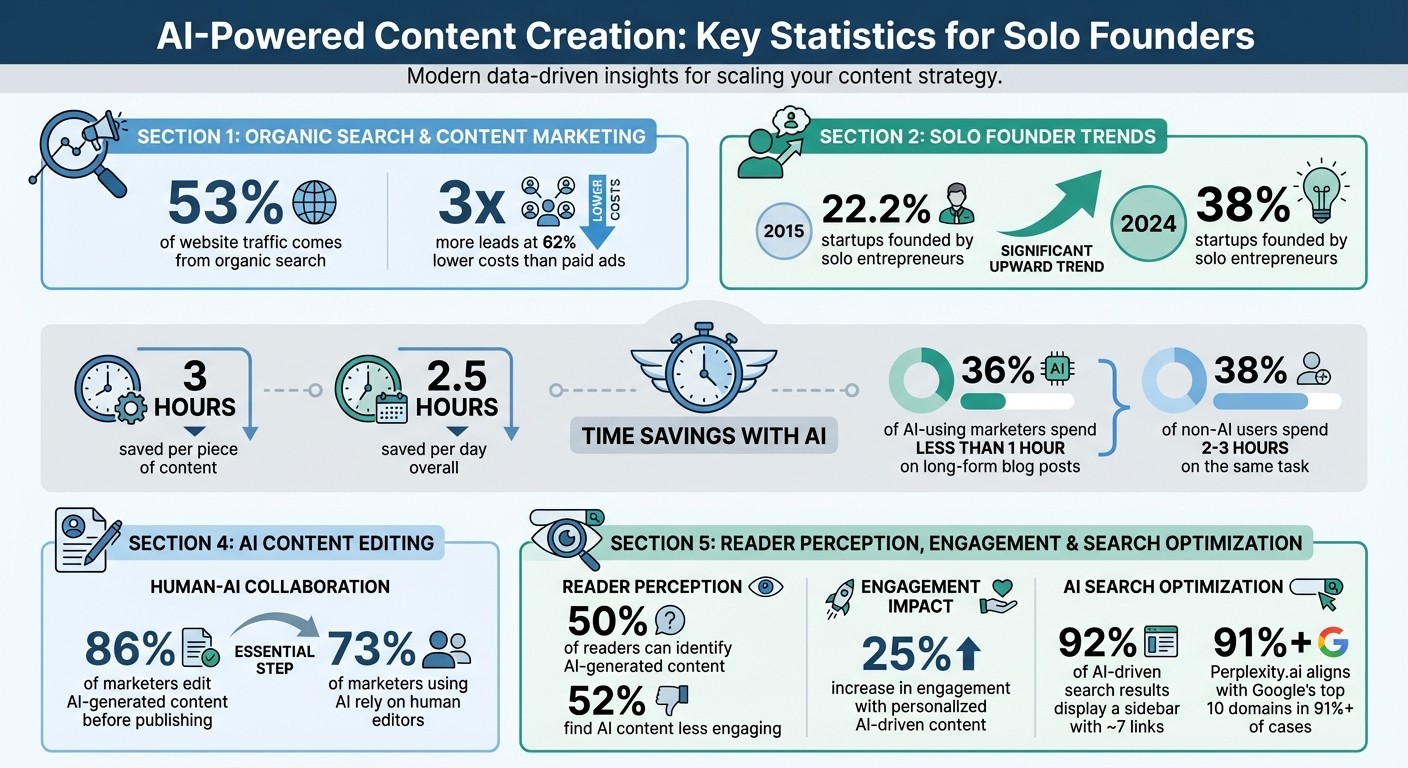
AI Content Creation Statistics: Time Savings and Efficiency Gains for Solo Founders
Founders Stop Wasting Time on SEO! The Simple Hack Every Solo Founder NEEDS

1. Build Your Content Strategy First
Jumping into content creation without a plan is like trying to build a house without a blueprint - it’s bound to fall apart. A solid strategy ensures that every piece of content speaks directly to your audience and aligns with your business goals.
Interestingly, the percentage of startups founded by solo entrepreneurs has risen significantly, from 22.2% in 2015 to 38% in 2024 [4]. This means more founders are navigating the content game on their own. Before diving into full-scale production, you need a strategy that lays the groundwork for everything you create. This foundation will also help you take advantage of AI content tools to streamline your content process.
Define Your Audience and Core Message
The first step is knowing exactly who you’re talking to. Identify your Ideal Customer Profile (ICP) - the people who will benefit the most from your product or service. If you already have customers, analyze your top users and map out their industry, company size, location, pain points, and decision-making roles. If you’re still pre-launch, dig into market research to uncover who you’re solving problems for.
ICP Category | Key Details |
|---|---|
Industry / Type | The sector or niche your target audience works in |
Location | Geographies you want to prioritize |
Company Size | Typical employee count or revenue range |
Pain Points | Problems your product or service addresses |
Business Goals | Outcomes your audience hopes to achieve |
Decision Makers | The roles you should target for maximum impact |
Once you’ve nailed down your audience, develop 3–5 brand pillars that reflect your identity and perspective. These aren’t generic values like “innovation” or “quality.” Instead, they should be bold, specific, and memorable. Think along the lines of “Execution Over Ideas” or “No-BS Pricing.” These pillars will guide your content, ensuring your voice is consistent and recognizable.
To add depth, use AI to create detailed personas or try the voice-to-draft method: record your thoughts about your product, customers, and insights as voice memos. Then, let AI transcribe and structure them into a cohesive message. This approach captures your authentic voice better than typing from scratch.
Spot Content Gaps Through Competitor Research
Once you’ve defined your audience and message, shift your focus to finding areas where your competitors are falling short. This is where competitor analysis becomes invaluable.
Your competitors are already publishing content - use their efforts as a starting point. Analyze their material to identify gaps or unmet audience needs. AI tools can help by clustering competitor data and highlighting opportunities they’ve overlooked.
Research Task | AI/Automation Role | Human Role |
|---|---|---|
Keyword Research | Identifying trends and clusters | Shaping brand themes and POV |
Gap Identification | Analyzing competitor rankings | Prioritizing key topics |
SERP Analysis | Extracting “People Also Ask” questions | Validating intent and content format |
Performance Audit | Flagging significant traffic drops | Deciding strategic pivots |
Feed AI tools examples of competitor content and let them identify patterns, topics, and angles. Then, apply your brand pillars to these gaps. Don’t just mimic what’s working for others - use these insights to create content that feels fresh and aligned with your unique voice.
Set Realistic Content Goals
It’s important to be practical about what you can accomplish. While AI tools can save marketers up to 3 hours per piece of content [1], you’ll still need time for strategy, editing, and distribution. Start small with a Minimum Viable Content Engine (MVCE). This might mean producing one major piece of content each month, paired with 2–3 smaller derivative posts per week. With AI assistance, this workload typically takes about 5–7 hours per week.
Content Goal Level | Output Target | Estimated Time |
|---|---|---|
Minimum Viable (MVCE) | 1 Pillar/mo + 2–3 Derivatives/wk | 5–7 hours/week |
Growth Scale | 1 Pillar/wk + 5–10 Derivatives/wk | 10–12 hours/week |
SEO Authority | 100+ pieces in 60 days | 15–20 hours/week |
Set goals that match the time you have available, and use AI to maximize efficiency. For instance, batch similar tasks - create a month’s worth of social posts or an entire quarter’s email campaigns in one focused session. This reduces the time lost to context-switching [1].
Track your progress by monitoring content output, traffic, and engagement. Adjust your targets each month based on what’s working. A well-thought-out strategy is your roadmap for scaling production while maintaining quality.
2. Use AI for Topic Research and Content Planning
Once your strategy is ready, the next step is identifying the right topics to focus on. This is where AI tools can dramatically cut down the time spent on manual research, allowing you to shift your energy toward making strategic decisions.
Automate Keyword and Topic Research
Manually conducting keyword research can take anywhere from 4 to 6 hours. AI tools, however, can reduce this process to just 15–30 minutes. Platforms like Semrush One, Search Atlas, and SE Ranking combine traditional SEO techniques with Generative Engine Optimization (GEO), which measures how well your content performs in AI-driven search engines like ChatGPT and Perplexity.ai [5][6].
For solo entrepreneurs, these tools make it easy to identify high-traffic keywords and trending topics without the need for complex spreadsheets. AI-powered platforms like Keywordly and Semrush's Keyword Strategy Builder automatically group related keywords into clusters, helping you establish topical authority rather than chasing individual terms. For instance, instead of focusing solely on "content marketing tips", AI tools can group it with related searches like "content strategy for startups" and "how to plan blog content", providing a broader understanding of what your audience is looking for.
Another major advantage is real-time data integration. Tools like Writesonic (Chatsonic) and Koala AI pull live data from search engines and platforms like Ahrefs and Semrush. This ensures your research reflects current trends rather than outdated information [5][8].
Tool | Starting Price | Best For |
|---|---|---|
Writesonic | $16/mo | Real-time SEO research and content generation [5] |
$20 (one-time) | Tracking brand visibility in AI search engines [5] | |
$38/mo | SEO and GEO optimization with AI-generated outlines [7] | |
$0 (Solo) | Automating custom SEO workflows and briefs [5] | |
$99/mo | On-page optimization and AI visibility tracking [6] |
Generate Content Ideas in Batches
Once you’ve identified data-backed topic clusters, AI can help you quickly turn those into a wealth of content ideas. AI is particularly effective at taking a single insight and spinning it into dozens of creative directions. A popular approach is the hub-and-spoke model: create a central "pillar" piece of content and use AI to generate 10+ smaller assets from it, such as social media posts, email campaigns, or short snippets. This method not only saves time but also ensures consistency across your content.
Start by feeding AI tools your brand's core principles and competitor data. Platforms like AirOps and Frase can analyze top-ranking competitors on SERPs and produce structured outlines in just minutes [5][7]. Instead of brainstorming one idea at a time, dedicate a focused session to generate an entire month’s worth of social posts or a quarter’s worth of email campaigns. This eliminates the inefficiency of constant context-switching and keeps your creative momentum going.
Another effective method is using voice-to-text tools. Record a quick voice memo with your ideas, and let AI transcribe it into multiple structured content outlines. This approach captures your natural tone and speeds up the creative process.
Optimize for Search Engines and AI Citations
With topics and ideas in hand, the next step is ensuring your content is optimized for both traditional search engines and AI platforms. SEO is evolving into Generative Engine Optimization (GEO), which focuses on structuring content so that AI platforms like ChatGPT and Perplexity.ai can cite it effectively. Currently, about 92% of AI-driven search results display a sidebar with roughly seven links, and Perplexity.ai aligns with Google’s top 10 domains in over 91% of cases [6].
To meet these new standards, structure your content with concise FAQs, clear definitions, and authoritative citations. Tools like Frase and Rankability are designed to help you align your content with AI and SEO requirements. These tools emphasize comprehensive answers (2,000+ words), data-backed statistics, and well-organized Q&A formats [7].
A practical example of this is SEO expert Victoria Kurichenko’s experience in November 2025. After her "Ahrefs alternatives" blog post lost rankings due to a Google Core update, she used Rankability to analyze its performance. The tool identified a low "rankability score" of 49/100 and recommended specific keyword updates to raise it to 66. Within a month of implementing these changes, the post ranked for over 271 keywords and reached the #1 spot in organic search results [6].
Finally, don’t assume your content will be indexed immediately. Tools like Indexly can help you submit new URLs to search engines and large language models (LLMs) instantly, reducing the lag time often seen with "Crawled – Not Indexed" issues [6].
3. Create Content Faster With AI Workflows
Once you've nailed down your topics and completed your research, the next step is turning those ideas into finished content. This is where AI can become your secret weapon. Marketers using AI tools save an average of 3 hours per piece of content and 2.5 hours per day overall [1][9]. The trick lies in building workflows that let AI handle repetitive tasks while you focus on the creative and strategic aspects that demand human insight. With the right system, your ideas can quickly transform into polished content.
Generate First Drafts With AI
For solo founders, staring at a blank page can be one of the biggest obstacles to productivity. AI takes that challenge off your plate by generating workable first drafts in minutes. 36% of marketers using AI spend less than one hour writing a long-form blog post, compared to 38% of non-users who take 2–3 hours [9]. AI gives you a head start with something tangible to refine.
A step-by-step approach works best: start by generating a detailed outline, then expand each section with specific instructions, such as your company’s background, target audience, desired length, and any phrases to avoid [9]. This method ensures the draft is cohesive and reduces the need for extensive revisions.
You can also batch-create content like social posts or email campaigns during focused time blocks [1]. This eliminates the inefficiency of switching between tasks and helps maintain your creative flow. Tools like Averi streamline this process with features like its /create mode, which moves through three phases - Discuss → Draft → Edit - to turn briefs into ready-to-publish content. Whether you're working on blog posts, ads, or landing pages, AI can help you get a solid draft ready for the next phase.
Edit and Refine With AI and Human Input
Raw AI output, while helpful, is rarely ready to publish as-is. 86% of marketers edit AI-generated content before releasing it [9]. The key to maximizing efficiency is dividing the work effectively: let AI handle the structure and speed, and reserve the finer details for human judgment.
One useful technique is reading the draft aloud to catch awkward phrasing and assess its tone, clarity, and accuracy. Assign scores (1–5) to these elements to identify areas that need manual adjustments [10]. Anything scoring below a 4 should be refined by hand. If you do ask AI for editing help, focus on getting recommendations rather than a complete rewrite [11]. This approach preserves your original perspective while benefiting from AI’s insights.
AI can also assist with fact-checking and validating links, dates, and claims before your final review [9]. This ensures your content is accurate without requiring tedious line-by-line checks. The result? Content that’s polished, on-brand, and ready to go without the usual grind.
Keep Your Brand Voice Consistent
One of the biggest hurdles with AI-generated content is ensuring it reflects your unique brand voice. Half of readers can identify AI-generated content, and 52% find it less engaging [11]. The answer isn’t to shy away from AI - it’s to train it effectively. Start by clearly defining your brand voice and providing the AI with the context it needs to replicate it.
Outline 3–5 core traits that define your brand and supply the AI with 5–10 high-quality examples of your writing. Tools like Averi's Brand Core can automatically apply these guidelines [10]. This helps the AI mimic your natural tone and vocabulary, reducing the need for constant adjustments.
As brand voice expert Justin Blackman explains:
"The biggest limitation of AI copywriting is that even if you can get it to write like you, it can't think like you. So it's on you to make sure it knows your perspective" [10].
To keep your content aligned, revisit your brand guidelines regularly and tweak them based on what resonates with your audience. The more you refine your inputs, the less you'll need to fix on the back end, making the process smoother and more efficient.
4. Automate Publishing and Track Performance
Once your content is polished, don’t let manual processes slow you down. Automating publishing and performance tracking can save time and ensure your efforts are focused on what truly matters. By closing the loop on content production, you can get your work live faster and gain insights into what’s working - so you can do more of it. Let’s dive into how AI can simplify these workflows.
Connect AI Tools to Your CMS
Platforms like Averi allow direct publishing to popular content management systems such as WordPress, Webflow, and Framer. This eliminates formatting headaches and ensures your content appears exactly as intended. If your tools don’t support direct integration, automation solutions like Zapier or Make can fill the gap. These platforms can trigger actions as soon as you hit publish - automatically generating social media snippets or drafting email campaigns.
To streamline your workflow even further, consider using status labels like "AI Drafted", "Human Reviewed", or "Scheduled" within your workspace. This approach keeps everything organized without relying on manual checklists. Think of it as running a busy kitchen: AI handles most of the prep work - drafting, formatting, and SEO - while you focus on the final touches before deployment.
Track Key Metrics With Dashboards
Jumping between tools to gather performance data is inefficient. AI-powered dashboards consolidate metrics like impressions, rankings, clicks, and traffic into one easy-to-navigate view. Some tools even let you ask questions in plain English, such as, "Why did our email open rates drop?" and provide actionable insights without the need to dig through endless spreadsheets.
These dashboards also help you stay ahead of potential issues. They can flag problems like declining content performance, crawl errors, or mobile usability issues, allowing you to address them before they impact your rankings. AI tools can also group pages by performance trends, highlighting "near-miss" keywords - those on pages 2 or 3 of search results - that require far less effort to push to page 1 than creating entirely new content. This kind of prioritization eliminates guesswork, helping you focus on what matters most.
Use Performance Data to Improve Future Content
Performance tracking isn’t just about analyzing past results - it’s about informing a smarter content strategy for the future. When a piece of content performs well, feed its text and metrics back into your AI tool to create similar high-performing drafts. Update your brand style guides with examples from successful campaigns to teach the AI what resonates with your audience.
AI-powered predictive modeling can also help you identify content formats with the highest potential return on investment. Some tools even use Dynamic Creative Optimization (DCO) to assemble content elements in real-time based on performance data, ensuring your audience sees the most effective version. Personalized AI-driven content can increase engagement by 25% [13]. As Karen McFarlane, Chief Marketing Officer at LetterShop x KMC, aptly puts it:
"You can't improve what you can't measure." [3]
Incorporate continuous A/B testing into your process to refine messaging on social media and other platforms. By basing your adjustments on real data, you’ll reduce the need for fixes later and consistently improve your results over time.
5. Bring in Human Experts When AI Isn't Enough
AI can handle repetitive tasks with ease, but some projects demand a level of creativity and judgment that only people can provide. Knowing when to involve human specialists - and doing so effectively - can elevate your content from merely adequate to truly impactful.
Know When You Need Human Help
There are certain areas where AI falls short. For instance, highly technical content, intricate storytelling, or communications in regulated industries often require a human touch to ensure credibility and depth. AI-generated content can sometimes feel mechanical, which might undermine trust. Similarly, tasks like community engagement and responding to comments benefit greatly from human emotional insight.
Think of it like running a kitchen: AI can handle the bulk of the prep work, but a "Head Chef" (your human expert) is needed to refine, perfect, and add the finishing touches. As Christina Inge, a respected author and marketer, wisely notes:
"Your job will not be taken by AI. It will be taken by a person who knows how to use AI." [9]
By combining human expertise with AI-driven processes, you can bridge the gaps in nuance, creativity, and context.
Connect With Vetted Specialists Through AI Platforms
When specialized skills are required, relying on traditional hiring methods can be slow and unpredictable. Instead, platforms like Averi's Human Cortex provide quick access to a network of over 2,500 skilled professionals, including copywriters, strategists, and designers. These experts integrate seamlessly into your existing workflow, saving time on extensive briefings and onboarding.
This hybrid AI-human model offers a significant advantage: speed and consistency. Traditional hiring cycles can take months before new hires become fully productive. In contrast, blending AI with vetted specialists allows you to scale technical capabilities in just days [14]. Whether you need expertise in design, technical SEO, or advanced copywriting, these platforms ensure you get high-quality results without the hassle of managing freelancers or dealing with inconsistent output.
Share Context to Avoid Re-Briefing
To avoid wasting time on repetitive clarifications, provide specialists with all the context they need right from the start. Share your brand guidelines, examples of past work, and detailed project briefs upfront. Collaborative workspaces and shared libraries can further streamline the process, ensuring everyone is aligned from the beginning.
6. Build Systems That Last
Creating sustainable content isn't about working harder - it’s about setting up workflows that run efficiently without draining your energy. The difference between a founder who publishes consistently for years and one who burns out after a few months often lies in having dependable systems, not just sheer willpower.
Batch Similar Tasks Together
Switching between brainstorming, writing, editing, and scheduling throughout the day can sap your mental energy. Instead, group similar tasks into focused blocks. For example, dedicate one session to outlining multiple topics, another to drafting several articles in a row, and a third to reviewing social media posts for the week. This method reduces the time lost to context switching, which can save an average of 2.5 hours per day [1]. Some creators even record multiple short voice memos in one sitting and use AI to transcribe and organize them into drafts. This transforms content creation into an assembly line: AI handles about 80% of the heavy lifting - like research, drafting, and formatting - while you focus on refining the tone and adding personal insights. Once tasks are batched, the next step is to align them with a structured weekly timeline.
Set Realistic Timelines and Review Points
Efficient task batching works best when paired with a steady, predictable rhythm. A sustainable content system thrives on consistency rather than sporadic bursts of activity. Design a simple weekly schedule that assigns specific tasks to each day. For instance, outline on Monday, draft on Tuesday, edit on Wednesday, create social snippets on Thursday, and schedule content on Friday. This time-blocking approach helps avoid bottlenecks and keeps your content pipeline moving smoothly. Wendy Covey, Co-founder and CEO of TREW Marketing, explains:
"Chaos doesn't scale. As organizations grow, they need a framework for planning and prioritization that helps them work more strategically" [3].
Even if you’re working solo, this principle applies: structure always outperforms chaos.
Refine AI Output Over Time
AI-generated drafts won’t be flawless on the first try, and that’s perfectly fine. The real value comes from refining your AI prompts with every project. Regularly update your prompts and brand guidelines by drawing on examples from your most successful campaigns [12]. Use a simple review framework to evaluate AI drafts: decide what to keep, cut, clarify, or support with stronger evidence. This feedback loop ensures your content quality improves over time, keeping your brand voice sharp and aligned with your evolving goals.
Conclusion
Scaling content production as a solo founder isn’t about burning the midnight oil - it’s about creating systems that combine the speed of AI with your personal expertise. Let AI handle tasks like research, drafting, and formatting, while you focus on adding your unique perspective and refining the final product. This collaborative approach is becoming the norm, with 73% of marketers using AI relying on human editors to polish the output [2].
The time savings are substantial: marketers using AI tools save an average of 2.5 hours per day and 3 hours per piece of content [1]. But as Brian Clark, Founder of Copyblogger, reminds us:
"AI doesn't create expertise, it amplifies it" [15].
Your ability to think strategically, maintain your brand’s voice, and make judgment calls is what transforms AI drafts into content that truly resonates and converts. By combining AI’s efficiency with human creativity, you can build a system that supports long-term growth.
The key is finding the right balance between automation and human input. Use AI for repetitive tasks like keyword research, first drafts, and scheduling, while turning to trusted professionals for specialized insights or creative projects. As Eli Goodman, CEO of Datos, wisely notes:
"The founders who succeed are those who know when to delegate and when to dig in" [16].
This approach allows you to create workflows that are not only efficient but also sustainable. Start by batching tasks, setting manageable timelines, and fine-tuning your AI prompts as you go. The aim isn’t to get everything perfect right away but to develop a process that improves with each iteration. When your content production relies on a well-designed system rather than sheer effort, you’ll have more time to focus on growing your business.
Want to kickstart your AI-powered workflow? Sign up for Averi and get a free, customized marketing plan - no demos, no waiting. Start building your system today.
FAQs
How can solo founders use AI tools to scale content production effectively?
AI tools have become a game-changer for solo founders looking to manage and scale content production. By automating labor-intensive tasks like research, drafting, editing, and repurposing, these tools allow one person to produce the kind of output that typically requires an entire team - without compromising on quality or consistency. For instance, AI can take a 30-minute voice memo and transform it into multiple polished content pieces, cutting down the time investment to just a few hours each week.
But it’s not just about speed. AI also ensures brand consistency and maintains high-quality standards by integrating features like SEO optimization, enforcing a cohesive brand voice, and streamlining workflows. Founders can potentially reclaim up to 10 hours per week by automating as much as 80% of routine tasks. This extra time can then be redirected toward more strategic and creative efforts. Plus, as your business grows, AI-powered systems scale right alongside it, creating repeatable processes that turn content creation into a reliable and sustainable growth strategy.
What are the key steps for solo founders to scale content production effectively?
To grow your content production as a solo founder, start by setting clear goals and understanding your audience. Define what you want to achieve - whether it's driving leads, boosting brand awareness, or improving SEO - and create a detailed profile of your target audience. This helps ensure that every piece of content aligns with your objectives. Focus on a few main content themes, and use AI tools to quickly conduct keyword research to find relevant, low-competition topics.
Next, optimize your workflow by combining AI tools with human input. Let AI handle tasks like brainstorming, drafting, and repurposing content, but make sure to set aside time for reviewing your brand voice and making final edits. Allocate 5–7 hours each week for a focused content sprint. During this time, create one high-value piece, like a 1,000–1,500-word blog post or an in-depth video, and then break it down into smaller assets such as social media posts, infographics, or email snippets to stretch its reach.
Finally, ensure quality and measure your results. Use tools like brand voice checklists and automated publishing platforms to maintain consistency. Track performance metrics - such as traffic growth, engagement, and conversions - to identify what’s working and adjust your strategy as needed. By blending automation with thoughtful planning, you can build a reliable content system that supports your growth without overwhelming your resources.
How can solo founders ensure their brand voice stays consistent when using AI for content creation?
Solo founders can keep their brand voice consistent by using AI as a starting point rather than a replacement for their own writing. Begin by crafting a detailed style guide that outlines your preferred tone, vocabulary, key phrases, and clear examples of both dos and don’ts. This guide acts as a roadmap for the AI, ensuring its outputs stay aligned with your brand’s personality.
Human involvement is essential. Once the AI produces a draft, take the time to review it thoroughly. Compare it against your style guide, refine the tone, and inject your personal touch where needed. This step ensures your brand’s voice remains genuine, even as you take advantage of AI’s efficiency.
To improve results over time, fine-tune how you interact with the AI. Pay attention to recurring edits - whether it’s swapping out specific words or reworking sentences - and adjust your prompts and settings accordingly. By doing this, you’ll teach the AI to better match your preferences, cutting down on revisions and allowing you to scale your content while staying true to your brand’s identity.