Jan 12, 2026
How Unicorn Startups Built Their Content Engines

Averi Academy
Averi Team
8 minutes

In This Article
How top startups build scalable content systems using AI, data-driven strategy, automation, and human review to increase traffic and conversions.
Updated:
Jan 12, 2026
Don’t Feed the Algorithm
The algorithm never sleeps, but you don’t have to feed it — Join our weekly newsletter for real insights on AI, human creativity & marketing execution.
Unicorn startups didn’t reach billion-dollar valuations by chance - they built efficient content systems that drive predictable growth. Their success lies in using data-driven strategies, automated tools, and scalable workflows to consistently produce high-quality content. These systems balance AI for efficiency (handling 60% of tasks) with human oversight for quality and brand alignment.
Key Takeaways:
AI + Human Collaboration: AI drafts, humans refine - resulting in 40% more output and 5.44x more traffic.
Consistent Publishing: Companies posting 16+ times monthly see 3.5x more traffic than those posting less.
SEO + AI Search Optimization: Content optimized for both traditional SEO and AI-driven tools like ChatGPT converts 4.4x better.
Proven Results: Startups like Canva, Grammarly, and NerdWallet scaled content production and achieved exponential growth by using these methods.
With the right tools and processes, any startup can replicate these systems to turn content into a reliable growth lever.
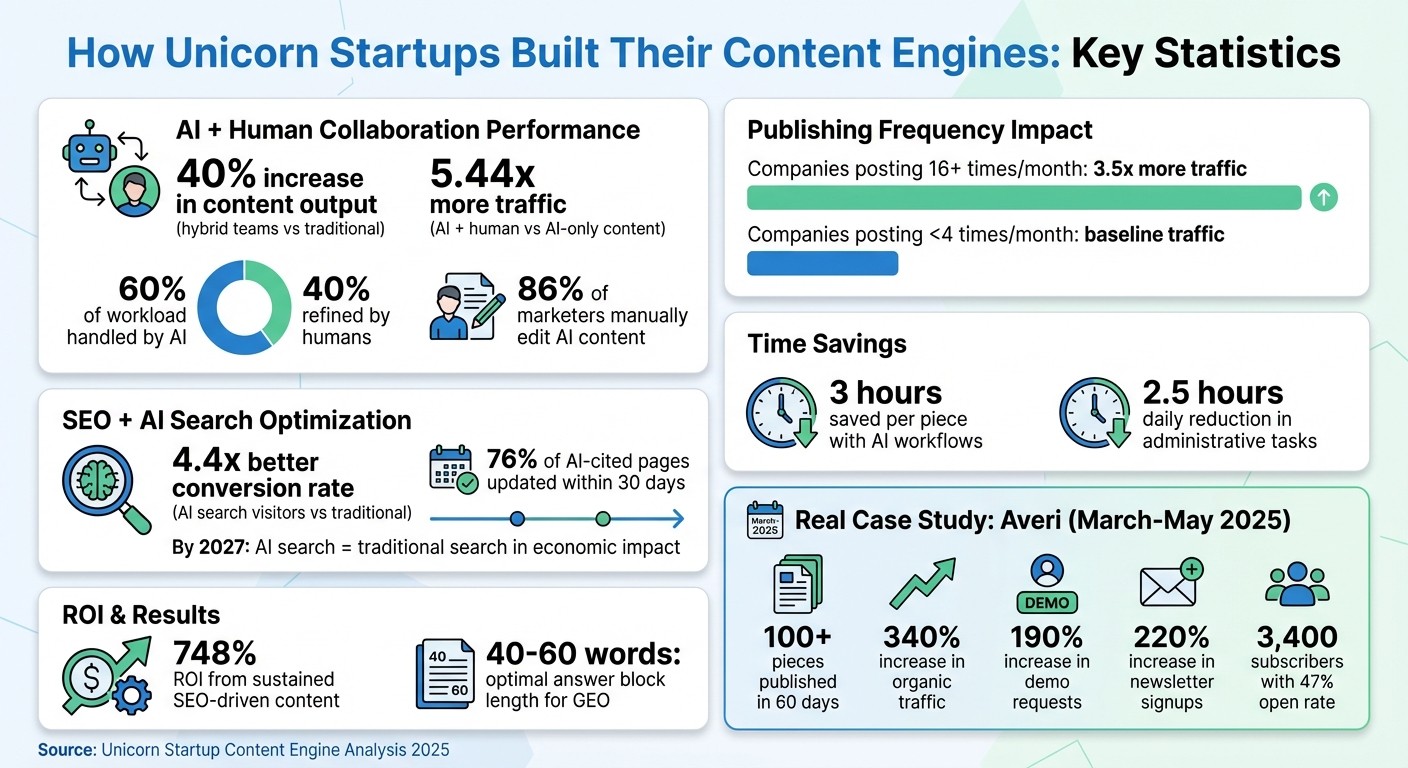
Content Engine Statistics: AI vs Human Performance and ROI Metrics
Creating an AI-Driven Content Marketing Workflow

What Makes a Content Engine Work
A content engine operates as a streamlined system where AI handles about 60% of the workload, leaving humans to refine the remaining 40% to ensure quality and maintain a distinctive voice [1].
This system relies on three essential components: a data-driven strategy to pinpoint your audience, automation tools to assist with research and drafting, and scalable workflows that make content creation predictable [1][6]. Together, these elements create a self-reinforcing cycle. Each new piece of content builds topical authority, feeds performance data back into the strategy, and helps train AI to produce better drafts. Research shows that companies publishing 16 or more posts monthly generate 3.5 times more inbound traffic than those posting fewer than four times a month [1]. Hybrid teams, combining AI for drafting with human refinement, produce 40% more content while maintaining high quality. Their work attracts 5.44 times more traffic compared to content produced solely by AI [1]. By the end of 2027, AI-driven search channels are expected to rival traditional search in economic impact [1].
"The companies that win aren't publishing more content. They're building better systems" [1].
Let’s break down how a data-driven strategy, automation, and scalable workflows come together to make this possible.
Strategy: Planning Based on Data
A strong strategy starts with understanding your audience and identifying gaps in the market. High-performing content engines define their brand voice, outline Ideal Customer Profiles (ICPs), and analyze competitive gaps before creating any content [1][6]. Successful engines often organize their content around 3–5 core themes, supported by 8–12 specific topic clusters. This structure helps establish topical authority [3]. Additionally, modern strategies must optimize for both traditional SEO and Generative Engine Optimization (GEO). This includes incorporating concise answer blocks, clear entity definitions, and credible sources [1].
For example, between March and May 2025, Averi developed their content engine using this method. They published over 100 pieces in just 60 days by training their AI on specific brand pillars like "AI + Human" and "Calm Over Chaos." This approach resulted in a 340% increase in organic traffic and a 190% jump in demo requests [5]. A key part of this success was training their AI with 10–15 examples of high-performing content and specific brand voice guidelines to ensure consistency [3].
"Chaos doesn't scale. As organizations grow, they need a framework for planning and prioritization that helps them work more strategically" [6].
A well-thought-out strategy isn’t just a one-time effort - it influences every piece of content you create and sets the stage for automation.
Automation and Tools
Once the strategy is in place, the next step is leveraging tools to automate repetitive tasks. AI can take care of 60% of the work - such as research, data collection, drafting, and technical optimization - while humans focus on adding strategic insights, refining the brand voice, and injecting creativity [1][4].
Modern tools can analyze industry trends, track competitor content, and generate content ideas organized by type, like listicles or how-to guides. These tools can suggest titles, target keywords, and content outlines [1]. AI also pulls from verified sources, integrates brand-specific context, and drafts content optimized for search engines. Human editors then step in to review and refine the drafts in collaborative environments, making adjustments and adding final touches. On average, using AI workflows can save 3 hours per piece and reduce administrative tasks by 2.5 hours daily [1]. Despite these efficiencies, 86% of marketers still manually edit AI-generated content to ensure quality [1].
"Tools alone cannot replace the expertise of skilled professionals. Prioritize and heavily invest in your people and processes" [6].
Workflows That Scale
Turning content creation into a predictable process requires repeatable workflows. For instance, high-output teams might dedicate Monday to planning topics, use Tuesday and Wednesday for drafting with AI, reserve Thursday for reviews, and publish on Friday [5]. Clear quality checkpoints - such as verifying facts, ensuring brand voice consistency, and aligning with strategic goals - help maintain standards without sacrificing speed [3]. Batching similar types of content, like related blog posts, can also save time and ensure thematic consistency [3].
Workflows should also be optimized for both traditional SEO and GEO. This involves structuring content with direct answer blocks, precise entity definitions, and authoritative sources to maximize AI citations [1]. Notably, 76% of pages frequently cited by AI search engines had been updated within the past 30 days [1]. By integrating strategy and automation, these workflows ensure that every new piece of content reinforces your brand’s authority.
Averi’s team demonstrated this approach between March and May 2025, publishing over 100 pieces in 60 days. By training their AI on specific brand guidelines and adhering to strict quality checks, they achieved a 220% increase in newsletter signups, growing to 3,400 subscribers. This also led to significant gains in website traffic and demo requests [5]. Each new piece of content helped the AI better understand the brand, improving the quality of future drafts.
"The difference between successful scaling and chaotic activity is synchronization" [6].
How Unicorns Built Their Content Engines
Some of the most successful startups have built scalable content engines by embracing distinct strategies tailored to their goals. Let’s explore the approaches taken by NerdWallet, Canva, and Grammarly - each showcasing how data-driven planning, automation, and streamlined workflows can drive growth and visibility.
NerdWallet: Scaling SEO Content
NerdWallet’s content strategy revolved around understanding what users searching for financial advice truly needed: clear comparisons and data-driven recommendations. To address this, the company structured its content around 3–5 core pillar topics - credit cards, loans, insurance, banking, and investing. These pillars were supported by detailed clusters of related content, creating a robust architecture that established NerdWallet as an authority in competitive financial niches.
Their approach didn’t stop at traditional SEO. NerdWallet also optimized for Generative Engine Optimization (GEO), ensuring their content was ready for AI-powered search tools. Each piece included concise answer blocks (40–60 words) and clear definitions of key terms, making it accessible for both search engines and AI systems. By maintaining a consistent publishing cadence, they steadily increased inbound traffic. To maximize reach, they repurposed pillar content into email newsletters, social media posts (5–7 posts per pillar), and other formats, ensuring their message resonated across multiple channels [3].
Next, let’s see how Canva scaled its content through creative repurposing.
Canva: Driving Global Traffic with Free Resources

Canva built its content engine around offering free templates and design resources - a strategy that delivered value while driving massive organic traffic. Their approach relied heavily on repurposing. For example, a single asset like a design guide or template collection was transformed into blog posts, video tutorials, social media content, and email campaigns [3]. This system allowed Canva to address diverse design needs across different languages and regions, significantly expanding their global reach.
A standout feature of Canva’s strategy was its human-in-the-loop model, which blended AI-driven research with human oversight. This combination ensured both efficiency and quality. Hybrid teams - where AI drafted content and humans refined it - produced 40% more content and generated 5.44 times more traffic than content created solely by AI [1].
Finally, let’s examine how Grammarly established itself as a trusted authority through its content strategy.
Grammarly: Building Authority Through Brand-Led Content

Grammarly evolved from being just a grammar-checking tool to becoming a trusted authority on writing. Their content strategy leaned on generative AI to analyze language, tone, and audience context [7]. At the core of their engine were authoritative pillar pages covering writing fundamentals, each meticulously optimized for traditional search engines and AI citations.
Grammarly’s content was designed to be a go-to resource for AI tools like ChatGPT and Perplexity. By structuring their pages with clear headings, concise answers at the start of sections, and credible sources, they ensured their content was both user-friendly and AI-friendly. This dual focus positioned Grammarly as a trusted resource for both human readers and AI systems recommending writing solutions. Notably, visitors arriving through AI search channels converted at 4.4 times higher rates than other channels [1].
How to Build Your Own Content Engine
Building a content engine that delivers consistent results doesn’t require a massive team or endless resources. Startups can achieve impressive outcomes by following a streamlined approach divided into three clear phases: research and strategy, automated production, and ongoing improvement. Each phase builds on the previous one, creating a system that becomes smarter and more efficient over time.
Phase 1: Research and Strategy
The foundation of a strong content engine begins with defining what sets your content apart. Leverage AI to analyze your existing materials and pinpoint your brand voice, ideal customer profiles (ICPs), and positioning. Tools like Averi AI can simplify this process by reviewing your website and competitors, delivering a comprehensive content strategy in just minutes instead of weeks of manual effort [1].
Identify 3–5 core brand pillars - key topics where you want to establish authority. For example, Averi's 2025 launch demonstrated the power of focusing on these pillars to drive strategic growth [5].
To maximize reach, your strategy should cater to both traditional SEO and Generative Engine Optimization (GEO). This means structuring content with concise 40–60 word answer blocks and clear headings. Such formatting ensures your content ranks well on Google while also being cited by AI tools like ChatGPT and Perplexity. This dual approach is critical, as AI-driven search visitors are 4.4 times more likely to convert compared to traditional organic traffic [1].
Phase 2: Automating Content Production
Once your strategy is in place, the next step is automating production. A human-in-the-loop workflow strikes the right balance: let AI handle about 60% of the workload - such as research, drafting, and technical optimization - while humans refine the content to ensure it aligns with your brand’s voice and maintains quality. This approach can result in 5.44 times more traffic [1].
To maintain brand consistency, train your AI tools using 10–15 of your top-performing content pieces [3]. Establish a weekly production rhythm to keep things on track: dedicate Mondays to planning and topic selection, use mid-week for AI-assisted drafting with linked sources, and reserve Thursdays for human review and polishing. This schedule allows startups to publish over 16 posts per month - a frequency that typically generates 3.5 times more inbound traffic compared to companies publishing fewer than four posts [1].
"AI should handle the work that slows you down, while humans add the judgment that makes it work." – Averi Team [2]
Maximize your efforts by repurposing content into multiple formats. A single pillar article can be transformed into several social media posts, an email newsletter, and even scripts for videos or podcasts. This method amplifies your return on investment without significantly increasing your workload [3].
Phase 3: Measuring and Improving
With your strategy refined and production streamlined, the final phase focuses on measurement and optimization. Track metrics like visibility, engagement, growth, and overall business impact [1]. But don’t just gather data - use it to guide your next moves.
Incorporate a weekly analysis routine where AI identifies trending topics, monitors competitor content, and suggests fresh angles for your brand to explore. It can also flag content that’s ranking in positions #4–10 and recommend updates to push it to the top of search results [1]. This feedback loop transforms a basic content calendar into a dynamic engine.
Keep your content library fresh with an automated update process. Regularly refreshing evergreen content ensures it remains relevant and valuable for both search engines and readers. As your library grows, it also provides richer context for future AI drafts, helping them align even more closely with your brand’s voice.
Sustained, SEO-driven content can deliver a 748% ROI [1]. Achieving this requires a well-defined system with clear phases, automated workflows, and continuous iteration - not sporadic publishing or chasing fleeting trends.
Phase | AI Responsibility | Human Responsibility |
|---|---|---|
Strategy | Data gathering, competitor research, ICP suggestions | Strategic direction, POV definition, goal setting |
Execution | First drafts, SEO/GEO structure, technical optimization | Voice refinement, original insights, quality judgment |
Distribution | CMS publishing, multi-format repurposing | Final review, community engagement, expert polish |
What You Can Learn from Unicorn Startups
Unicorn startups offer some invaluable takeaways for building scalable content engines. Their success often boils down to three fundamental principles: prioritizing strategy over tools, valuing consistency over perfection, and leveraging AI to complement human creativity. These aren’t abstract theories - they’re actionable approaches that deliver real, measurable outcomes.
Take this B2B startup case study, for example. Between March and May 2025, this startup built a content engine from the ground up, guided by these very principles. By identifying five core brand pillars and adopting a unique "Don't Feed the Algorithm" perspective, their two-person team managed to publish over 100 pieces of content in just 60 days. The results? A 340% spike in organic traffic, 3,400 new newsletter subscribers with an impressive 47% open rate, and a 190% increase in demo requests [5].
The Power of Hybrid Workflows
One of the most effective strategies unicorn startups use is blending AI with human expertise. AI handles tasks like research and drafting, while humans refine the tone and add nuanced insights. This partnership boosts output by 40% and drives significantly higher traffic [1]. It’s not about choosing between AI and humans - it’s about assigning each the work they excel at.
"The startups that win aren't publishing more content. They're building better systems." – Zach Chmael, Head of Marketing, Averi [1]
Distribution: The Secret Multiplier
For these startups, content creation is only half the battle - distribution is equally critical. The most efficient systems transform one high-value piece of content into multiple formats. For instance, a single pillar article can be repurposed into email newsletters, social media posts, video scripts, and even podcast episodes [3][5]. This approach not only stretches the value of each piece but also ensures a steady stream of content across different channels, all without adding extra workload.
Consistency Over Perfection
When it comes to content, consistency beats perfection every time. Companies that publish 16 or more posts per month generate 3.5 times more inbound traffic than those that post sporadically [1]. A consistent publishing schedule transforms your content engine into a reliable system - one that operates predictably and compounds in value over time.
FAQs
How can small startups build content strategies like unicorn companies?
Small startups can build effective content strategies by combining AI-driven efficiency with the nuanced touch of human expertise. Start by using an AI platform, such as Averi AI, to handle tasks like generating outlines, drafting posts, and identifying SEO-friendly topics. Then, have a human reviewer step in to polish the tone, ensure alignment with your brand's voice, and incorporate strategic insights that resonate with your audience.
A simple workflow - brief → AI draft → human edit → approval → publish - can transform your content production process. This approach allows startups to produce over 16 high-quality posts each month, saving significant time and effort while freeing up resources for other strategic priorities. Publishing regularly at this pace can drive lead generation and reduce costs compared to traditional advertising.
To begin, focus on 3–5 core topics that matter most to your audience. Utilize tools like Averi’s Synapse AI to create drafts on a consistent schedule, and integrate your process with your CMS and approval systems to streamline operations. By treating content as a scalable asset and reviewing your strategy every 30 days, startups can achieve consistent growth with limited resources - just like some of today’s most successful unicorn companies.
How does AI improve content optimization for search engines?
AI has become a key player in shaping modern search engine optimization (SEO), ensuring that content is structured in a way machines can easily process. Tools like Bing Copilot and Google’s AI Overviews prioritize content that delivers clear, well-rounded answers, making it crucial to craft content with AI comprehension in mind. This means incorporating question-based headings, on-page FAQs, detailed alt text, and schema markup to signal expertise and relevance effectively.
To simplify and enhance this process, AI-driven SEO tools have stepped in to automate many tasks. Platforms such as Averi and Rankscale.ai assist with generating topics, suggesting schema, and optimizing content for AI-friendly formats. These tools bring speed and consistency to the table, but human involvement remains vital. By overseeing accuracy, ensuring the content aligns with the brand’s voice, and maintaining strategic quality, humans and AI can work together to produce content that performs exceptionally well.
How do scalable workflows help maintain consistent content production?
Scalable workflows take the chaos out of content creation, turning an unpredictable process into an organized system that delivers consistent, high-quality results. By standardizing critical steps - such as brainstorming, drafting, reviewing, and publishing - teams can sidestep common bottlenecks and ensure every piece of content follows a clear, repeatable path. This structure allows marketers to plan their output with confidence, avoid last-minute scrambles, and keep their editorial calendar on track.
When AI-powered tools are added to the mix, the entire process becomes faster without compromising quality. While AI can speed up tasks like drafting and editing, human oversight ensures the content retains its brand tone and meets the necessary standards. For instance, a streamlined workflow can shave hours off the time it takes to produce an article, letting teams publish more often while maintaining consistency. Features like built-in approvals, version control, and data retention further guarantee that every piece meets the same high standards.
A thoughtfully designed workflow also integrates smoothly with tools like CMS platforms, CRMs, and ad systems. This integration creates a feedback loop that not only enhances efficiency but also ensures your content stays true to your brand voice and supports long-term growth.