Dec 13, 2025
What Behavioral Data Reveals About User Intent

Averi Academy
Averi Team
8 minutes

In This Article
Clicks, revisits, downloads and other behavioral signals reveal where users are in the buying journey and enable timely, personalized marketing actions.
Updated:
Dec 13, 2025
Don’t Feed the Algorithm
The algorithm never sleeps, but you don’t have to feed it — Join our weekly newsletter for real insights on AI, human creativity & marketing execution.
Behavioral data shows what users actually do online, offering a clear view of their intent. Actions like revisiting pricing pages, downloading resources, or searching for reviews reveal where users are in their decision-making process. This helps marketers deliver personalized messages at the right time, improving engagement and conversions. Platforms like Averi AI go beyond just analyzing data - they turn it into actionable campaigns.
Key Takeaways:
What it is: Behavioral data tracks clicks, scrolls, and interactions to reveal user intent.
Why it matters: It helps predict actions, personalize content, and boost conversions.
How it's used: AI tools analyze patterns to target users based on their stage in the buying journey.
Sources: Data comes from first-party (your platforms), integrated tools, and third-party providers.
Challenges: Translating insights into action and ensuring data quality while respecting privacy.
By integrating tools, identifying high-intent actions, and acting on insights, businesses can create tailored campaigns that resonate with users and drive results.
How to Analyze Behavioral Data for Search | Whiteboard Friday | Giulia Panozzo | 4K

What Behavioral Data Tells You About User Intent
Behavioral data is like a map of user activity, capturing intent through every click, scroll, and interaction. It forms a digital trail that reveals how users explore websites, engage with content, interact with ads, and move through the buying process. For instance, revisiting a pricing page multiple times signals a much stronger purchase intent than a single click on a social media ad.
The power of behavioral data lies in its ability to predict what users might do next. Patterns like repeated visits to a product page followed by searches for comparisons suggest users are in the research phase. On the other hand, actions such as downloading a case study, watching a demo, and then checking pricing indicate they are likely ready to make a purchase. By recognizing these patterns, marketing platforms can deliver personalized messages at just the right time, avoiding the trap of sending generic content to everyone. Let’s dive into what behavioral data includes, how it reveals intent, and where it originates.
What Behavioral Data Includes
Marketers rely on a variety of behavioral signals to decode user intent. Metrics like click-through rates (CTRs) from paid social campaigns offer clues about initial engagement and interest levels [1]. Content retention metrics, such as how long users spend reading a product guide versus skimming a blog post, provide further insights into their attention and focus [1]. Website activity - tracking page visits, navigation paths, and time spent on specific pages - helps pinpoint what holds user interest and where they may encounter challenges.
Direct interaction data adds even more depth. For example, sales transcripts capture customer questions, objections, and needs during conversations, making them an invaluable resource for gauging purchase readiness [2]. Similarly, lead interaction signals - like email opens, link clicks, form submissions, and content downloads - can help track intent as users move through the marketing funnel [2].
How User Behavior Reveals Intent
Different types of user behavior point to varying levels of intent. For example, research-stage intent is often reflected in actions like consuming educational content, comparing features, or reading multiple blog posts. In contrast, purchase-stage intent becomes evident through actions like visiting pricing pages, requesting demos, signing up for free trials, or repeatedly viewing product pages.
AI tools can analyze these behaviors to shape marketing strategies. Take Averi AI, for instance, which reviewed Q3 campaign data and found high CTRs from paid social campaigns but low content retention. Using these insights, they developed channel-specific adjustments to improve engagement [1]. For purchase-stage decisions, analyzing detailed account and contact behavior allows teams to tailor sales strategies, identifying strong buying signals and predicting deal outcomes [2]. Sales transcripts, in particular, can help score deals, suggest next steps, and even forecast close dates by revealing the likelihood and timing of purchases [2].
Behavioral insights also play a critical role in Account-Based Marketing (ABM). By understanding intent signals, businesses can craft highly relevant assets tailored to specific accounts [2]. To make sense of these signals, though, it’s important to understand where the data comes from.
Where Behavioral Data Comes From
A comprehensive view of behavioral data depends on integrating multiple sources. These fall into three main categories:
First-party data: This is data collected directly from your own platforms, such as website analytics, CRM systems, email platforms, and product usage logs. It’s highly reliable because it comes straight from your own properties and is fully within your control.
Integrated platform data: This combines information from tools like revenue systems, analytics platforms, and advertising networks to create a unified perspective [1]. When AI platforms train on this core data, they can deliver more precise personalization and deeper insights into user intent.
Third-party data: External providers contribute signals like content consumption on industry websites, competitor research activity, and technographic details. While less precise than first-party data, these signals can help identify early-stage interest before users even visit your site.
How to Collect and Analyze Behavioral Intent Signals
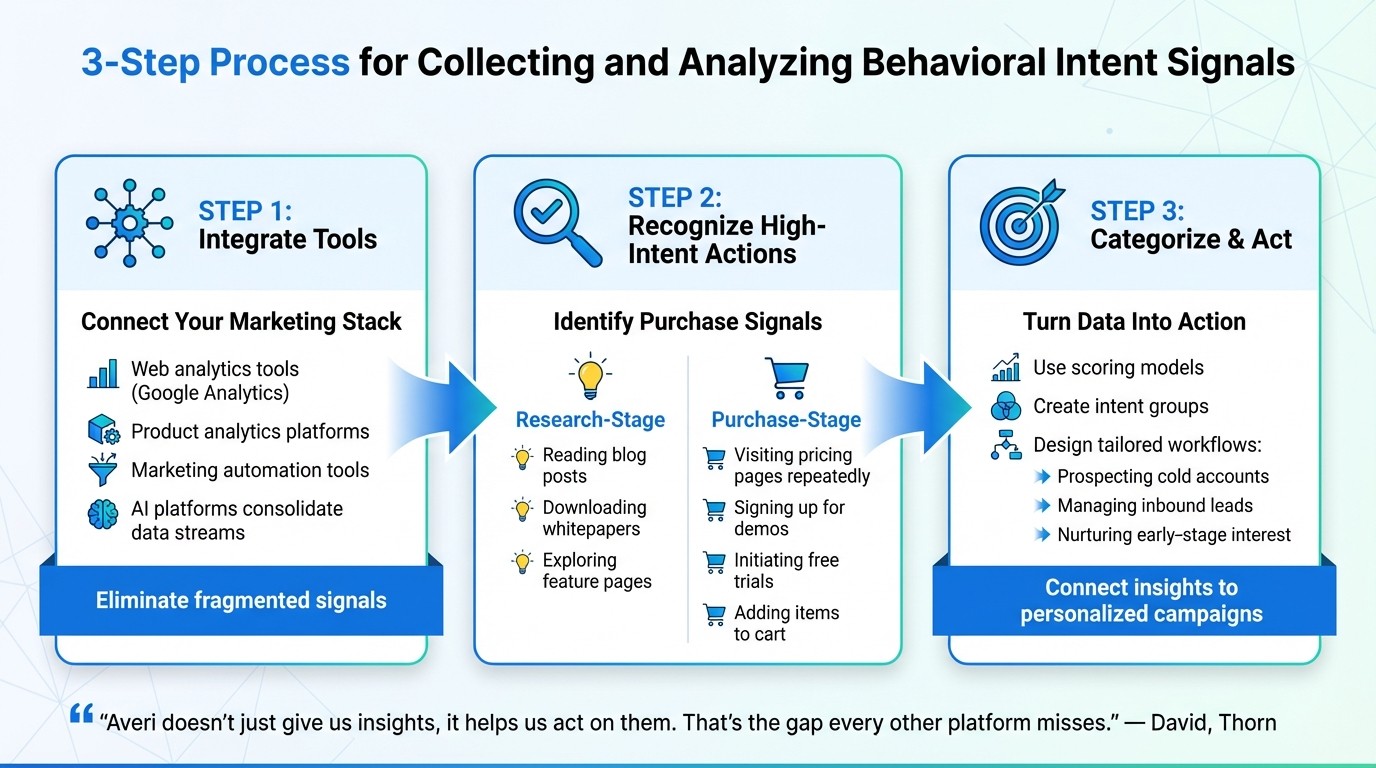
How to Collect and Analyze Behavioral Intent Data: 3-Step Process
To effectively gather behavioral data, the first step is integrating the right tools across your marketing stack. Platforms like Averi AI make this process seamless by connecting revenue systems, analytics platforms, and advertising networks to provide a comprehensive view of user behavior [1]. Without this level of integration, behavioral signals remain fragmented, offering only a partial understanding of your audience. For example, you need to link a user’s ad click to their website activity, email interactions, and product usage to fully grasp their intent. This unified approach lays the groundwork for deeper analysis and actionable insights.
Tools for Collecting Behavioral Data
Marketers typically rely on three types of tools to gather behavioral data:
Web analytics tools like Google Analytics to track visits and navigation patterns.
Product analytics platforms to monitor in-app behavior.
Marketing automation tools to measure email engagement and content downloads.
AI-powered platforms, such as GTM systems, consolidate these data streams into a single, cohesive foundation. This eliminates the need for manual data processing, which can take weeks, and enables teams to act on insights much faster [2].
Recognizing High-Intent Actions
Not all user behaviors carry the same weight when it comes to purchase intent. Research-stage actions - like reading blog posts, downloading whitepapers, or exploring multiple feature pages - indicate early interest. On the other hand, purchase-stage signals - such as visiting pricing pages repeatedly, signing up for a demo, initiating a free trial, or adding items to a cart - point to users who are closer to making a decision.
For instance, Averi AI can analyze campaign performance to detect patterns, such as high click-through rates from paid social ads paired with low content retention. With this insight, it can suggest adjustments tailored to specific channels [1].
"Thanks to Copy.ai, we're generating 5x more meetings with our personalized, AI-powered GTM strategy."
Jean English, former Chief Marketing Officer at Juniper Networks[2]
Turning Data Into Intent Categories
Once high-intent behaviors are identified, the next step is to categorize them into actionable intent groups. This involves using scoring models and pattern analysis to translate raw data into AI-driven marketing strategies [1][2]. For example, you can design workflows tailored to different scenarios, such as:
Prospecting cold accounts.
Managing inbound leads.
Nurturing accounts showing early-stage interest.
The ultimate goal is to ensure that these categories drive immediate action, connecting behavioral insights to personalized campaigns and efficient execution.
"Averi doesn't just give us insights, it helps us act on them. That's the gap every other platform misses. We're finally turning data into real campaigns."
Using Behavioral Data to Improve Search Personalization
Behavioral data has reshaped how users find content by tailoring search results to individual preferences. Instead of presenting the same results to everyone, modern AI systems analyze users' actions - like pages visited, time spent on content, and engagement levels - to better understand intent. For instance, someone researching enterprise-level solutions will see recommendations tailored to their needs, while someone exploring beginner options gets entirely different suggestions, even if their search terms are identical.
Personalizing Search Results and Recommendations
AI platforms leverage behavioral insights to fine-tune content rankings and suggestions based on user activity. Take, for example, a user who frequently clicks on pricing pages and case studies. The system recognizes that they may be in the evaluation phase and prioritizes similar resources. By analyzing data from accounts, industries, and user personas, these systems create highly relevant marketing materials. They also adapt based on past interactions, continually refining recommendations to align with what resonates most.
Averi AI, for instance, examines performance metrics like click-through rates on paid social campaigns and content retention levels. If it spots high click-through rates but low engagement with the content, the platform identifies specific areas for improvement. This data is then used to craft tailored marketing strategies, with ongoing feedback loops ensuring recommendations grow more accurate over time [1][2].
Understanding Unclear Search Queries
Searches like "best solution" or "pricing options" can be frustratingly vague, but behavioral data helps add clarity. If a user has been consistently engaging with pricing pages or case studies, the system interprets their intent as focused on evaluating options rather than casual browsing. This context allows AI tools to disambiguate queries, reducing irrelevant results and improving accuracy. Platforms like Averi AI use these insights to further refine search personalization, ensuring users find exactly what they need.
How Averi AI Uses Behavioral Data for Personalization
Averi AI takes this concept further by combining data from multiple sources to turn ambiguous signals into actionable insights. By integrating revenue, analytics, and advertising data, the platform trains its AI to understand your specific business needs [1]. This means it doesn’t just monitor generic behaviors - it identifies the actions most relevant to your brand and audience. With these insights, Averi AI personalizes marketing workflows and content recommendations, ensuring that every decision is backed by real user behavior rather than assumptions. This approach makes behavioral data a driving force in delivering tailored marketing experiences.
Best Practices for Using Behavioral Data Responsibly
Behavioral data can be a powerful tool, but its value hinges on accuracy, compliance, and thoughtful interpretation. Without proper safeguards, even the most advanced AI systems can produce misleading insights, wasting resources and eroding user trust. The line between effective personalization and poorly targeted campaigns often depends on how well your data is managed.
Maintaining Data Quality
Reliable insights start with consistent and comprehensive tracking across all user interactions. When data sources are fragmented, you’re left with an incomplete view of user behavior, which can lead to misguided decisions. The key is to integrate all your data into a single, unified system. Standardizing tracking processes with AI-powered workflows can help eliminate silos and inconsistencies, ensuring your data remains clean and actionable. Many marketing platforms are designed to automate this standardization, reducing the need for manual intervention and keeping your data ready for analysis.
Privacy and Legal Requirements
Adhering to privacy laws like GDPR and CCPA is non-negotiable. Non-compliance can lead to hefty fines and damage your reputation. Users must be informed and give explicit consent before their behavioral data is collected. Additionally, they should have easy access to view, modify, or delete their information. Being transparent about what data you collect and how it’s used not only ensures legal compliance but also fosters trust with your audience. Once you’ve established this foundation, your focus can shift to interpreting the data accurately and effectively.
Avoiding Misreading Behavioral Signals
Behavioral data can be tricky - single actions rarely provide the full picture. For example, a one-time visit to a pricing page might simply indicate curiosity, while repeated visits could suggest serious purchase intent. Fragmented or poorly interpreted data often leads to errors, creating what some refer to as an "illusion of progress", where activity appears meaningful but doesn’t reflect actual user intent [2].
To address this, AI tools should be tailored to align with your brand’s unique context and voice [1]. Generic insights, without proper contextualization, often miss the subtle differences between high-intent users and casual browsers. By connecting behavioral data directly to actionable workflows - rather than leaving it in isolated dashboards - you can reduce misinterpretation and ensure your efforts align with what users truly want.
Putting Behavioral Intent Data to Work in AI Marketing
Gathering behavioral data is just the beginning. The real challenge lies in turning those insights into campaigns that drive conversions. Successful marketing teams don’t just collect data - they integrate it, automate responses to high-intent actions, and use AI systems capable of understanding context, not just patterns. Let’s explore how unifying data sources can lead to impactful, action-driven campaigns.
Connecting Behavioral Data Across Platforms
When data is scattered across multiple systems - like analytics tools, ad platforms, and CRMs - it limits visibility into the full customer journey. This fragmentation creates siloed workflows, making it harder for AI to deliver meaningful insights.
Bringing all behavioral data together into a single, queryable platform can change the game. For instance, one team streamlined operations by replacing five disconnected tools with a unified system, speeding up execution by 40% and boosting performance by 25% [1]. Platforms offering extensive integrations - some now supporting over 2,000 connections [2] - are invaluable. Additionally, training AI systems to reflect your brand’s unique voice ensures outputs align with your messaging and goals.
Marketing Campaigns Triggered by Intent Data
The most effective automated campaigns are built around specific, high-intent actions. For example, repeated visits to a pricing page signal a much stronger interest than a single casual click. AI workflows can interpret these signals and tailor responses - like sending a detailed case study to a high-intent user while offering educational content to someone still exploring.
The results of such targeted automation can be transformative. Jean English, former CMO of Juniper Networks, shared that personalized, AI-driven go-to-market strategies yielded five times more meetings by responding to behavioral intent [2]. Similarly, Roman Olney, Lenovo’s Head of Global Digital Experience, saved $16 million in a year by automating content workflows based on behavioral triggers, reducing the need for external agencies [2]. Platforms like Averi AI take this a step further by directly orchestrating these campaigns, making the process seamless.
How Averi AI Orchestrates Marketing with Behavioral Insights
Averi AI bridges the gap between data analysis and campaign execution. By integrating with revenue, analytics, and advertising systems, it collects a comprehensive set of behavioral signals. Its Synapse architecture then analyzes campaign performance in real-time [1]. For example, if it spots high click-through rates on paid social ads but notices a drop in content retention, it identifies the issue, maps out solutions by channel, and notifies the appropriate team members to take action [1].
"Averi cut through the noise and gave us what we actually needed... a clear path from insight to campaign. No more guessing, no more wasted effort."
Laura, Cove & Current [1]
This streamlined approach ensures that insights flow directly into execution, eliminating inefficiencies. For teams swamped with dashboards but hungry for actionable results, behavioral data becomes truly powerful when it’s seamlessly integrated into tools that drive campaigns forward.
Conclusion
Behavioral data offers a window into what users truly want by analyzing browsing habits, engagement patterns, and purchase signals. This insight allows you to craft experiences that not only meet but anticipate their needs.
However, the real game-changer lies in taking action. As David from Thorn aptly noted:
Averi doesn't just give us insights, it helps us act on them. That's the gap every other platform misses. We're finally turning data into real campaigns [1].
This proactive approach paves the way for scalable, AI-driven strategies. Tools like Averi AI leverage advanced models to uncover performance issues and design campaigns based on real-time data [1]. Jean English shared how this type of AI-powered strategy resulted in a remarkable fivefold increase in meetings [2].
To harness these possibilities, start by integrating your data sources to create a complete view of the customer journey. Train AI systems to understand your brand’s voice and customer behaviors, and set up automated workflows that deliver the right message at the perfect moment. This cohesive strategy, emphasized throughout this article, is essential for driving higher conversion rates.
FAQs
How can businesses combine behavioral data from different sources to understand user intent?
To effectively merge behavioral data from multiple sources, businesses should focus on centralizing data collection, maintaining consistency and accuracy, and utilizing AI-driven platforms to analyze and integrate these data streams.
By doing so, companies gain a comprehensive understanding of user behavior, allowing them to interpret user intent more effectively, create tailored experiences, and make well-informed decisions that drive strategy.
How can businesses protect user privacy when leveraging behavioral data?
To ensure user privacy when working with behavioral data, businesses should follow a few critical practices. Start by restricting access to sensitive data - only those who absolutely need it should have access. It's also important to anonymize or pseudonymize user information, making it harder to trace data back to individuals. Strong encryption and secure storage methods are non-negotiable for protecting this information.
Equally vital is obtaining clear and explicit user consent before collecting or using their data. Adhering to regulations like GDPR or CCPA isn't just about compliance - it’s about building trust. Regularly auditing data security measures is another key step, as it helps identify vulnerabilities and ensures user information remains protected.
How can AI tools like Averi AI use behavioral data to improve marketing strategies?
AI tools, like Averi AI, delve into behavioral data - examining user interactions, preferences, and engagement trends - to reveal deeper insights into what users want. These insights empower marketers to craft campaigns that are more precise, deliver tailored content, and enhance the overall customer journey.
By blending AI-powered automation with human insight, tools such as Averi help marketers make quicker, more informed decisions. This combination doesn’t just boost campaign performance; it ensures strategies are closely aligned with genuine user behaviors, leading to more impactful outcomes on a larger scale.